All species › Waders, gulls and terns › Skimmers, noddies, terns and gulls › Gray-backed Tern
Gray-backed Tern | Onychoprion lunatus
Fijistern | Gaviotín pascuense
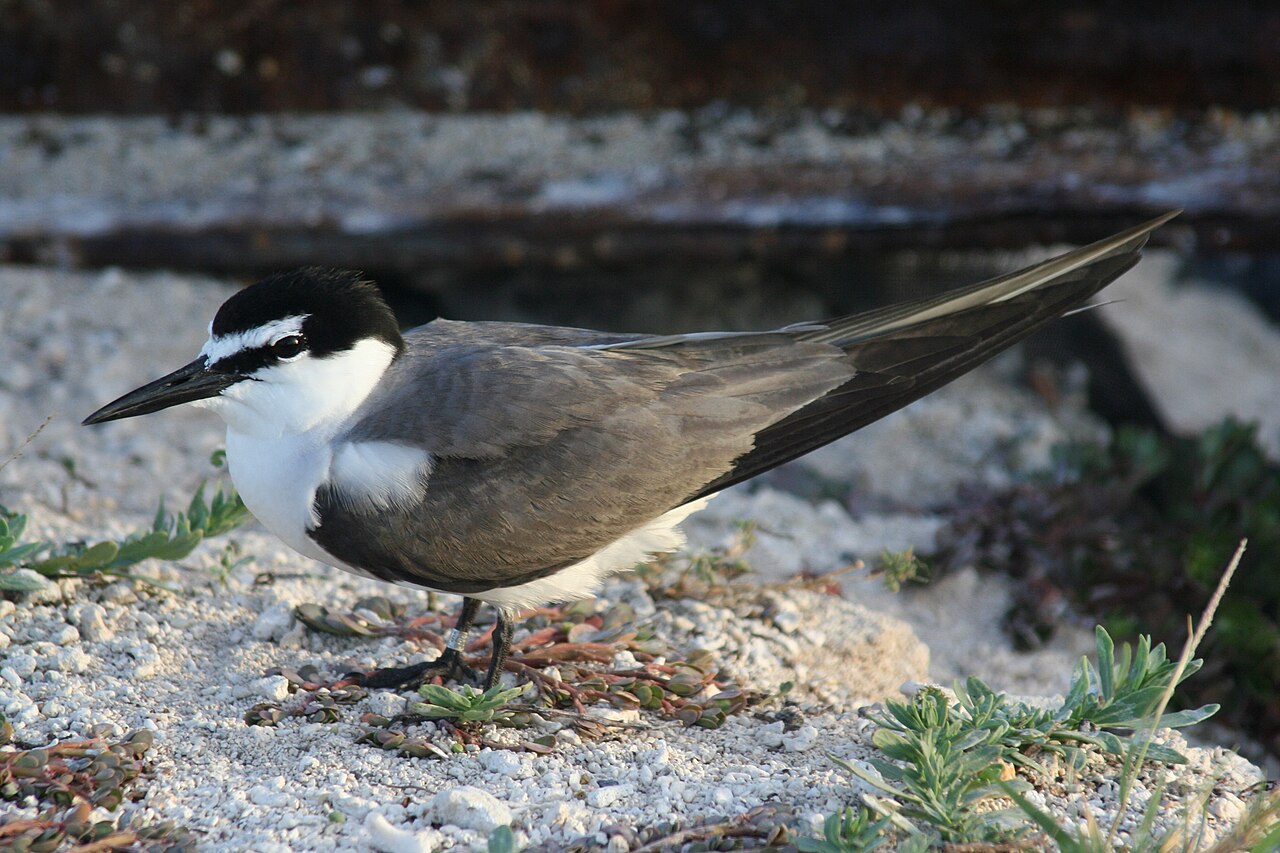
The Gray-backed Tern is the grey counterpart of the Sooty Tern: nearly as large, as sharply marked, but with a slate-grey back instead of a black one and a white eyebrow that runs on behind the eye. It breeds only on remote islets in the tropical Pacific, and within the guide area that means the Northwestern Hawaiian Islands, where it is called pakalakala.
Voice
At the breeding colony it calls short and sharp, higher in pitch and far less sustained than the Sooty Tern with which it shares several islands. Over the sea, feeding parties give short high cries; away from those it is silent. Recordings of birds in flight do exist, but a good description of the full vocal repertoire is lacking. Of all the terns in this guide this is the least studied species, and that is truest of its voice: anyone who hears it is hearing something about which almost nothing is written down.
Recording: Saxony Charlot — CC BY-NC-SA 4.0 · Kure Atoll, United States · xeno-canto
Identification
A medium-sized tern with a sharp two-tone pattern: slate grey above, pure white below, with a black crown running into a black nape with no pale break between them. A narrow white eyebrow runs from the base of the bill to behind the eye and is outlined in black above and below; that marking gives the bird its other English name of Spectacled Tern. The wings are brownish grey and darker than the mantle; the tail is long and deeply forked with white outer edges. Bill and legs are black. Male and female are alike; outside the breeding season crown and eye-stripe become streaked with white. Young birds are greyer, with pale feather fringes above and a shorter tail.
Confusion species
Sooty Tern (Onychoprion fuscatus) is the great danger and breeds on the same islands: it is black above rather than grey, and its white forehead patch ends above the eye instead of running on as a stripe. Bridled Tern (Onychoprion anaethetus) is almost identical in pattern but smaller, a darker brownish-grey on the back, and has a clear pale collar on the hindneck which the Gray-backed Tern lacks. In the western Pacific the two occur side by side, and the collar is then the most useful mark. Outside the breeding season, when the crown becomes streaked with white, it most resembles young Sooty Terns.
Compare terns: bill, legs, head and tail side by side
Habitat
It lives over warm, open ocean and often feeds alongside Sooty Terns and Wedge-tailed Shearwaters above schools of predatory fish, taking small fish from the surface by plunging or by hovering and dipping. The diet includes cowfish, young flyingfish, goatfish and dolphinfish, with squid alongside. It breeds on small remote islands and atolls, in a shallow scrape in sand or gravel, sometimes on a bare rock slope. Unlike the Bridled Tern it seeks no cover under bushes or boulders: the nest lies in the open. Inhabited islands with rats and cats it avoids, and on the main Hawaiian islands it accordingly hardly breeds at all.
Where the bird is most often found, arranged by the USNVC — the vegetation classification of the United States and Canada — and CMECS for sea and coast.


Range and movements
The range covers the tropical Pacific, from the Marianas and Samoa eastward to the main Hawaiian Islands and the Tuamotus, reaching northeastern Melanesia and far eastern Polynesia. Within the guide area it breeds only in Hawaii, with the large colonies on Lisianski, Nihoa and Laysan and small numbers on the rock islets off Oʻahu. Outside the breeding season the Hawaiian birds spread south over open ocean; exactly where they go is poorly known, and the extent of the non-breeding range has not been established. Away from Hawaii it has scarcely been recorded in North America.
- Breeding (summer)
Where and when to look
The colonies lie within the closed Papahanaumokuakea monument and cannot be visited; anyone hoping to see the bird in Hawaii depends on a pelagic trip or on a coastal seawatch on Oʻahu, of which Makapuʻu Point is the best known. Look between March and July, when the birds are at the colonies and are most often seen along the coast. Among the Sooty Terns, watch for a bird with a grey rather than a black back — in good light that shows at long range.
Conservation
The world population is put at roughly seventy thousand pairs, of which some 44,000 breed in Hawaii: 20,000 on Lisianski, 12,000 on Nihoa and 10,000 on Laysan. The species is listed as Least Concern (LC), but that judgement rests on few counts, and the numbers are heavily concentrated on three islands. Introduced rats and cats, disturbance that makes breeding birds desert the nest, and collisions with structures on some islands are the known threats.
Scientific name
Onychoprion lunatus | (Peale, 1849)
Titian Ramsay Peale described the species in 1849 as Sterna lunata, from material of the United States Exploring Expedition; because it was later placed in another genus, author and year stand in parentheses. The genus Onychoprion is formed from Greek onyx 'claw' and prion 'saw'. lunatus is Latin for 'crescent-shaped', after the sickle of white above the eye. The described specimen came from Vincennes Island in the Tuamotu archipelago; in English the bird is called both Gray-backed Tern and Spectacled Tern.