All species › Waders, gulls and terns › Skimmers, noddies, terns and gulls › Sooty Tern
Sooty Tern | Onychoprion fuscatus
Bonte stern | Charrán sombrío
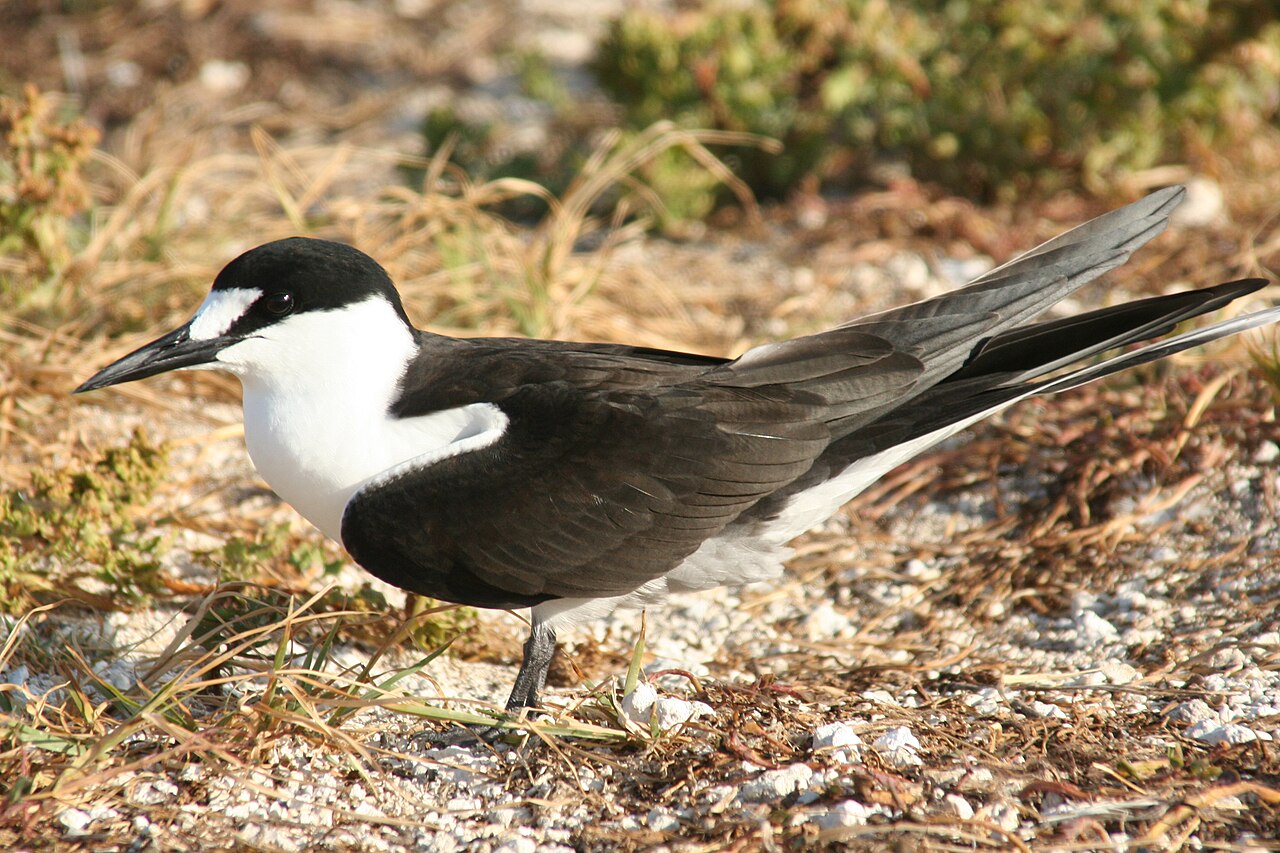
The Sooty Tern is black above and white below, and it is the seabird that lives furthest from solid ground: its plumage is not waterproof enough to rest on the sea, so that fledged young stay almost continuously airborne for years. With an estimated twenty-three million mature birds it is one of the most numerous seabirds in the world, yet in the contiguous United States it breeds on a single small sand island.
Voice
A colony can be heard day and night: a dense cloud of sound in which one call rises above everything else, a high and emphatic wek-a-wek that English-speaking sailors wrote down as wide-a-wake and which gave the bird its nickname of wideawake tern. Around it runs the constant growling and rasping of birds on the ground. At sea it is far quieter, but a flock feeding over a school of predatory fish sets up a sharp, barking din again. The noise of a large colony carries for kilometres over water and can be heard in calm weather before the island comes into view.
No freely licensed recording has been found for this species yet; what to listen for is described below.
Identification
A large, long-winged tern, sooty black above and pure white below, with a sharply bounded white forehead patch that ends exactly above the eye. The tail is deeply forked with white outer feathers; bill and legs are black. In flight the contrast is strong: black flight feathers against white underwing coverts. Male and female are alike. Juveniles come as a surprise and resemble their parents in nothing: entirely sooty brown to black, with fine white droplets on mantle and wing coverts. The flight is powerful and direct, with stiff beats well above the water.
Confusion species
Bridled Tern (Onychoprion anaethetus) is the great stumbling block and differs little in size. The Sooty Tern's back is black, the Bridled Tern's grey, and the Sooty Tern's nape is as black as its cap while the Bridled Tern keeps a pale collar between cap and mantle. The white forehead patch ends above the eye in Sooty Tern; in Bridled Tern it runs on as a narrow eyebrow behind the eye. From below, the Sooty Tern's flight feathers are darker. Young, all-dark Sooty Terns are sometimes taken for a Brown Noddy (Anous stolidus), but that bird is brown with a pale crown and has a wedge-shaped, not forked, tail.
Habitat
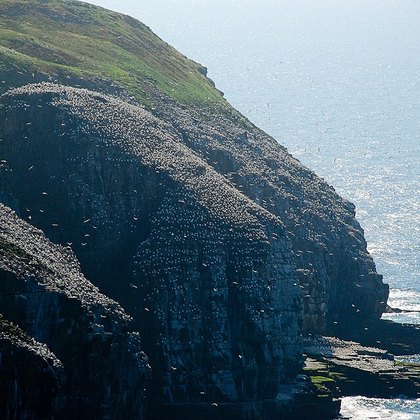
Outside the breeding season it lives over open, warm ocean, often hundreds of kilometres offshore, fishing above schools of tuna and dolphinfish that drive small fish and squid to the surface. It does not plunge-dive: it takes prey on the wing from at or just below the surface. It breeds on sandy coral islets and bare rock islands with low vegetation, in colonies that can reach a million pairs. Otherwise it does not touch land, and it almost never settles on the water: driftwood, buoys and basking sea turtles are the only resting places it uses.
Where the bird is most often found, arranged by the USNVC — the vegetation classification of the United States and Canada — and CMECS for sea and coast.


Range and movements
It breeds on tropical islands in every ocean. Within this guide the colonies lie in Hawaii — well over a million pairs, with Laysan and Lisianski holding some half a million each — and scattered through the Caribbean, from the Bahamas and Cuba to Puerto Rico and the cays of Belize and Honduras. In the contiguous United States it breeds only on Bush Key in the Dry Tortugas off Florida, in the order of twenty thousand pairs. From April to September it ranges over the Gulf of Mexico and the Gulf Stream off the southeast coast; outside that it moves away to tropical waters far from any shore. Hurricanes carry it deep inland with some regularity, as far as Oklahoma, Arkansas and Ohio.
- Resident
- Breeding (summer)
- Winter
- Passage
- dark = core range, pale = thinly spread
Where and when to look
A boat trip to the Dry Tortugas between mid-April and mid-June is the surest way: the colony on Bush Key can be seen and heard from the water, and the birds fill the sky above Fort Jefferson. On any summer pelagic in the Gulf Stream one rule applies: look at the back. Black is Sooty, grey is Bridled, and that difference holds at long range.
Conservation
The world population is of the order of twenty-three million mature birds and the species is listed as of least concern. Locally the picture is less calm: introduced rats and cats cost colonies their chicks, and on many islands eggs were harvested for centuries. In the Dry Tortugas the colony is sensitive to disturbance and to hurricanes that wash away the nesting beach. Because so much of the population sits in a handful of enormous colonies, any loss there weighs heavily.
Scientific name
Onychoprion fuscatus | (Linnaeus, 1766)
Linnaeus described the species in 1766 as Sterna fuscata; because it has since been placed in another genus, author and year stand in parentheses. The genus Onychoprion is formed from Greek onyx 'claw' and prion 'saw'. fuscatus is Latin for 'darkened', after the blackish-brown upperparts. The described specimen came from Santo Domingo on Hispaniola, in the middle of the Caribbean breeding range.