All species › Waders, gulls and terns › Skimmers, noddies, terns and gulls › Aleutian Tern
Aleutian Tern | Onychoprion aleuticus
Aleoetenstern | Charrán aleutiano
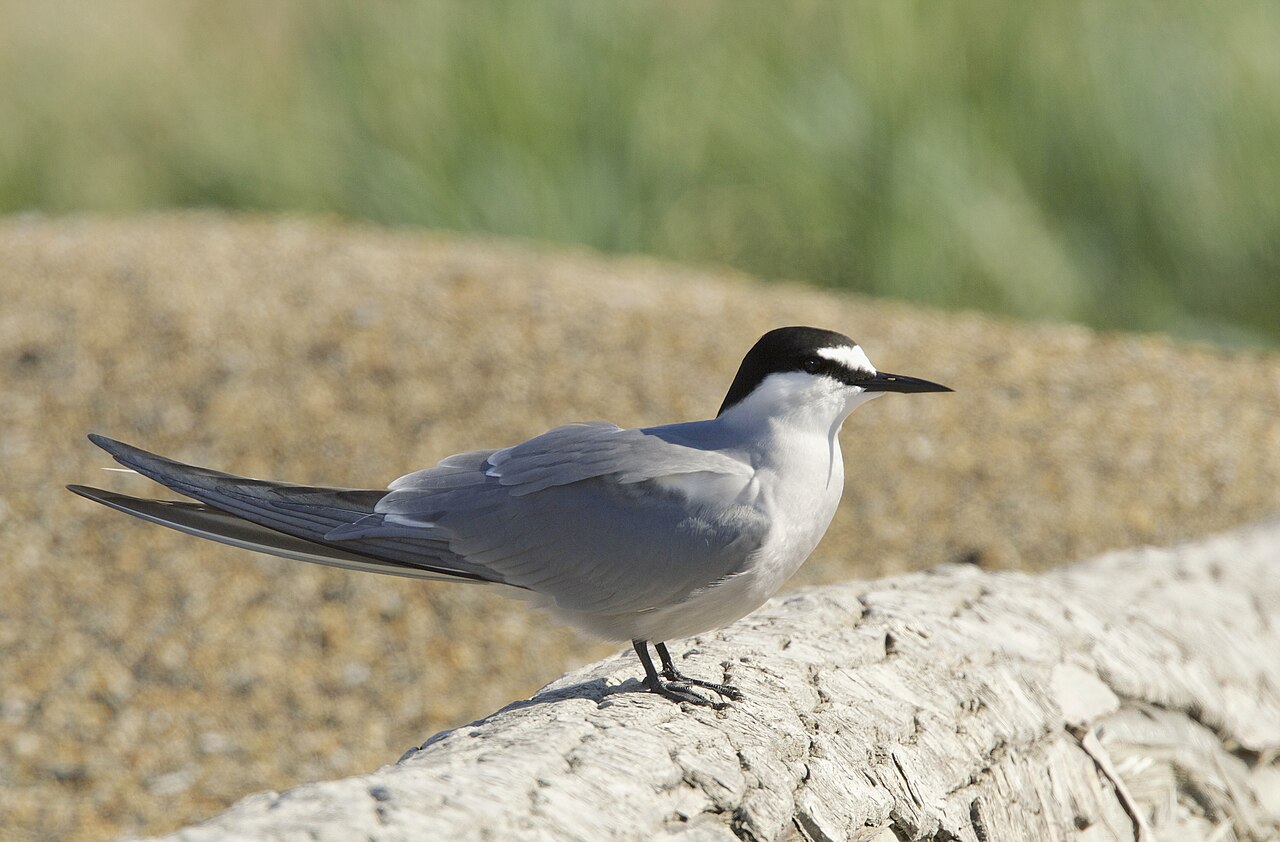
The Aleutian Tern is the only member of its genus that breeds in cold water: where its relatives sit on tropical coral islands, it nests in the wet coastal meadows of Alaska and the Bering Sea. It is greyer than any other tern of the region, with a sharply cut white forehead patch and a black bill. Its numbers are falling fast and it is listed as vulnerable.
Voice
The voice is higher, softer and more whistled than that of the terns whose colonies it shares. The usual contact call is a hurried chif-chif-chu-ak, followed when the birds are uneasy by a rapidly falling whee-hee-hee-hee. Walking past a mixed colony you hear that whistle over the screaming of the Arctic Terns, and it is often the first sign that the species is present. Unlike the Arctic Tern it rarely attacks an intruder at the nest: it circles higher and calls less fiercely.
No freely licensed recording has been found for this species yet; what to listen for is described below.
Identification
A medium-sized, strikingly grey tern: mantle, wings and underparts all mid-grey, with a pure white rump and tail that light up as a pale wedge when the bird lifts off. The black cap leaves a sharply cut, almost square white forehead patch that reaches above the eye. Bill and legs are black, in every plumage and all year. In flight a dark bar along the trailing edge of the inner wing stands out, a mark no other tern of the region shows in the same way. Male and female are alike; young birds are warm brown-scaled above and lack the black cap. The tail is deeply forked but shorter than an Arctic Tern's.
Confusion species
The danger lies almost entirely with Arctic Tern (Sterna paradisaea), which occupies the same Alaskan colonies. In breeding plumage that bird has a blood-red bill and red legs and an entirely black cap with no white forehead; the Aleutian Tern always has a black bill and that white patch. Common Tern (Sterna hirundo) likewise has a red bill base and is paler below. At a distance the underside settles it: the Aleutian Tern is clearly grey on breast and belly, with a white rump contrasting against the grey back. Juveniles are harder and are best held on the black bill and on the grey, not white, underparts.
Habitat
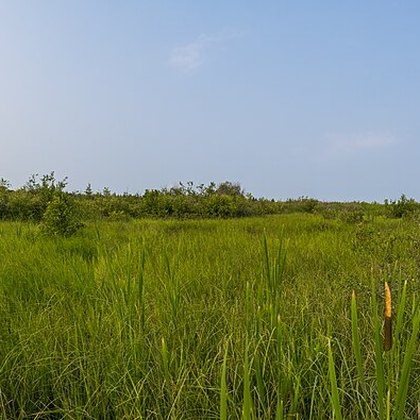
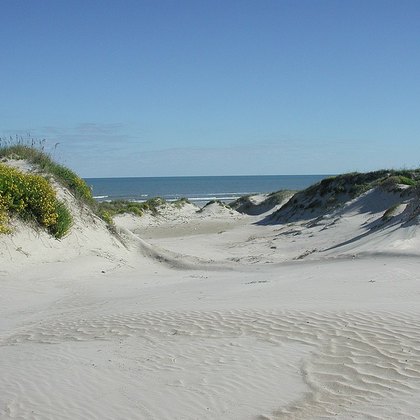
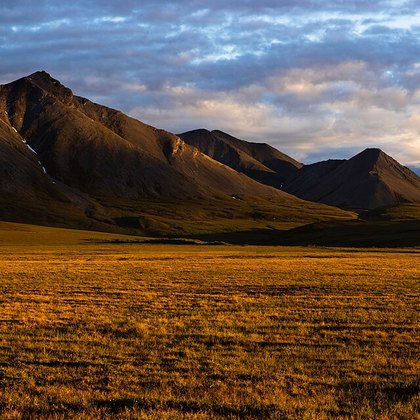
It breeds on low, wet coastal ground: sedge meadows and wet tundra behind a beach ridge, grass tussocks in river mouths, and the sandy or gravelly margins of lagoons and deltas. Colonies almost always lie within a few kilometres of open water, often on islets in or just behind an estuary, and they shift from year to year. It feeds in shallow inshore water, in the turbid plume of a river and over kelp beds: it dives little, taking small fish, krill and crustaceans from the surface while hovering, and it also catches insects on the wing. The bare seabird cliffs where most Bering Sea seabirds breed it does not use.
Where the bird is most often found, arranged by the USNVC — the vegetation classification of the United States and Canada — and CMECS for sea and coast.


Range and movements
A breeder of North Pacific coasts: from Sakhalin, the Sea of Okhotsk and Kamchatka in eastern Russia eastward through the Aleutians to southwestern and southern Alaska, with the largest colony on the coastal forelands near Yakutat — an estimated third of the Alaskan birds. Outside the breeding season it leaves the continent entirely. The winter quarters lie in Southeast Asia, from the coasts of Thailand and the Philippines to New Guinea and eastern Australia, and migration runs down the western Pacific by way of Japan to Taiwan; until the late 1980s those winter quarters were completely unknown. Away from Alaska it is a great rarity in North America, and the map in this guide accordingly shows a breeding area only.
- Breeding (summer)
- Passage
- dark = core range, pale = thinly spread
Where and when to look
Look for it from mid-May to early August at a colony along the Alaskan coast — Yakutat, Homer, Kodiak, Nome and Grant Point at Izembek are the classic places — and listen first: the soft, whistled chif-chu-ak among the screaming Arctic Terns gives it away before you see it. Then look at the bill: black is Aleutian, red is Arctic. After August it is virtually unfindable in North America.
Conservation
The world population is put at roughly 31,000 birds, centred on Alaska and eastern Russia. Counts at Alaskan colonies point to a decline of about eight per cent a year since 1960, and the species is accordingly listed as vulnerable. Just where the loss falls is not clear: colonies are abandoned after disturbance and predation, but in the Southeast Asian winter quarters the birds are also under pressure from fisheries and coastal development. Because colonies move from year to year the trends are hard to measure, and that in itself is a problem for management.
Scientific name
Onychoprion aleuticus | (Baird, 1869)
Spencer Fullerton Baird described the species in 1869 as Sterna aleutica; because it later moved to another genus, author and year stand in parentheses. The genus Onychoprion, which also holds the Sooty Tern and the Bridled Tern, is formed from Greek onyx 'claw' and prion 'saw'. aleuticus means 'of the Aleutians'. The described specimen, however, came not from that island chain but from Kodiak Island, Alaska, where the species still breeds.