All species › Waders, gulls and terns › Skimmers, noddies, terns and gulls › Blue-gray Noddy
Blue-gray Noddy | Anous ceruleus
Blauwgrijze noddy | Tiñosa azulada
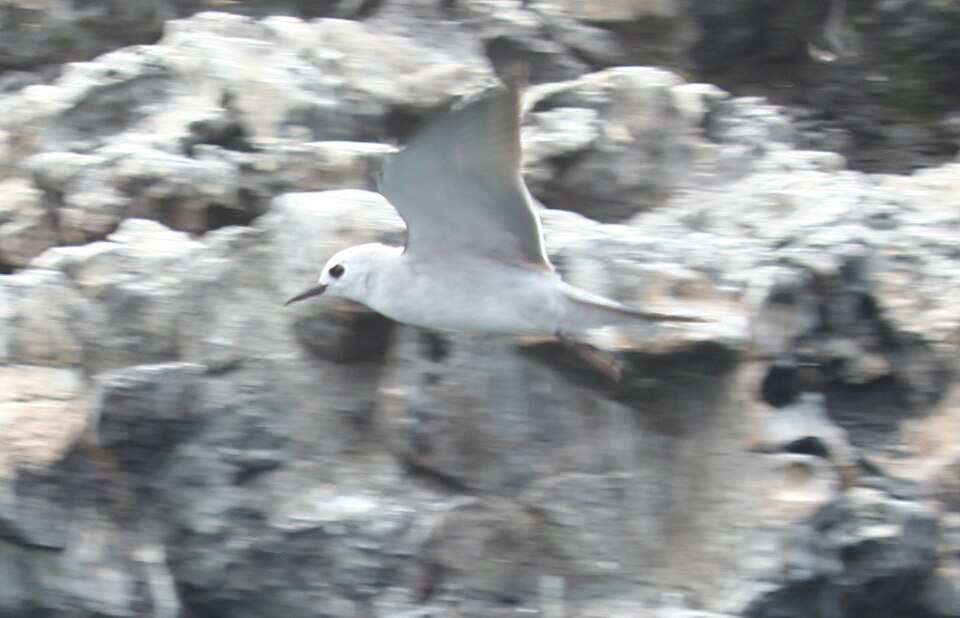
At twenty-five to twenty-eight centimetres the Blue-gray Noddy is the smallest tern in the world: uniformly blue-grey from head to tail, with a thin white crescent along the rear edge of the eye. Within the area of this guide it breeds only on a few bare rock islands of the Hawaiian chain, in crevices in old lava.
Voice
At the colony a settled bird gives a soft, sustained purring krrr-r-r-r that suggests an insect more than a seabird. When a group takes off it does so with high, shrill cries that carry far over calm water. Away from the breeding place it is virtually silent. Of all the terns in this guide its voice is the least well recorded; most descriptions come from the closely related Grey Noddy (Anous albivitta) of the southern Pacific.
Recording: Eric VanderWerf — CC BY-NC-SA 3.0 · Nihoa Island, Hawaii, United States · xeno-canto
Identification
Everything about it is blue-grey: head, mantle and underparts a pale pearly tone, the primaries and the leading edge of the wing clearly darker. The bill is short, slender and black; the legs are black with pale, flesh-coloured webs. A narrow white rim around the rear half of the eye is the only pattern in the plumage and gives it a startled expression at close range. Male and female are alike; young birds are browner in tone. The tail is short and only shallowly forked, and the flight consists of rapid, shallow beats low over the water, the feet pattering on the surface.
Confusion species
In North American waters confusion is barely possible: no other tern of the region is blue-grey from head to tail. Brown Noddy (Anous stolidus) and Black Noddy (Anous minutus), which breed on the same islands, are far larger, dark brown to black, and have a pale crown on a dark body rather than the reverse. White Tern (Gygis alba) is just as small but snow white, with a black patch around the eye. At a distance its pattering flight suggests a storm-petrel rather than a tern, but the size and the even blue-grey tone settle it at once.
Habitat
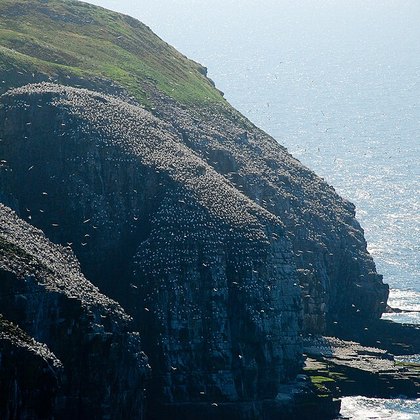
It lives over open, warm ocean, usually within a few tens of kilometres of its breeding island, and there takes the smallest prey any tern handles: fish larvae, small squid and crustaceans, picked from the surface while hovering and dipping. It breeds on bare rock islands and cliffs, in crevices and cavities in old lava and under overhanging blocks, where egg and chick lie out of the sun. Sandy atolls with low vegetation it does not use: it needs stone. It also avoids the deep pelagic water far from land where the Sooty Tern is at home.
Where the bird is most often found, arranged by the USNVC — the vegetation classification of the United States and Canada — and CMECS for sea and coast.


Range and movements
The range covers the tropical Pacific, from the Marianas and Samoa to the Cook Islands and French Polynesia, with five subspecies spread over the island groups. Within this guide it is confined to Hawaii, and there to the Northwestern Hawaiian Islands: Necker and Nihoa together hold by far the most birds, with smaller numbers on La Perouse Pinnacle, French Frigate Shoals and Gardner Pinnacles. It formerly bred on Kaʻula off Niʻihau; from the inhabited main islands it is absent. It does not migrate: birds stay near their colony all year, and eggs can be found in any month from March to September.
- Resident
Where and when to look
The chance of seeing it is small and depends entirely on a boat: all the Hawaiian colonies lie within closed reserves, and from the inhabited islands it is almost never reported. Anyone sailing in the northwest of the chain should watch for a small, pale tern moving low and fast over the water, usually in small loose parties. It does not plunge and does not splash: that pattering over the surface is the mark by which to know it at range.
Conservation
The world population is put at roughly a hundred thousand pairs, of which some 3,600 breed in Hawaii. It is listed as of Least Concern (LC), but the Hawaiian numbers are small and concentrated on two islands, which leaves them vulnerable to a single accident. Introduced rats and feral cats are the heaviest threat wherever it comes ashore; on the Northwestern Hawaiian Islands these have now been removed everywhere. On Nihoa eggs are lost to the native finches that live there.
Scientific name
Anous ceruleus | (Bennett, 1840)
Frederick Debell Bennett described the species in 1840 as Sterna cerulea; because it has since been placed in another genus, author and year stand in parentheses. For a long time it stood in the genus Procelsterna; since molecular work published in 2016 it has been placed with the noddies in Anous. ceruleus is a spelling variant of Latin caeruleus, 'sky-blue', after the tone of the plumage; Anous is Greek for 'foolish', after the tameness with which noddies allow an approach at their colonies — the same idea sits in the English word noddy. The described specimen came from Christmas Island in the Pacific, present-day Kiritimati in the Line Islands.