All species › Waders, gulls and terns › Skimmers, noddies, terns and gulls › Black Noddy
Black Noddy | Anous minutus
Witkapnoddy | Tiñosa menuda
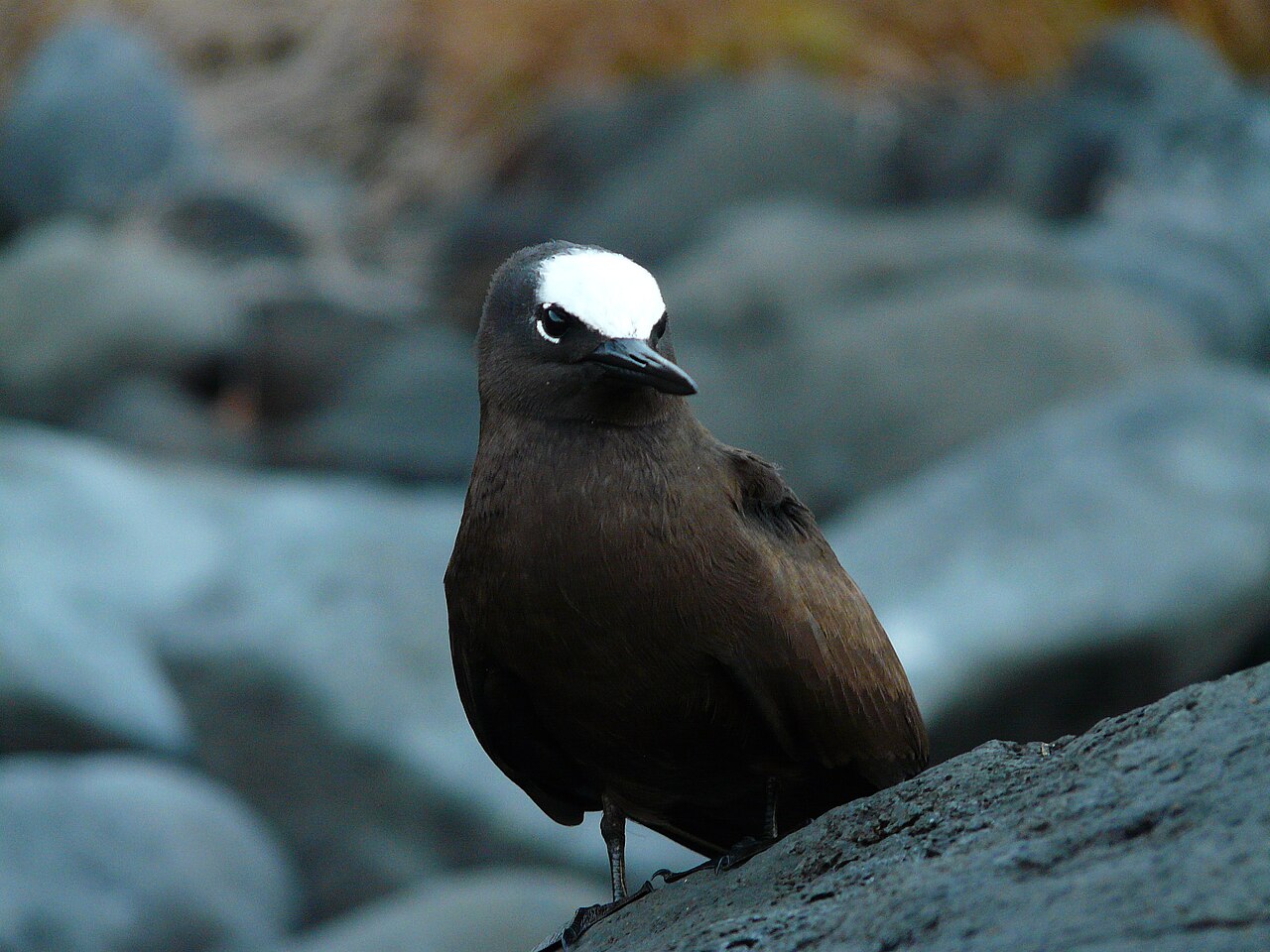
The Black Noddy is the smaller, blacker counterpart of the Brown Noddy: a slim tropical tern with a thin, long bill and a sharply bounded white cap on an almost entirely black body. In North America it breeds only in Hawaii, where it is called noio and makes its nests on ledges in sea caves and on steep coastal cliffs. It stays close to home: the birds feed in shallow water just off the shore and roost every night at the colony.
Voice
A short, dry, high call, far sharper than the low croaking of the Brown Noddy: a repeated kik-kik or tik-tik. At the colony this turns into a sustained rattling krrr-krrr which, in a sea cave, is thrown back by the rock walls and so sounds louder than the number of birds suggests. Around the nest chicks beg with a thin, squeaking note. At sea it is usually silent.
Recording: Sreekar — CC BY-NC-SA 4.0 · Coral Sea, Gladstone Regional, Queensland, Australia · xeno-canto
Identification
Smaller and slimmer than the Brown Noddy, with narrower wings, a shorter and more squarely cut tail and a thin, long, straight bill. In most populations the plumage is deep black to blackish brown, with a snow-white cap that breaks off sharply — almost with an edge — against the black of the nape, and a clear white crescent below the eye. The birds of the inhabited Hawaiian Islands are an exception: they are more dark brown, with a greying nape, a greyer tail and orange rather than black legs. Male and female look alike; juveniles have an equally white but narrower cap and pale fringes to the coverts. The flight is lighter and more agile than the Brown Noddy's, with quicker beats and much turning just above the water.
Confusion species
Brown Noddy (Anous stolidus) is clearly bigger and warmer brown, with a heavier bill, a longer wedge-shaped tail and a cap that grades gradually into the brown of the nape instead of breaking off sharply. That difference in the cap is the most useful at range; in the main Hawaiian Islands part of it falls away, for there the Black Noddy is itself brownish, leaving the thin bill, the shorter tail and the smaller build. Juvenile Sooty Terns (Onychoprion fuscatus) are dark too but show white spotting on the back and a deeply forked tail. In the Dry Tortugas, where the species turns up yearly as a stray among thousands of Brown Noddies, it is precisely the sharp white cap over a black body that everyone watches for.
Habitat
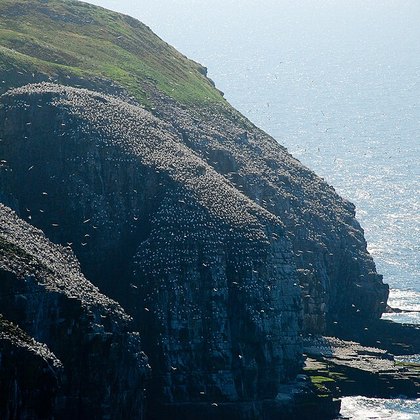
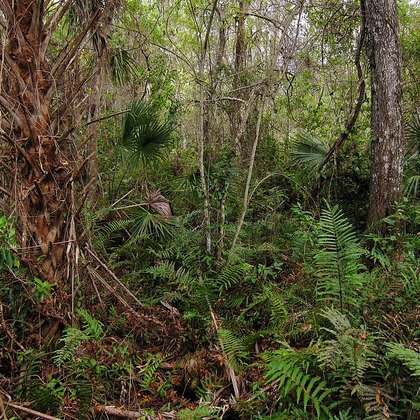
It breeds on oceanic islands, taking ledges and crevices in coastal cliffs, building slight nests in sea caves, and elsewhere making flat nests of leaves and guano in trees — on many islands in pisonias, in Hawaii also in planted ironwoods. What it needs is a fixed site, reusable year after year, beyond the reach of rats. It feeds close inshore, in shallow water over reefs and in the surf line, seeking out hunting schools of predatory fish. It makes no use of open ocean far from land, river mouths or the interior.
Where the bird is most often found, arranged by the USNVC — the vegetation classification of the United States and Canada — and CMECS for sea and coast.

Range and movements
The species breeds on islands in the tropical and subtropical Pacific, scattered through the Caribbean and the central Atlantic, and locally in the northeastern Indian Ocean. Within the guide area Hawaii is the only real stronghold: it breeds throughout the chain, with the largest numbers on Midway and Nihoa, and in smaller groups along the cliffs of the inhabited islands. It does not migrate and generally stays within eighty kilometres of its colony, outside the breeding season as well. On the North American mainland it is not a breeding bird: at the Dry Tortugas off Florida one or two birds have been found among the Brown Noddies in most years since 1960, without a nest ever being confirmed.
- Resident
- Breeding (summer)
Where and when to look
In Hawaii it comes right in under the coast: from a headland or from the rocks along a steep coast road, watch for the small dark terns turning back and forth low over the surf, and look for the white cap. Early in the morning and towards evening the birds pass between roost and fishing ground. At the Dry Tortugas you must scan Bush Key from the wall of Fort Jefferson and pick out, among thousands of Brown Noddies, the one blacker, smaller bird with a sharply drawn white cap; it often sits on the same post or jetty.
Conservation
Worldwide the species runs to more than a million birds and is listed as Least Concern (LC). In Hawaii the breeding population is put at about twelve thousand pairs, with Midway and Nihoa the main sites. The threats are those of any island breeder: introduced rats and cats, breeding sites overgrown by alien plants, and disturbance of colonies by boats and sea-cave tours. Because it fishes just off the shore, pollution of coastal water hits it harder than species that feed far out at sea.
Scientific name
Anous minutus | Boie, 1844
Friedrich Boie described the species in 1844 as Anous minutus; because he placed it at once in that genus and it still stands there, author and year carry no parentheses. The genus Anous was introduced by Stephens in 1826 and is Ancient Greek for 'without sense', a name sailors gave these tame birds. minutus is Latin for 'small' and sets it apart from the larger Brown Noddy, Anous stolidus. Boie gave the origin as 'New Holland', the old name for Australia; that was later restricted to Raine Island off the northeast Australian coast.