All species › Passerines › Tyrant flycatchers and allies › Great Crested Flycatcher
Great Crested Flycatcher | Myiarchus crinitus
Grote kuiftiran | Copetón Viajero
The Great Crested Flycatcher is the only Myiarchus of eastern North America and the only flycatcher of that region that nests in a cavity. It lives high in deciduous woodland and is recognised there mainly by its loud, rising call. Shed snakeskin is often worked into the nest.
Voice
The call is a loud, sharp wheeep that shoots upward at the end, audible far off and given throughout the breeding season. Under stress it follows with a series of short, rising huit notes. The male's dawn song has three parts: two short whistles, a wheerreep followed by a higher whee, and a soft low churr. It sings from an hour before sunrise out of the canopy, usually without being seen.
Recording: Bobby Wilcox — CC BY-NC-SA 4.0 · Tama (near Burlington), Des Moines, Iowa, United States · xeno-canto
Identification
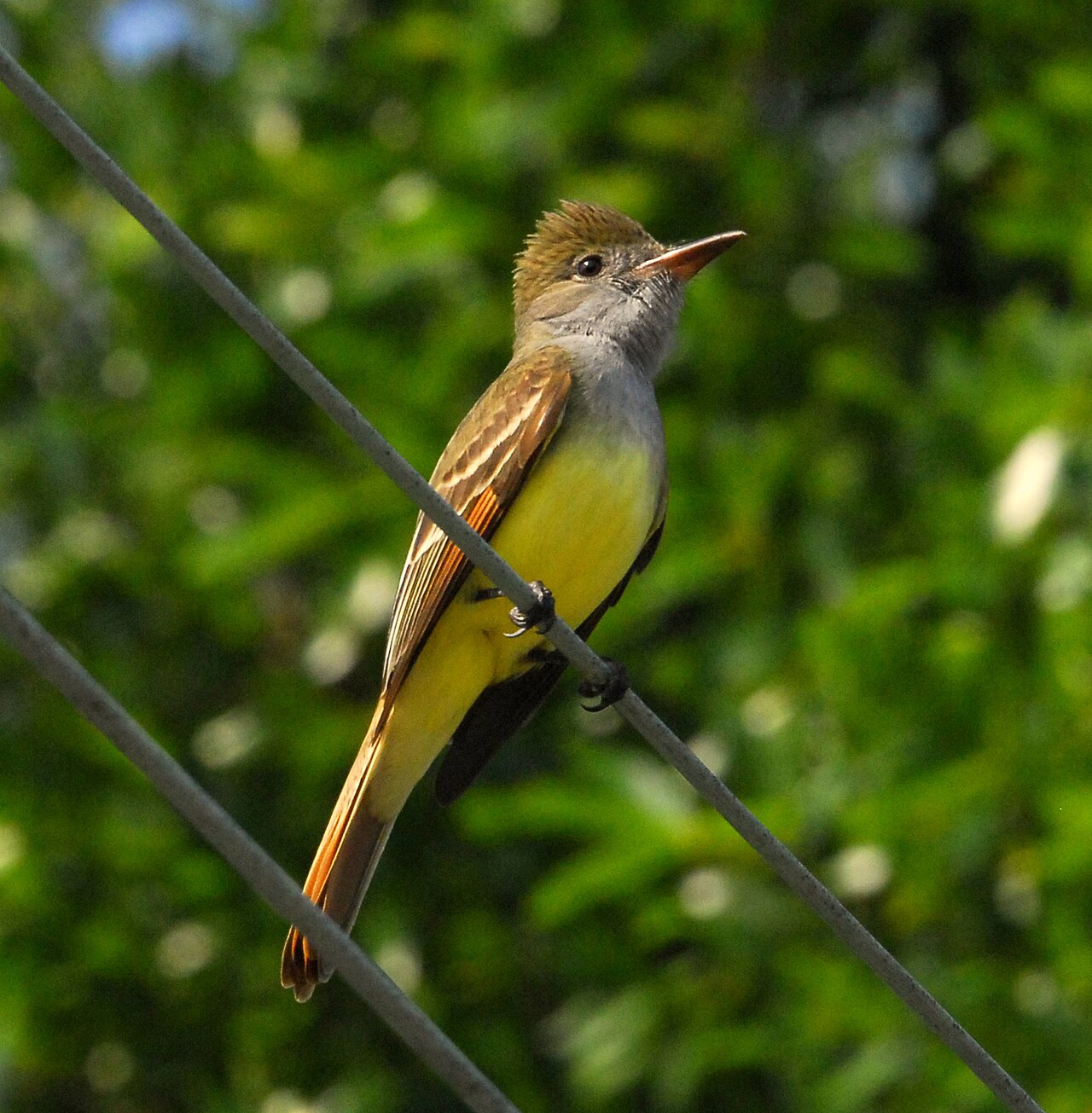
A bulky, elongated flycatcher with a full bushy crest. The upperparts are olive-brown, the throat and breast grey, the belly and undertail coverts bright sulphur yellow, with a sharp boundary between grey and yellow. The tail is rufous above and below, and the flight feathers have rufous edges. The lower mandible has an obvious pale or flesh-coloured base, unlike the wholly dark bill of its western relatives. The wingspan is about 34 centimetres and the weight 27 to 40 grams.
Confusion species
In the east it barely overlaps with other Myiarchus species. Where it does, in Texas: Ash-throated Flycatcher is smaller and much paler, with a faintly yellow belly, a wholly dark bill and the burry ka-brick; Great Crested has a deep yellow belly, the pale bill base and the rising wheep. Brown-crested Flycatcher is the same size but has a heavier, wholly dark bill, a paler yellow belly and a rolling whirrp. Western Kingbird has a grey head and breast, a white tail edge and a wholly different chattering voice. Dusky-capped Flycatcher is smaller, with a dark cap and almost no rufous in the tail.
Habitat
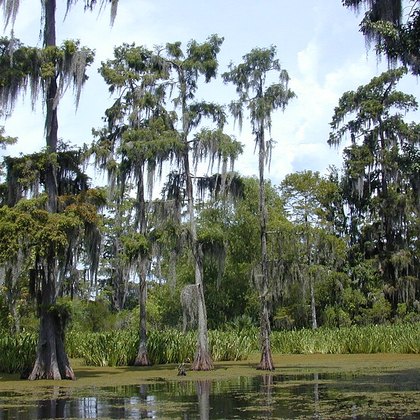
Open deciduous and mixed woodland with a thin canopy, woodland edge, wooded hedgerows, second growth and selectively cut forest. It avoids conifer-dominated country. It adapts to parks, cemeteries, golf courses and orchards, provided dead trees with cavities remain. It stays almost entirely in the canopy and rarely comes to the ground. In winter, tropical forest and forest edge down into the lowlands.
Where the bird is most often found, arranged by the USNVC — the vegetation classification of the United States and Canada — and CMECS for sea and coast.





Range and movements
Breeds from southern Manitoba, southern Ontario, southern Quebec and the Maritimes south through the whole eastern United States to the Gulf Coast, and west to eastern North Dakota, central Texas and eastern Oklahoma. It arrives between late April and mid May and leaves in August and September. The winter range runs from southern Mexico and the Yucatán Peninsula through Central America to northwestern South America; in Cuba and the Bahamas it is a passage migrant. In southern Florida part of the population stays all year.
- Resident
- Breeding (summer)
- Winter
- Passage
- dark = core range, pale = thinly spread
Where and when to look
Hear it first: the wheep carries across a woodlot and in May and June is the quickest way to establish its presence. Then look along a woodland edge or a clearing for a large flycatcher high in a dead top; the rufous tail is what shows first as it flies off. Nest boxes with an entrance of about four centimetres at a woodland edge are regularly occupied in the breeding season.
Conservation
The IUCN places the species in the Least Concern (LC) category. Partners in Flight puts the breeding population at about 8.8 million birds and the Breeding Bird Survey shows a stable trend between 1966 and 2019. Competition for nest cavities with European Starlings, swallows and wrens plays a local part, as does the removal of dead trees in forest management. As a migrant the species also depends on forest cover in the winter range.
Scientific name
Myiarchus crinitus | (Linnaeus, 1758)
Linnaeus described the species in 1758 as Turdus crinitus; because it was later moved to Myiarchus, author and year stand in parentheses. Myiarchus comes from Greek muia 'fly' and arkhos 'ruler'. The species name crinitus is Latin for 'hairy' or 'long-haired', after the full crest. The type locality was first given vaguely as 'America' and was restricted to South Carolina by Bangs in 1898. The Dutch and English names both refer to the crest; the Spanish name copetón viajero adds the migratory habit.