All species › Passerines › Tyrant flycatchers and allies › Brown-crested Flycatcher
Brown-crested Flycatcher | Myiarchus tyrannulus
Cayennetiran | Copetón Tiranillo
The Brown-crested Flycatcher is the largest Myiarchus in the guide area: a cavity nester with a greyish-brown crest, grey throat and yellow belly that breeds in saguaro (the giant columnar cactus of the Sonoran Desert) cactus and riparian woodland in the southwestern United States. The range runs from California and Texas all the way to Argentina.

Voice
The call is a sharp, liquid whip or hwit, often in short series, together with a rough, grating rattle. Characteristic is a two-syllable whay-burg, alternated in the dawn song with rapid series of hwit notes. That dawn song starts before sunrise and runs for half an hour. Since the Myiarchus species differ hardly at all in plumage, voice is the most usable character.
Recording: JAYRSON ARAUJO DE OLIVEIRA — CC BY-NC-SA 4.0 · Brejo do tricolino oliváceo - Campestre de Goiás, Brazil · xeno-canto
Identification
Upperparts light brown to olive-grey, with a darker-streaked crown that can be raised as a bushy crest. Throat and upper breast are light grey, the belly clear yellow, and the transition between the two is fairly sharp. The primaries have rufous edges and the secondaries pale edges, together forming two wing bars. The tail shows rufous inner webs from below. The bill is black, long and heavy, with a distinct hook at the tip; the southwestern subspecies magister is the largest-billed.
Confusion species
Ash-throated Flycatcher is smaller with a noticeably smaller bill, a weaker transition from grey breast to pale yellow belly, and usually more rufous in the tail; its call is a dry ka-brick against the clear whip of Brown-crested. Dusky-capped Flycatcher is clearly smaller, with a slimmer bill, little rufous in the tail, and a drawn-out, descending, plaintive peeeur. Great Crested Flycatcher, in Texas the only other large species, has a deeper yellow belly, a more strongly rufous tail and a rising wheep! that is shorter and sharper. Bill size and tail pattern help, but on silent birds the identification often stays open.
Habitat
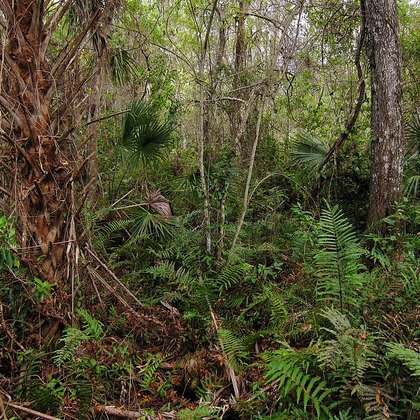
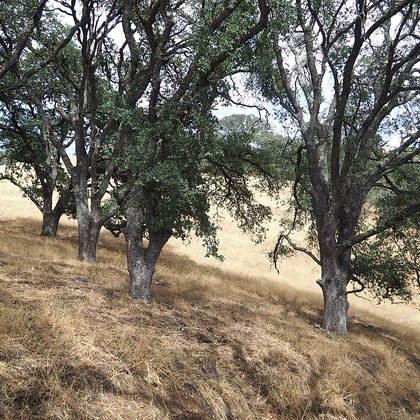
Cavities are the limiting factor: the species nests in old woodpecker holes and natural hollows in saguaro (the giant columnar cactus of the Sonoran Desert), mesquite (a thorny pod-bearing shrub of the Southwest that forms dense thickets), hackberry and cottonwood. In Arizona that means saguaro desert and the cottonwood-willow woodland along the Santa Cruz and San Pedro; in South Texas, mesquite and thorn scrub along rivers. Further south it uses thorn forest, deciduous woodland and open oak country, from sea level to about 2000 metres.
Where the bird is most often found, arranged by the USNVC — the vegetation classification of the United States and Canada — and CMECS for sea and coast.



Range and movements
Breeds in southwestern California, southern Nevada, southwestern Utah, Arizona, southwestern New Mexico and South Texas; in Texas the highest densities in the United States lie in Jim Hogg and Brooks counties. Birds arrive there in early March and leave by mid-September. From northern Mexico south the species is resident, with a continuous range along both coasts, across the Yucatán Peninsula and through Central America into South America as far as Argentina. Vagrants have been recorded in Louisiana and Florida.
- Resident
- Breeding (summer)
- Winter
- Passage
- dark = core range, pale = thinly spread
Where and when to look
Look for it in May and June in the saguaro (the giant columnar cactus of the Sonoran Desert) desert near Tucson or along the Rio Grande: the bird perches high and in the open on a cactus arm or dead branch and returns to the same perch after a sally. Go by ear — the loud whay-burg before sunrise places it before you see it, and that is more reliable than plumage.
Conservation
The IUCN lists the species as Least Concern (LC); the range is large and the population appears to be increasing. In the United States it breeds largely on protected land. Loss of old trees and saguaros with cavities is the pressure point, because the bird cannot excavate a hole itself and depends on large woodpeckers. One banded bird reached an age of at least eleven years.
Scientific name
Myiarchus tyrannulus | (Müller, 1776)
Statius Müller described the species in 1776 as Muscicapa tyrannulus; because it was later moved to another genus, author and year stand in parentheses. The genus Myiarchus comes from Greek muia 'fly' and arkhos 'ruler', so 'ruler of flies'. The species name tyrannulus is a diminutive of Latin tyrannus, 'little tyrant'. The specimen described came from Cayenne, in French Guiana, which is the source of the Dutch name.