All species › Cuckoos › Cuckoos › Greater Roadrunner
Greater Roadrunner | Geococcyx californianus
Grote renkoekoek | Correcaminos grande
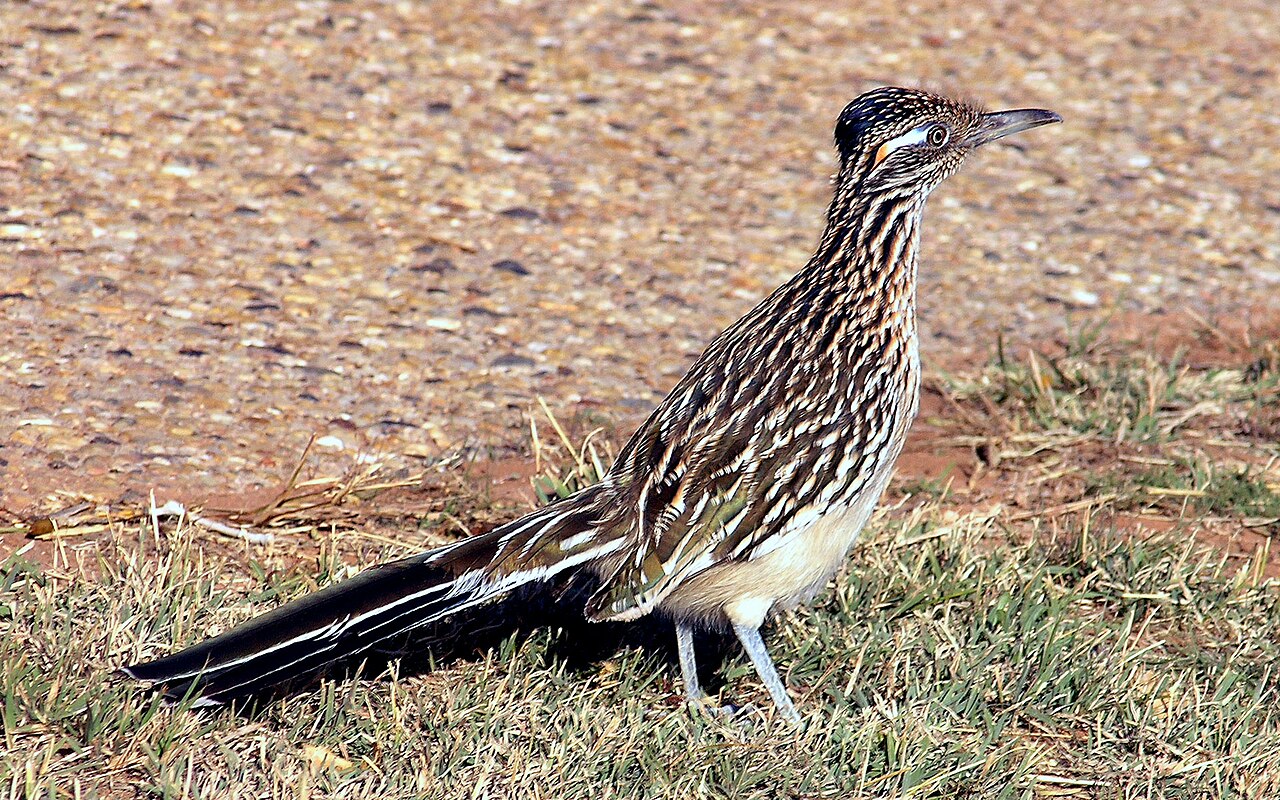
Greater Roadrunner is the cuckoo that runs instead of flying: a long, streaked bird with a shaggy crest and a long tail that sprints across the open desert and dry scrubland of the Southwest from perch to perch along the ground. It is one of the few cuckoos in the world to actively hunt lizards and snakes, rattlesnakes included. Its silhouette — low, elongated, tail cocked at an angle — is distinctive within its range.
Voice
The song is a series of six to eight low, descending coo notes, dove-like in tone and usually given from a low perch or post at sunrise: coo-coo-coo-coo-cooo-cooo. It also produces a rasping clatter by snapping its mandibles rapidly together, especially when excited or as a threat display. The call does not carry far and is easily lost among the dawn chorus of other desert birds.
Recording: Mark McClelland — CC BY-NC-SA 4.0 · Vanderpool, Bandera County, Texas, United States · xeno-canto
Identification
A large, elongated bird streaked brown-black above and below, with a shaggy dark crest it can raise at will and a long white-edged tail usually carried at an angle. Behind the eye sits a patch of bare skin that runs from blue to orange-red and brightens further during display. The legs are sturdy and the bill long, heavy and slightly curved. Juveniles resemble the adults but have a duller eye patch and a shorter tail.
Confusion species
Its size, silhouette and running behaviour make it distinctive within its range; the closest confusion risk is with a large thrasher such as Curve-billed Thrasher, which is likewise streaked and desert-dwelling but far smaller, with a short tail and no crest. Pheasant-like birds are largely absent from its range, leaving few other ground-running birds to confuse it with.
Habitat
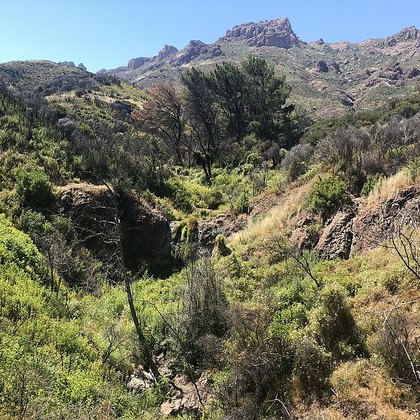
It seeks dry, open to semi-open terrain: desert scrub, mesquite flats, chaparral (dense, hard-leaved scrub of the Californian Mediterranean climate) and the edges of farmland and ranchland, with scattered shrubs and cacti for cover and nesting. It avoids dense closed forest and high mountains as well as completely bare, plantless sand. Water is not a requirement: it obtains most of its moisture from its prey.
Where the bird is most often found, arranged by the USNVC — the vegetation classification of the United States and Canada — and CMECS for sea and coast.


Range and movements
Resident across the arid Southwest of the United States — from California and Nevada to Kansas and Texas — and south through nearly all of Mexico. It does not migrate; what movement occurs is limited wandering by young birds after fledging. The range has crept slightly northeast in recent decades, with occasional breeding records as far as Kansas and Missouri.
- Resident
- Breeding (summer)
- Winter
- Passage
- dark = core range, pale = thinly spread
Where and when to look
Look along dry gravel roads and washes in early morning, when the bird spreads its back feathers on a fence or low wall to sunbathe — a posture that gives it away instantly. Later in the day it often dashes straight across the road, using the long tail for balance.
Conservation
Least Concern (LC); common and stable across its range, without major threats. Local loss of desert scrub to development narrows its habitat, and its ground-dwelling habits make it vulnerable to traffic on desert roads.
Scientific name
Geococcyx californianus | (Lesson, 1829)
Lesson described the species in 1829 as Saurothera californiana, in the genus then used for Caribbean lizard-cuckoos; it was later moved to Geococcyx, a genus Wagler introduced in 1831 from Greek geo- ('earth') and kokkyx ('cuckoo') — hence the parentheses around author and year. The species name californianus refers to the type locality, simply given as 'California'. Both the Dutch and English names highlight a characteristic habit: running rather than flying.