All species › Cuckoos › Cuckoos › Groove-billed Ani
Groove-billed Ani | Crotophaga sulcirostris
Groefsnavelani | Garrapatero Asurcado
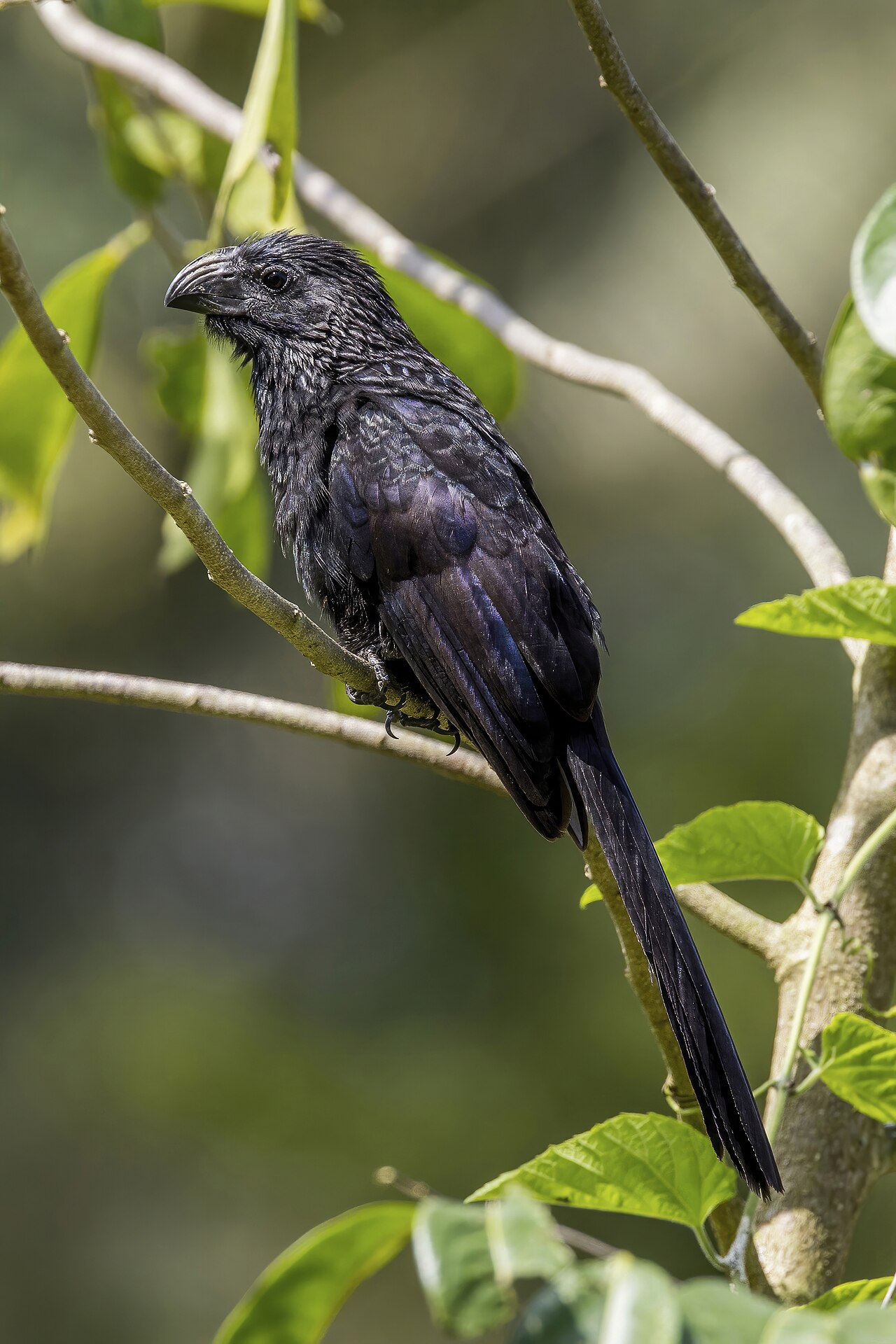
The Groove-billed Ani is an all-black, long-tailed bird with a bill that looks too big for its head: deep, flattened from the side, and carrying a few fine grooves along the upper half. It lives in noisy little groups that build a single nest together and tend it together; every female in the group lays into the same bowl. In the United States it reaches no farther than the extreme south of Texas.
Voice
The usual call is a thin, upward-sliding tee-ho, the first syllable starting high and plaintive, the second sliding back down. Groups also keep up a continuous muttering and clucking by which you hear them long before you see them, since they like to stay hidden in dense scrub. Alarm brings a short hard chek that sets the whole group moving. The voice does not carry far and is masked by the rustle of wind through dry grass.
Recording: Johan Chaves — CC BY-NC-SA 4.0 · Playa del Rey wetlands, Puntarenas, Costa Rica · xeno-canto
Identification
Entirely black, with a purple or green gloss over back and wing coverts in good light. The bill is deep and laterally compressed, with a strongly arched upper edge and three or four shallow grooves visible only at close range. The long, loose tail seems poorly attached and swings on after every landing. Male and female look the same; young birds are duller black and have a lower, smoother bill. The flight is weak and fluttering, with short glides, as if the tail had to catch up each time.
Confusion species
Smooth-billed Ani (Crotophaga ani) of Florida and the Caribbean is similar, but has a higher hump at the base of the bill and no grooves, and calls with a rising nasal whine rather than a two-syllable whistle. At a distance an ani is taken for a small crow or a large grackle; neither has that loosely swinging tail or that bulging bill. In North America the two anis barely overlap, so place already gives half the answer.
Habitat
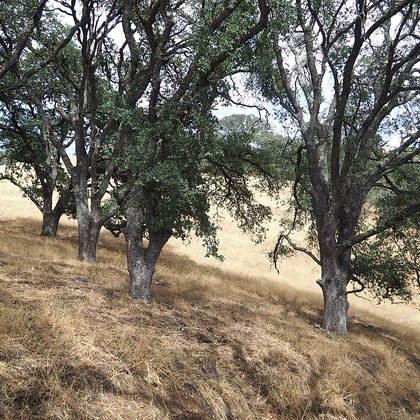
Open and half-open lowland with bushes: rank pasture, thorn scrub, field edges and the thickets along seasonal creeks. It wants a dense low shrub layer to roost and nest in, with open ground beside it to run after grasshoppers. Grazing cattle are welcome company: the anis walk with the herd and take the insects it flushes, and sometimes ticks off the animals themselves. It avoids closed high forest and bare desert, and unlike its relative it keeps to the drier ground.
Where the bird is most often found, arranged by the USNVC — the vegetation classification of the United States and Canada — and CMECS for sea and coast.



Range and movements
Resident from the extreme south of Texas and the tip of Baja California through the lowlands of Mexico and Central America, and on south into South America; on the map that ends at Nicaragua. In Texas it is far more numerous in summer than in winter, and after the breeding season part of the population drifts north and east along the Gulf coast, well beyond the breeding range. In the tropics the clearing of forest has helped rather than harmed it: where woodland gives way to bushy pasture it moves in.
- Resident
- Breeding (summer)
- Winter
- Passage
- dark = core range, pale = thinly spread
Where and when to look
Drive the back roads of the Lower Rio Grande Valley in summer and watch the barbed wire and low bushes near cattle: a row of black birds sunning themselves with hanging tails in the morning is almost always a group of anis. They answer approaching footsteps by flapping one at a time to the next bush, which lets you count the group as it goes.
Conservation
The world population is estimated at about two million birds and was stable between 1966 and 2015. In the United States perhaps five thousand breed, all in South Texas, where the species depends on the remaining brush along the Rio Grande that has been much reduced by farming and building. Elsewhere in its range it is common; the species is listed as Least Concern (LC).
Scientific name
Crotophaga sulcirostris | Swainson, 1827
Swainson described the species in 1827 as Crotophaga sulcirostris; because it still stands in that same genus, author and year carry no parentheses. The genus name is Greek for 'tick eater', from kroton ('tick') and phagein ('to eat'), after the habit of picking ticks off cattle. The species name is Latin for 'grooved bill', from sulcus ('groove') and rostrum ('bill'). The description appeared in The Philosophical Magazine; the specimen described came from Temascaltepec in Mexico.