All species › Waterfowl › Ducks, swans and geese › Greater White-fronted Goose
Greater White-fronted Goose | Anser albifrons
Kolgans | Ánsar careto
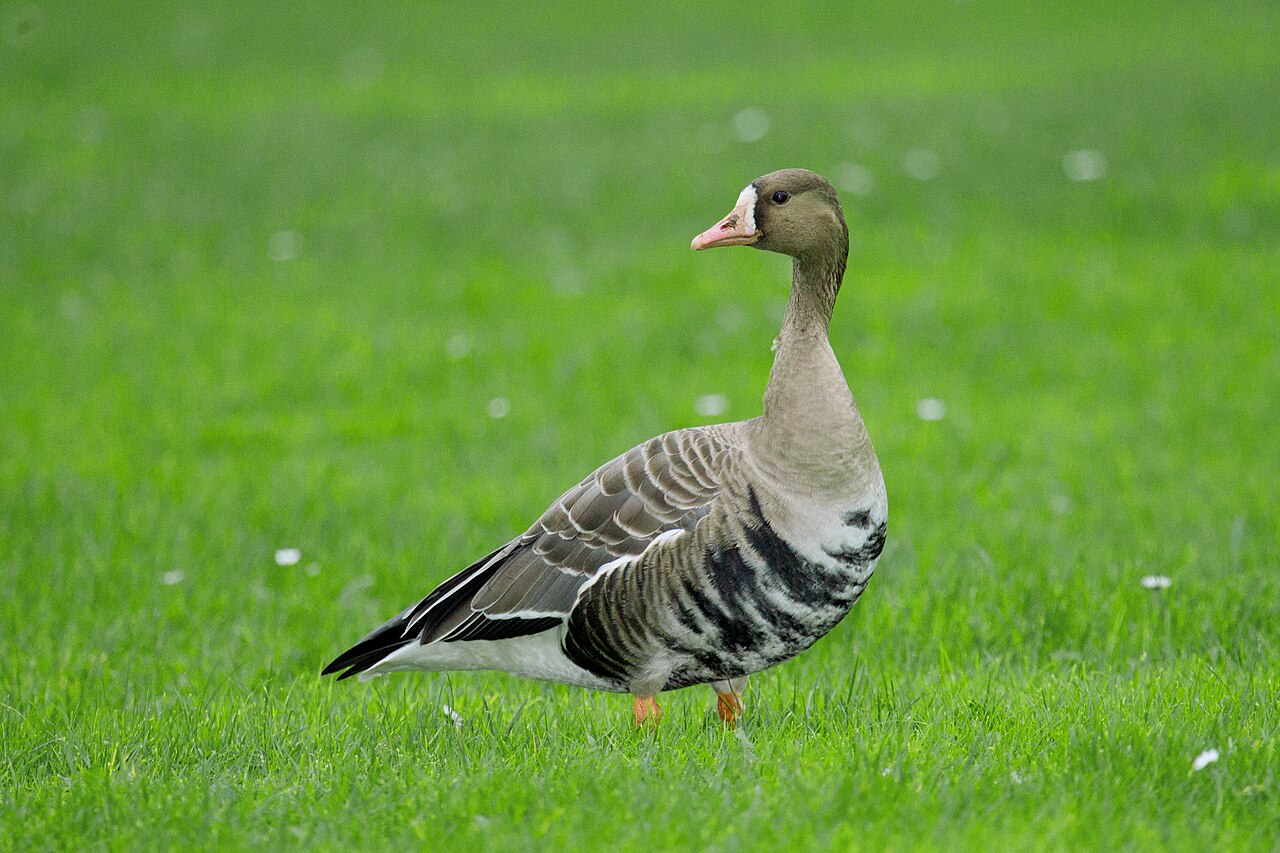
The Greater White-fronted Goose is the most talkative of the grey geese, with a loud, laughing call that earned it the old nickname 'laughing goose'. A sharply defined white patch at the base of the bill and irregular black blotches on the belly of the adult distinguish it from other geese.
Voice
The call is a high, laughing bark, kla-ha or kla-ha-luk, which explains an old English nickname for the species: the laughing goose. A large flock leaving the roost keeps up a steady, musical gabbling and honking that carries over the fields from first light. In flight the flock calls constantly, shorter and higher than the deep clamour of the Canada geese.
Recording: David Darrell-Lambert — CC BY-NC-SA 4.0 · Ras Al Khor Wildlife Sanctuary (near Dubai), Dubai, United Arab Emirates · xeno-canto
Identification
A medium-sized, stocky goose with a relatively small bill, thick legs and a short neck. Adults have a sharply defined white patch around the base of the bill and irregular, scattered black blotches and bars on the belly — known to hunters as the 'speckle-belly'. The body is even greyish brown, the legs orange, the bill pink to orange. Juveniles entirely lack the white front and the black belly marks and are harder to tell from other young grey geese; the orange legs remain the best mark then.
Confusion species
The Greenland subspecies has a yellow-orange rather than pink bill and darker plumage, and breeds in West Greenland, where it shares ground with the rapidly expanding Canada Goose. In western North America the rare Taiga Bean-Goose, a vagrant from Siberia, is the most similar species: larger, with a longer neck and a longer, darker bill lacking a broad white front. Snow Goose and Ross's Goose are told apart at once by their overall white, not greyish-brown, plumage.
Habitat
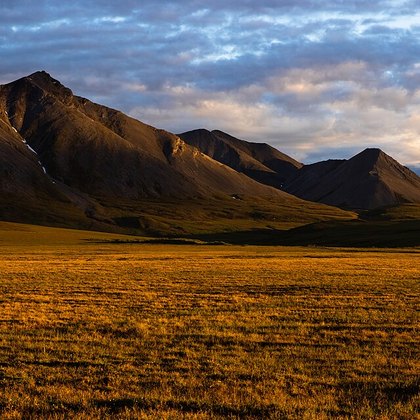
It breeds on damp tundra with pools and low vegetation, both on the coast and inland, avoiding the barest, driest ground. On migration and in winter it seeks wet meadow, freshwater marsh and above all cropland: rice fields and grain stubble along the Gulf Coast, and in California the marshes and fields around the Central Valley. It uses roosts on shallow open water to sleep between feeding bouts.
Where the bird is most often found, arranged by the USNVC — the vegetation classification of the United States and Canada — and CMECS for sea and coast.




Range and movements
It breeds from the coast of western and northern Alaska eastward through the western Canadian Arctic; a separate, darker subspecies, the Tule Goose, breeds much farther south around Cook Inlet in Alaska and numbers only a few thousand birds. It migrates by a narrow, central route through the prairies to the Gulf Coast of Texas and Louisiana, with a second, smaller route to California's Central Valley. In West Greenland an entirely separate subspecies breeds that does not migrate to North America but crosses the Atlantic to Ireland and Scotland — the same breeding ground into which the Canada Goose has, in recent decades, also been pushing in growing numbers.
- Resident
- Breeding (summer)
- Winter
- Passage
- dark = core range, pale = thinly spread
Where and when to look
Listen at sunrise at a roost in the prairies or along the Gulf Coast: the laughing clamour of a departing flock of White-fronted Geese can be heard before the birds themselves come into view. Then scan the flock for the sharp white front and the blotched belly of the older birds.
Conservation
Least Concern (LC); the main populations are stable to increasing and are hunted within annual quotas. The Tule Goose is the exception: with only a few thousand birds and a single small wintering area in California's marshes, this subspecies is far more vulnerable than the rest of the species and receives separate protection.
Scientific name
Anser albifrons | (Scopoli, 1769)
Scopoli described the species in 1769 as Branta albifrons, the same year in which he introduced the genus Branta itself; the species was later moved to Anser, hence the parentheses around author and year. The genus Anser was introduced by Brisson in 1760; anser is Latin for 'goose'. The species name albifrons is Latin for 'white-fronted', from albus and frons, after the patch at the base of the bill. Scopoli gave the type locality as northern Italy, with a question mark: he was working from a menagerie bird and did not know the species in the wild.