All species › Waterfowl › Ducks, swans and geese › Snow Goose
Snow Goose | Anser caerulescens
Sneeuwgans | Ánsar nival
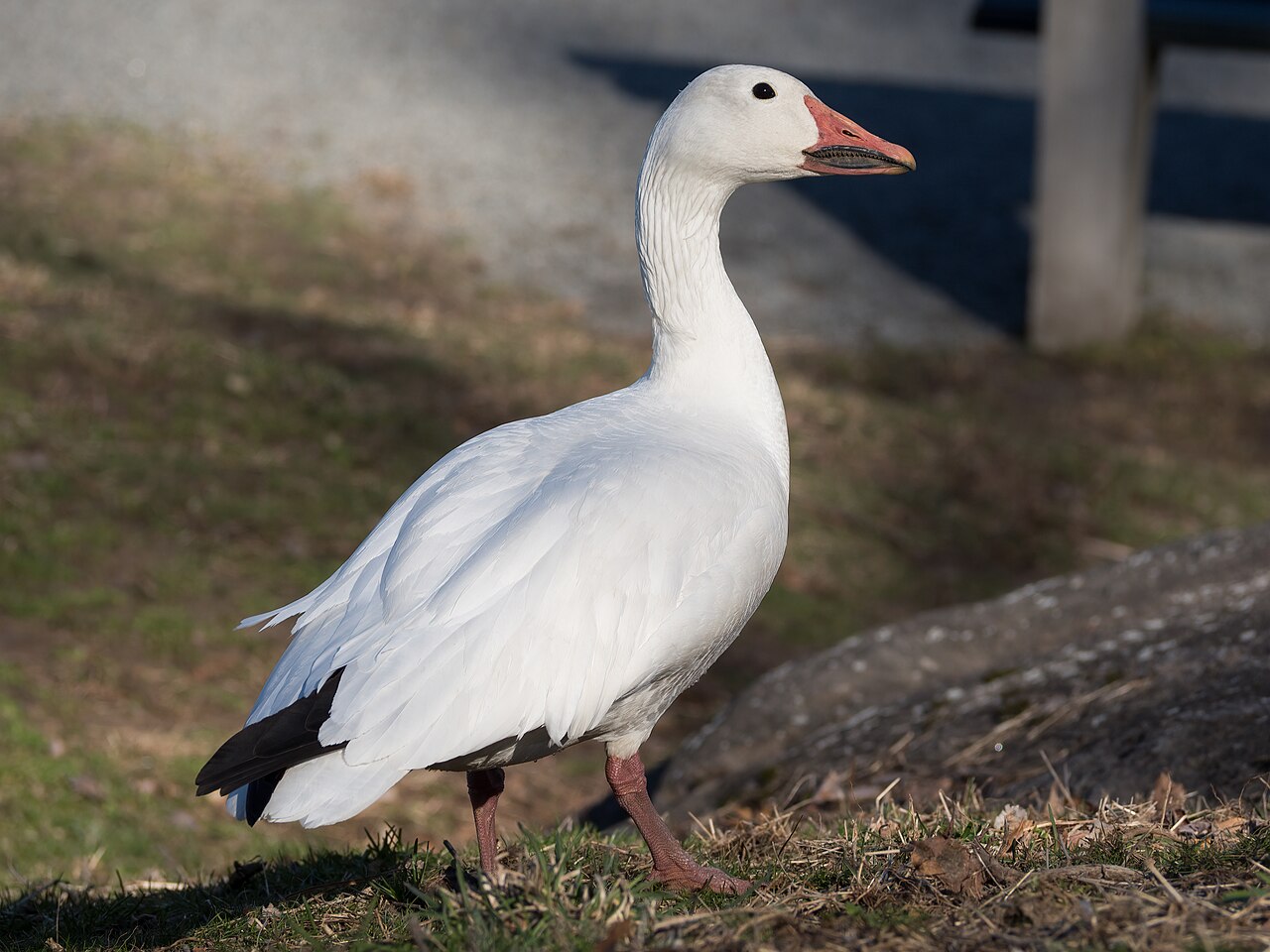
Snow Goose is the most numerous goose in North America, a bird that migrates in such numbers that a rising flock looks like a snowstorm and a landing one turns the ground white. Two colour morphs, one white and one blue-grey, breed side by side in the same colonies and readily pair with one another.
Voice
The call is a high, barking howk-howk or wank-wank, which in a migrating flock of thousands merges into a steady, metallic roar that carries for kilometres. At a roost taking off or coming in to land that sound swells into a deafening chorus. Individual birds call sharper and shorter than the heavier geese, and the blue morph sounds no different from the white.
Recording: Stanislas Wroza — CC BY-NC-SA 4.0 · Isle aux Coudres, Canada · xeno-canto
Identification
The white morph is almost entirely white with black primaries, a pink bill bearing a dark, tooth-like 'grinning patch' along the cutting edge, and pink legs. The blue morph has a white head and a dark greyish-brown body with white underwing coverts, and occurs mainly in the central and eastern populations; the two morphs interbreed freely and produce intermediates. Juveniles are dingy grey, with a dark bill lacking the adult's sharp pink colour. The species has a heavy bill and a thick neck, unlike the slight build of Ross's Goose.
Confusion species
Ross's Goose is the most similar species: smaller, with a short, triangular bill lacking an obvious grinning patch and a rounder head; the two mix constantly and occasionally hybridize. At greater range a flock on the water can be mistaken for white farmyard geese or for the far larger Trumpeter Swan, but the straight neck, black primaries and barking calls set Snow Goose apart from any swan at once.
Habitat
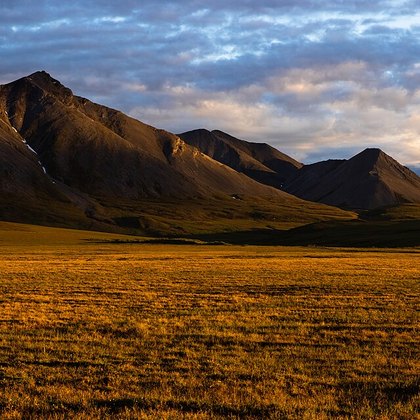
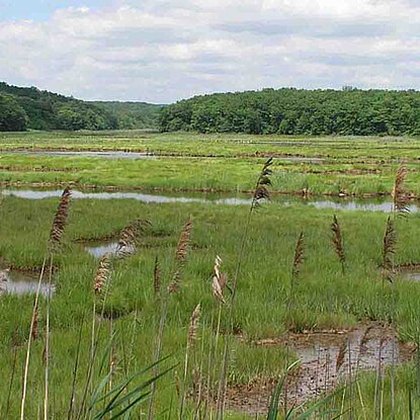
It breeds in dense colonies on flat Arctic coastal tundra, with sedge vegetation and shallow pools within reach of the goslings. On migration and in winter it seeks flooded stubble, wet meadow, freshwater marsh and, closer to the coast, brackish and salt marsh; large flocks graze feeding grounds literally bare before moving on. Winter wheat and rice farming have greatly expanded its wintering range over the past century.
Where the bird is most often found, arranged by the USNVC — the vegetation classification of the United States and Canada — and CMECS for sea and coast.



Range and movements
The western and central populations breed scattered across the whole North American Arctic, from the coast of Alaska to the islands of Nunavut, and winter by way of four flyways in California, along the Gulf Coast of Texas and Louisiana, and inland into Arkansas. A separate, larger subspecies breeds on the eastern Arctic islands — Bylot, northern Baffin and Ellesmere — and migrates by way of the St. Lawrence Valley to the Atlantic coast, wintering from Chesapeake Bay to North Carolina. Numbers have grown explosively since the 1970s thanks to the abundance of farmland along the migration route; at some breeding colonies density is now so high that the tundra itself is being damaged.
- Resident
- Breeding (summer)
- Winter
- Passage
- dark = core range, pale = thinly spread
Where and when to look
Find a large flock at a roost at sunrise: the moment when thousands of birds lift off together, in a cloud that shows white from a distance, is one of the spectacles of North American migration. Bosque del Apache in New Mexico and the rice country of southern Louisiana are among the most reliable sites.
Conservation
Least Concern (LC) — if anything, so abundant that overgrazing on the breeding grounds is a recognised problem: in places such as the west coast of Hudson Bay, oversized flocks have permanently damaged the sedge vegetation. To bring numbers down, the United States and Canada have since the late 1990s allowed an extended spring hunting season, with looser rules than for other geese. Despite that measure, the world population still runs into the millions.
Scientific name
Anser caerulescens | (Linnaeus, 1758)
Linnaeus described the species in 1758 as Anas caerulescens, among the ducks, based on a specimen of the blue morph; because it was later moved to another genus, author and year stand in parentheses. The genus Anser was introduced by Brisson in 1760; anser is Latin for 'goose'. The species name caerulescens means 'bluish' — fitting for the blue morph Linnaeus had before him, but confusing for a species now known chiefly as the white Snow Goose. Only in the twentieth century was it established that this is a single species with two colour morphs, controlled by a single gene. The type locality is Hudson Bay.