All species › Waterfowl › Ducks, swans and geese › Ross's Goose
Ross's Goose | Anser rossii
Ross' gans | Ánsar de Ross
Ross's Goose is the smallest white goose in North America, a scaled-down version of the Snow Goose with a short, triangular bill and a round head. Around 1950 the entire world population still bred on a handful of islets in a single lake in central Arctic Canada; today the species numbers well over a million birds and its breeding range has spread far to the east.
Voice
The call is a soft series of cackling and grunting notes, higher and less hoarse than the bark of a Snow Goose, and in a large mixed flock barely distinguishable unless the bird is close. In flight flocks call steadily, a thin, repeated cackle that rings just a touch higher above the heavier voice of the surrounding Snow Geese. On the breeding grounds the species is quieter, with short grunted contact calls between partners.
Recording: Paul Marvin — CC BY-NC-SA 4.0 · Vendel Road, Salton Sea NWR, Brawley, Imperial County, California, United States · xeno-canto
Identification
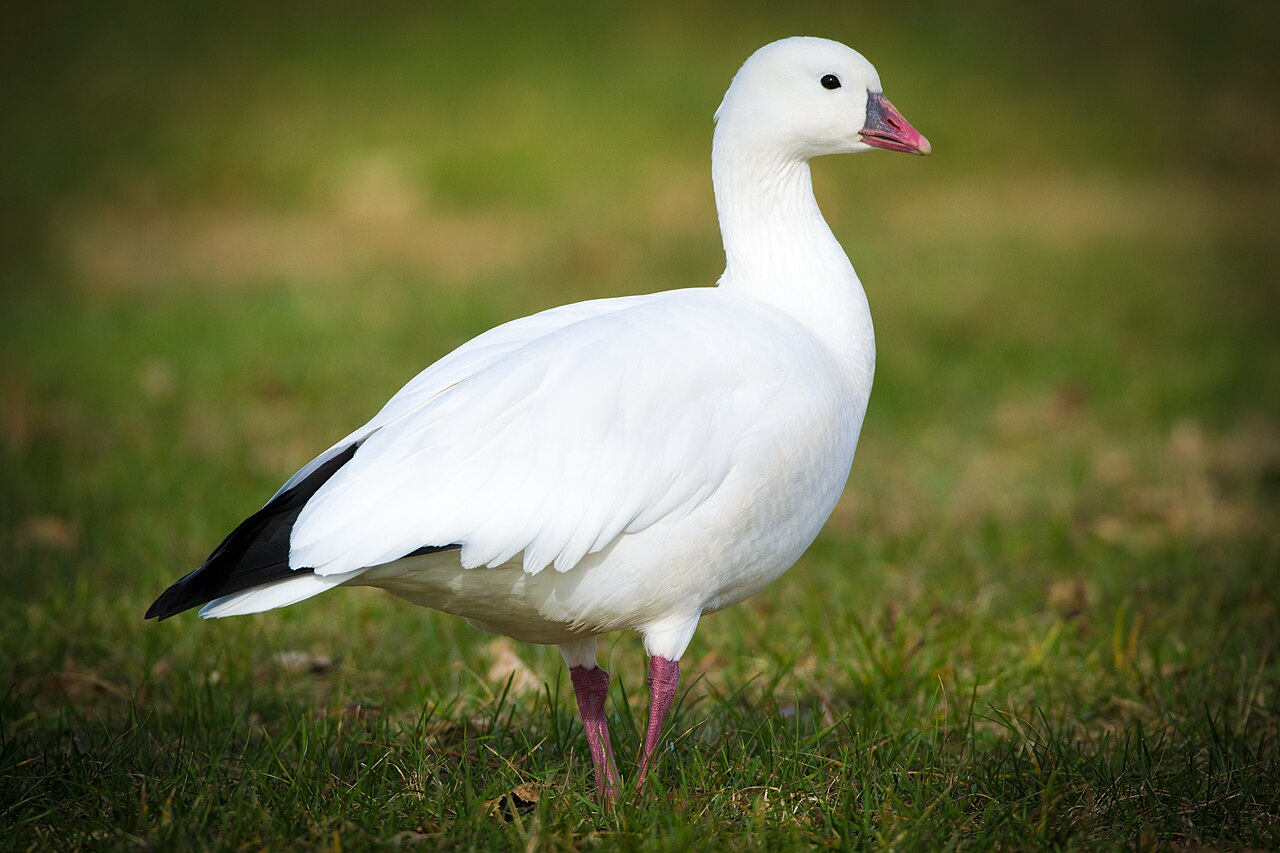
A small, stocky white goose with black primaries, a round head with the eye set close to the base of the bill, and a short, triangular bill lacking the Snow Goose's black 'grinning patch'. Older males develop a bluish-grey warty swelling at the base of the bill. Legs and bill are pink to red. A rare blue morph, dark grey-bodied with a white head, occurs but is far scarcer here than in Snow Goose. Juveniles are dingy grey on head and neck but noticeably whiter than young Snow Geese.
Confusion species
Snow Goose is by far the main confusion risk: larger, with a longer, more gradually sloping bill bearing an obvious black grinning patch along the cutting edge, a longer neck and a flatter forehead. The two species mix almost everywhere and occasionally hybridize, producing intermediates that cannot be named to either species with confidence. Emperor Goose has an entirely different, blue-grey scaled plumage and is never confused with Ross's Goose.
Habitat
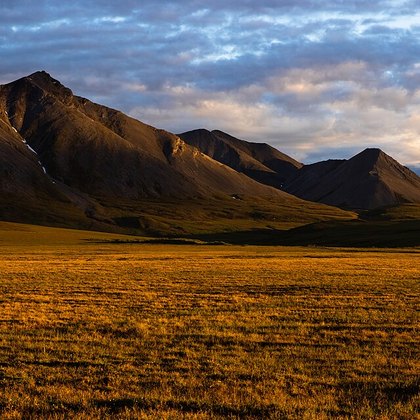
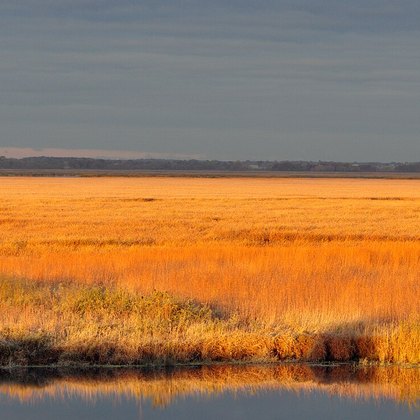
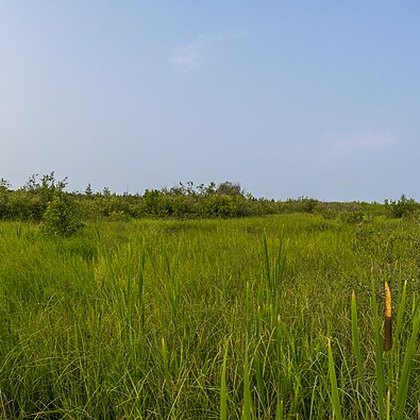
It breeds on flat Arctic tundra with a mix of grassland and low dwarf birch and willow scrub, with a strong preference for islets in shallow tundra lakes, where Arctic foxes have a harder time reaching the nest. On migration and in winter it seeks shallow lakes, freshwater marsh, flooded stubble and cropland, usually in the company of Snow Geese. Salt water plays almost no part in its year.
Where the bird is most often found, arranged by the USNVC — the vegetation classification of the United States and Canada — and CMECS for sea and coast.


Range and movements
It has traditionally bred around Queen Maud Gulf in central Arctic Canada, above all near the Perry River; the breeding range has expanded sharply in recent decades, eastward well past Hudson Bay. On migration the bulk of the population follows a narrow route south through Alberta and Montana. Winter was traditionally spent largely in California's Central Valley; for some decades growing numbers have also wintered in New Mexico and farther east, into Texas, among the far larger flocks of Snow Geese.
- Resident
- Breeding (summer)
- Winter
- Passage
- dark = core range, pale = thinly spread
Where and when to look
Look for it in the middle of a large Snow Goose flock: watch for a slightly smaller, round-headed bird with a short bill and a gentler expression. California's Central Valley and Bosque del Apache in New Mexico are both winter sites where the two species graze side by side and the difference can be learned.
Conservation
By the mid-twentieth century the world population had fallen to a few thousand birds, after decades of hunting a species with a single known breeding colony. Protection of that colony and a hunting ban let numbers recover to well over a million, and the species is now listed as Least Concern (LC), abundant and still increasing. At some breeding grounds, where Ross's Goose and Snow Goose nest together in vast numbers, grazing pressure is now damaging the tundra vegetation itself.
Scientific name
Anser rossii | Cassin, 1861
Cassin described the species in 1861 as Anser Rossii, already in its current genus, so author and year stand without parentheses. The genus Anser was introduced by Brisson in 1760; anser is Latin for 'goose'. For a long time, and in North America until 2017, the species was placed in the separate genus Chen together with Snow Goose; DNA studies later returned both to Anser. The species name honours Bernard Rogan Ross, a Hudson's Bay Company officer at Great Slave Lake, who sent specimens to Cassin in Philadelphia.