All species › Waterfowl › Ducks, swans and geese › Emperor Goose
Emperor Goose | Anser canagicus
Keizergans | Ánsar emperador
The Emperor Goose is the most sea-bound goose in North America: a compact, blue-grey bird with finely scaled plumage, a white head often stained rusty brown, and orange legs. Its whole life plays out within a narrow strip of Bering Sea coast, from the tundra of western Alaska to the rocky shores of the Aleutians.
Voice
The call is a loud, musical kla-ha, kla-ha, kla-ha, lower and fuller than the bark of a Snow Goose and with a ringing, almost shouted edge. A flock on the flats keeps up a constant, cackling murmur that swells, when disturbed, into a chorus of harsh cries. In flight the call is shorter and more urgent, often heard from high overhead before the flock comes into view.
Recording: Jens Kirkeby — CC BY-NC-SA 4.0 · Laguna Kayngypilgyn, Beringovsky, Chukotka Autonomous Okrug, Russian Federation · xeno-canto
Identification
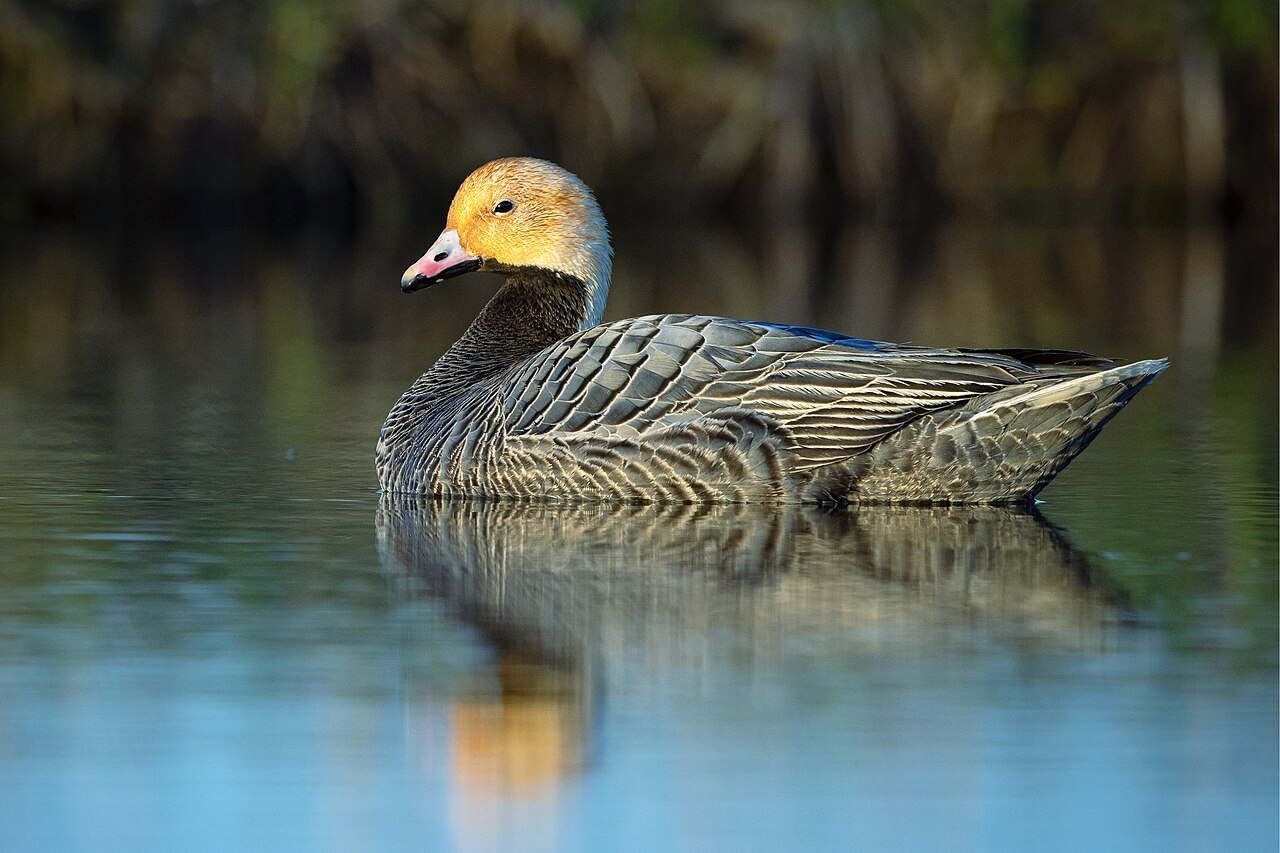
A stocky, short-necked goose with a small pinkish bill; the body is blue-grey, each feather sharply edged black and white, which from a distance gives a scaled pattern. The head and hindcrown are white, often stained rusty brown by iron-rich water and mud, with a black throat and foreneck that stands out like a beard against the white head. The legs are bright orange, brighter than on any other goose in this guide. Juveniles are dull greyish brown with a dark head and lack the adult's sharp head contrast into their first winter.
Confusion species
No other North American goose has plumage this scaled and this blue-grey, which makes confusion with the largely white Snow Goose or Ross's Goose unlikely once the body is seen well. A young Emperor Goose, dull and grey overall and lacking the white head, can at a distance be mistaken for a young blue-morph Snow Goose, but the Emperor's much shorter neck, stocky build and orange legs still settle it.
Habitat
It breeds on low, wet coastal tundra within a few kilometres of the sea, favouring sloughs and channels affected by the tide. Outside the breeding season it is almost entirely marine: rocky shores, mudflats and sheltered bays along the Aleutians, where it plucks mussels, other shellfish and marine algae from the substrate. It makes almost no use of fresh water or cropland, the mainstay of most other wintering geese.
Where the bird is most often found, arranged by the USNVC — the vegetation classification of the United States and Canada — and CMECS for sea and coast.




Range and movements
Breeds along the coast of western Alaska, above all on the Yukon-Kuskokwim Delta, and in smaller numbers on the far side of the Bering Sea in northeastern Siberia. Almost the entire population winters in the Aleutians and on the Alaska Peninsula, where flocks gather on rocky shores and tidal flats. Rare vagrants reach Oregon and California in autumn, but that remains exceptional. It is thus the most sedentary goose on the continent: its breeding and wintering grounds lie less than a thousand kilometres apart.
- Breeding (summer)
- Winter
- Passage
- dark = core range, pale = thinly spread
Where and when to look
Look for it on the rocky shores and tidal flats of the Aleutians and the Alaska Peninsula in winter, where flocks work the kelp line and the waterline for shellfish. The scaled pattern shows best up close on a resting bird in low morning light, when every feather edge catches separately.
Conservation
Numbers fell sharply between the 1950s and 1980s under both sport hunting and traditional spring harvest on the breeding grounds; hunting was closed in the United States in 1986. The population has recovered slowly since, but remains well below its former level and is closely monitored. Oil pollution along the narrow winter coast of the Aleutians remains the chief threat, precisely because almost the entire world population gathers there.
Scientific name
Anser canagicus | (Sevastianov, 1802)
Sevastianov described the species in 1802 as Anas Canagica, among the ducks; because it was later moved to another genus, author and year stand in parentheses. The genus Anser was introduced by Brisson in 1760; anser is Latin for 'goose'. The species name refers to Kanaga, one of the Aleutian Islands, where the type material came from, at a time when Russia held the islands. The English name 'Emperor Goose' refers to the scaled, almost armoured plumage, which suggests a ceremonial robe.