All species › Parrots › African and New World parrots › Green Parakeet
Green Parakeet | Psittacara holochlorus
Groene aratinga | Aratinga Verde
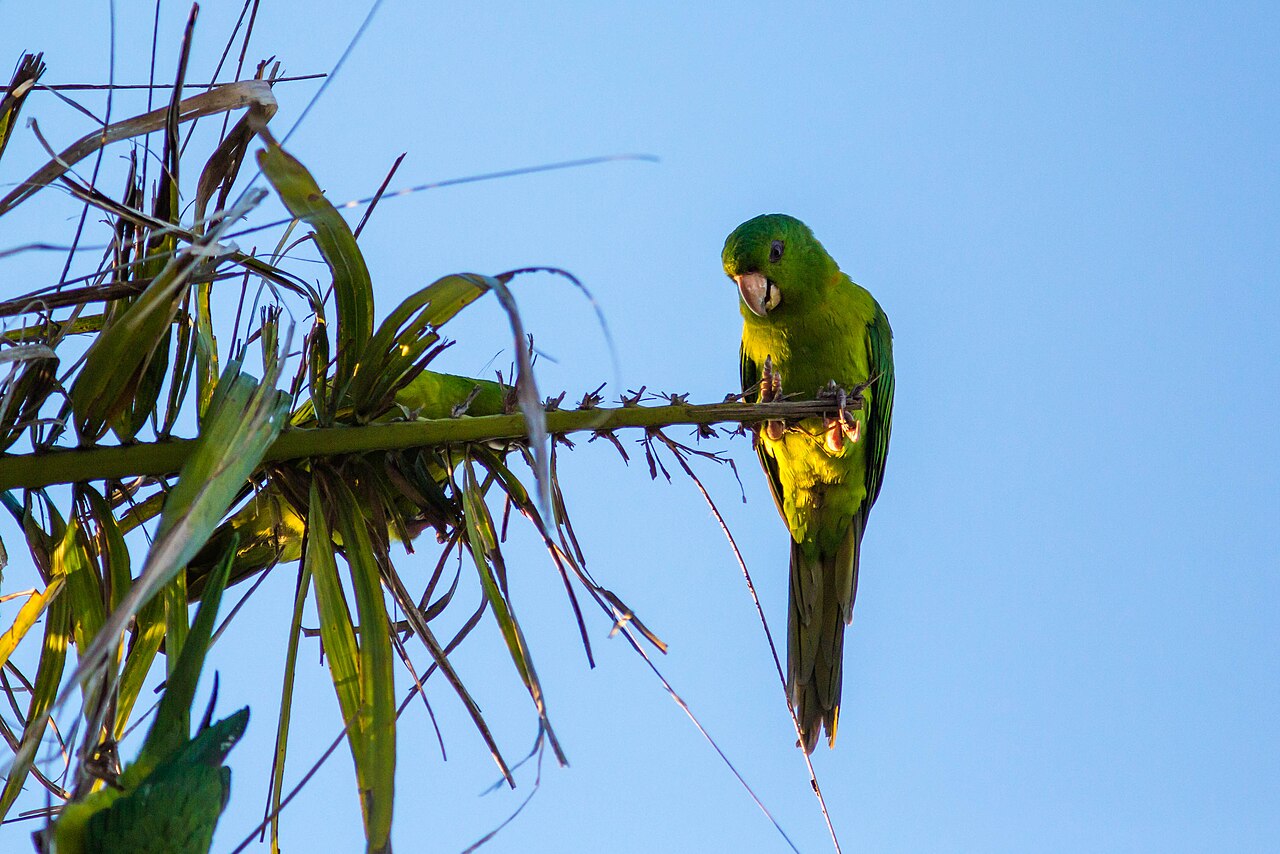
The Green Parakeet is, apart from a variable scatter of red flecks on cheek and throat, entirely green — a parakeet identified precisely by its lack of markings. Native to the lowlands of Mexico, it reaches the southern tip of Texas, where the population there may be partly a natural extension of that Mexican range and partly derived from escaped cage birds.
Voice
Sharp, squeaky notes and loud harsh screeching, with a rolling, high-pitched skreek-skreek in flight. A flock passing overhead can be heard from a distance; foraging in a treetop the chatter becomes softer and shorter.
Recording: Rodolfo Salinas-Villarreal — CC BY-NC-SA 4.0 · San Nicolás de los Garza, San Nicolás de los Garza, Nuevo Leon, Mexico · xeno-canto
Identification
Mostly green, yellower below, with olive-yellow undersides to tail and flight feathers and yellowish-green underwing coverts. Throat and cheeks can carry a variable amount of red flecking, but some birds lack it entirely. The eye is orange-red with pale, beige skin around it, the bill horn-coloured and the legs brownish.
Confusion species
Nanday Parakeet has a black facial mask and a black bill; that combination is entirely absent in Green Parakeet. Mitred and Red-masked Parakeets show far more extensive red on the head, while Green Parakeet shows at most flecks and, in some birds, no red at all. Without red flecking the species can only be told from other all-green Psittacara species by range.
Habitat
Semi-open country with deciduous woodland, riparian gallery forest and scrub, from sea level to about 2,000 metres; humid lowland rainforest is avoided. In this region mainly farmland, orchards and town edges in the Rio Grande Valley of south Texas.
Where the bird is most often found, arranged by the USNVC — the vegetation classification of the United States and Canada — and CMECS for sea and coast.



Range and movements
Its original range lies in the lowlands of Mexico: the nominate form from Nuevo León and Tamaulipas to Veracruz in the east, another subspecies in Sonora, Sinaloa and Chihuahua in the northwest. It is established in the Rio Grande Valley of south Texas; the origin of that group is not settled and may be both a natural extension from the nearby Mexican range and reinforcement by escaped cage birds. It does not migrate: the birds stay in the same area all year.
- Resident
- Breeding (summer)
- Passage
- dark = core range, pale = thinly spread
Where and when to look
Look first for what is missing: no black mask, no extensive red on the head, just green with at most a few flecks on the throat. In the Rio Grande Valley that is enough to tell it from the other naturalised parakeets.
Conservation
The world population is estimated at around two hundred thousand mature birds and is declining, though the species is listed as Least Concern (LC). The population of south Texas has no separate assessment. No agricultural damage has been reported in this region.
Scientific name
Psittacara holochlorus | (Sclater, 1859)
Sclater described the species in 1859; because it was later moved to another genus, author and year stand in parentheses. The genus Psittacara was introduced by Vigors in 1825, a compound of Latin psittacus, 'parrot', and the Tupi word ara, 'macaw'. holochlorus is Greek for 'entirely green', after the almost uniform plumage.