All species › Parrots › Old World parrots › Rose-ringed Parakeet
Rose-ringed Parakeet | Psittacula krameri
Halsbandparkiet | Cotorra de Kramer
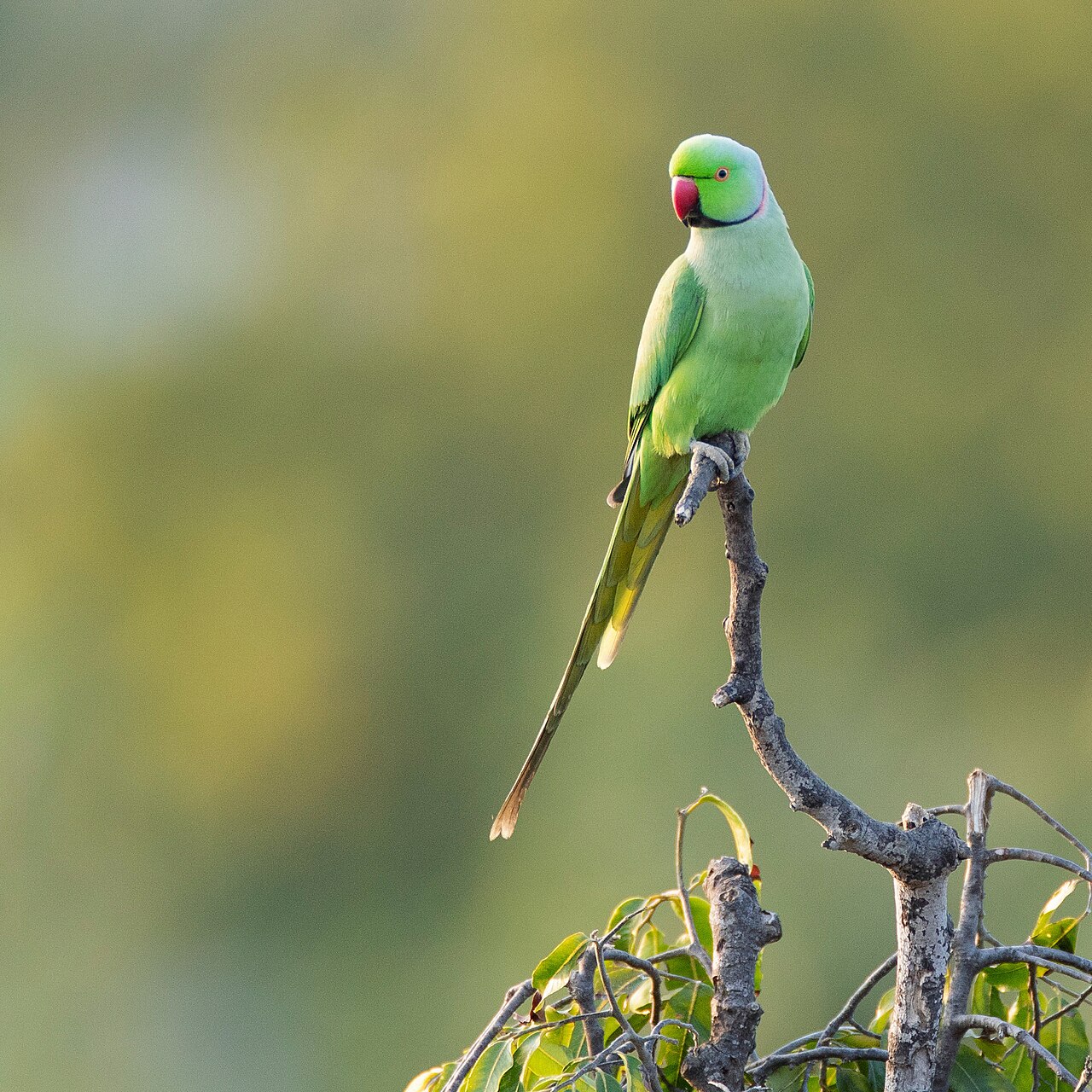
The Rose-ringed Parakeet is grass green, slim and long-tailed, with a deep red bill; the adult male carries a black chin stripe that runs round the neck and turns rose-pink on the nape. It is the most widely established parrot in the world: at home a bird of Africa and southern Asia, elsewhere naturalised as far as London and Tokyo. In this region it holds on in California, in south Florida and on Hawaii.
Voice
A shrill, far-carrying, two-syllable kee-ak kee-ak, repeated without a break in flight and audible over hundreds of metres on a still morning. The tone is higher and clearer than the harsh grating of the Monk Parakeet — a signal rather than a scream. From a perch there is also a soft, rapid chattering, which betrays a flock otherwise invisible in the leaves. The loudest calling comes as birds arrive and as they take off; a flock feeding quietly in a fruiting tree is almost inaudible.
Recording: Sam Hambly — CC BY-NC-SA 4.0 · Newcastle upon Tyne District, Tyne and Wear, England, United Kingdom · xeno-canto
Identification
Grass green, yellower below, with a long graduated tail whose two central feathers are greatly elongated and blue-green; that tail makes up about half the bird. The upper mandible is deep red, the lower blackish — a combination no other free-flying parakeet in this region has. The adult male carries a black chin and throat stripe running round the neck as a narrow band, with a rose-pink border on the nape and a blue-grey wash over the hind crown and neck. Females and young birds lack that pattern; at most they show a faint, slightly darker green shadow collar, and the tail is shorter. Males only gain the ring in their third year, so that outside the breeding season most of a flock looks female-like. The flight is arrow-fast and straight, on quick shallow beats of pointed sickle wings, the long tail trailing like a line behind.
Confusion species
Monk Parakeet, which occupies the same cities, is shorter-tailed, has a grey scalloped breast and a horn-coloured bill. Alexandrine Parakeet (Psittacula eupatria), free-flying in small numbers in south Florida and southern California, looks much the same but is far larger, heavier-billed, and carries a chestnut patch on the shoulder. The South American parakeets of the same neighbourhoods — Mitred, Nanday and their relatives — have a pale horn bill, a shorter tail and red or black on the head. If all you have is a silhouette, watch the proportions: in Rose-ringed Parakeet the tail is longer than head and body together.
Habitat
Cities and suburbs with tall trees, avenues of palms, parks, cemeteries and college campuses; also orchards, maize fields and farmyards in the countryside. On Kauaʻi the birds feed by day in farmland and along woodland edges and spend the night in town, covering the same route twice a day. Flowering and fruiting trees are the pivot — fig, longan, lychee, mango, date palm — and in California the feeders of the suburbs as well. It does not use closed natural forest.
Where the bird is most often found, arranged by the USNVC — the vegetation classification of the United States and Canada — and CMECS for sea and coast.



Range and movements
Its native range covers two separate areas, both outside the guide area: a broad band across Africa south of the Sahara from Senegal to Ethiopia, and the Indian subcontinent from Pakistan to Sri Lanka and Myanmar. The Californian population goes back to a storm on 20 December 1977, when the roof came off a bird dealer's in Bakersfield and two pairs got out; about three thousand birds were counted there in 2012, with smaller groups in Los Angeles and San Diego. In Florida it has flown free since the middle of the last century, with breeding recorded in Citrus, Pinellas, Miami-Dade and Collier counties, but numbers there have stayed low. On Kauaʻi it got out in the 1960s; after a long slow start the population grew fast, to some 12,500 birds by 2021, and there is a population on Oʻahu as well. It does not migrate: the birds stay in the same area all year.
- Resident
Where and when to look
Learn the call first: it is almost always heard before it is seen, and flocks travel high and fast. In the early morning watch the open sky between the trees — against the light the long tail and pointed wings are distinctive, while the green vanishes against foliage. Then look for the trees in flower or in fruit: there it sits for hours, silent and often overlooked.
Conservation
Least Concern (LC) worldwide, and numerous in its native range. The naturalised groups in this region are increasing, fastest on Kauaʻi; damage is reported there to maize, longan, lychee, mango and orange and to the seeds of the native Pritchardia palms, and for some years the state, the farming sector and land managers have been working on counts, trials of management tools and an island-wide plan. In Florida numbers have stayed low since the first settlement; the subspecies living there comes from a region closer to the equator, which may limit breeding success. In California the species stays almost entirely within built-up areas.
Scientific name
Psittacula krameri | (Scopoli, 1769)
Scopoli described the species in 1769 as Psittacus krameri, from a bird in the collection of Count Turriani; because it was later moved to another genus, author and year stand in parentheses. The genus Psittacula was introduced by Cuvier in 1800 and is the diminutive of Latin psittacus, 'parrot' — so something like 'little parrot'. The epithet almost certainly honours Wilhelm Heinrich Kramer, a German physician and naturalist in Austria who had died four years before the description. The original description carried no locality; this was later fixed on Senegal.