All species › Parrots › Old World parrots › Rosy-faced Lovebird
Rosy-faced Lovebird | Agapornis roseicollis
Perzikkopagapornis | Inseparable de Namibia
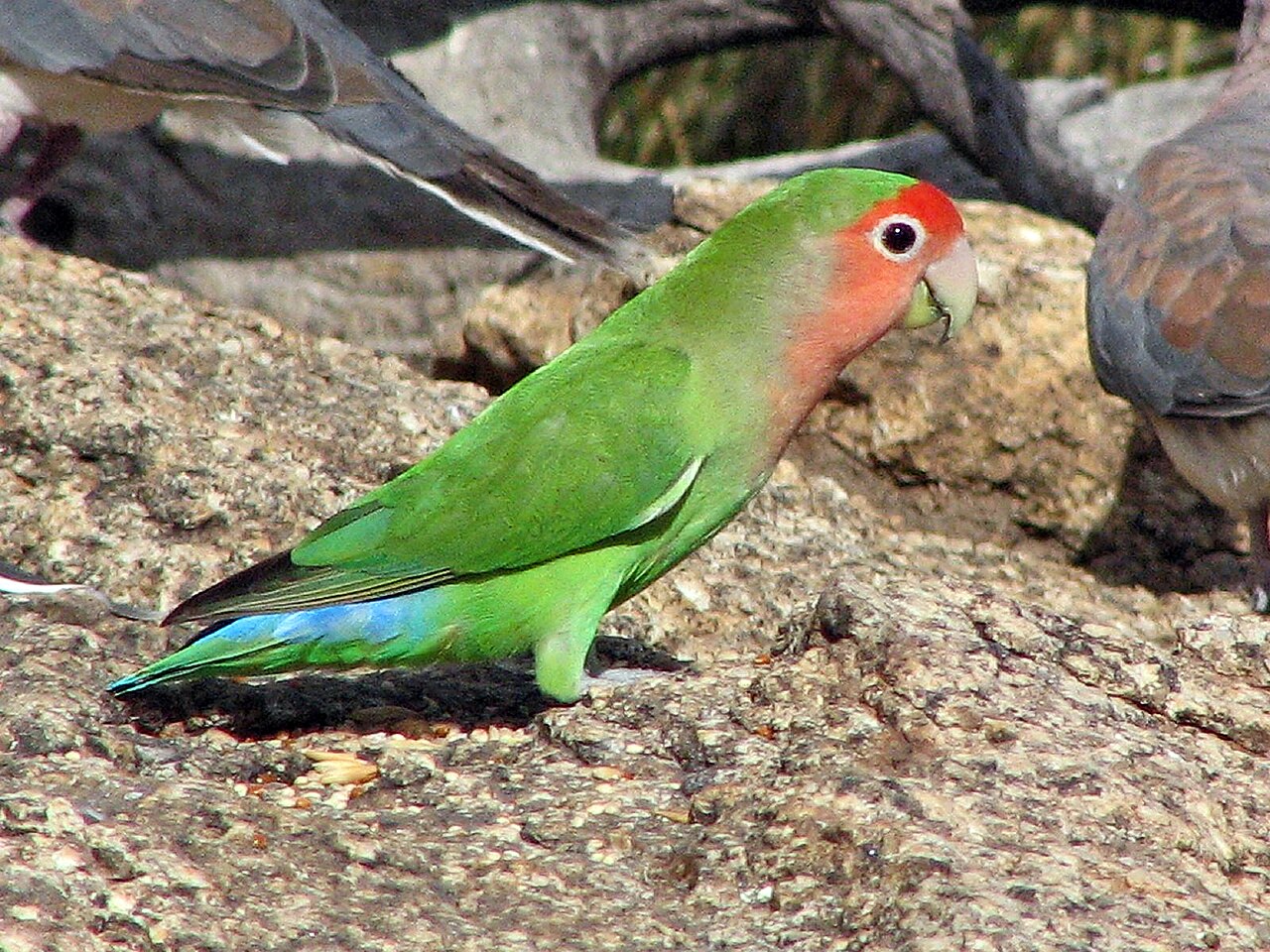
The Rosy-faced Lovebird is a small, stocky parrot with a green body and a pink face and throat, deepest in colour on the forehead. Native to the dry, open southwest of Africa, it is naturalised as a cage-bird escape in the suburbs of Phoenix, Arizona, where the population holds on around artificial water sources and wall cavities used as nest sites.
Voice
A loud, penetrating and almost constant chirping, kept up all day, both perched and in flight. Two birds side by side keep up a soft, rapid chatter; only at a disturbance does a short, shrill alarm call follow.
Recording: African Bioacoustics Community — CC BY-NC-SA 4.0 · City of Cape Town (near Cape Town), City of Cape Town Metropolitan Municipality, Western Cape, South Africa · xeno-canto
Identification
Mostly green with a blue rump, and a pink face and throat deepest in colour on the forehead and above the eye. The bill is horn-coloured, the eye brown and the legs grey. Male and female are almost identically coloured and cannot be told apart in the field. Young birds have a paler pink face and throat, a greenish crown and a bill with a brownish base.
Confusion species
No other naturalised parrot in this region is this small and stocky with a pink face; the larger parakeets and amazons lack that colour entirely and are clearly longer-tailed or heavier-built. Confusion is most likely with an escaped cage bird of another Agapornis species, which has no naturalised population in this region; check the blue rump, always present in Rosy-faced Lovebird.
Habitat
Dry open woodland, semi-desert and mountainous country up to 1,600 metres in its native range, always near water. In this region mainly Phoenix suburbs with palms and saguaro cacti (the giant columnar cactus of the Sonoran Desert) for nesting and drinking sites at pools and gardens.
Where the bird is most often found, arranged by the USNVC — the vegetation classification of the United States and Canada — and CMECS for sea and coast.


Range and movements
Its original range lies in the dry southwest of Africa, from southern Angola across almost all of Namibia to the lower Orange River valley in northwestern South Africa; that falls outside this map. In North America it has been naturalised since the 1980s in and around Phoenix, Arizona, from escaped and released cage birds; smaller groups live on Maui and the island of Hawaii. It does not migrate: the birds stay in the same neighbourhood all year.
- Resident
- Winter
- Passage
- dark = core range, pale = thinly spread
Where and when to look
In Phoenix, look for nest cavities in wall gaps, roof tiles and saguaro cacti, especially in older, leafy suburbs; the birds are heard before they are seen, through their constant chirping. At a garden pool or feeder they usually arrive in small groups together.
Conservation
The species is listed as Least Concern (LC) worldwide; artificial water sources and buildings used for nesting have, if anything, increased numbers in its native range despite past trapping for the cage-bird trade. The naturalised population near Phoenix is small and stable, with no reported agricultural damage.
Scientific name
Agapornis roseicollis | (Vieillot, 1818)
Vieillot described the species in 1818 as Psittacus roseicollis; because it was later moved to another genus, author and year stand in parentheses. The genus Agapornis was introduced by Selby in 1836, from Greek agape, 'love', and ornis, 'bird' — the source of the group's common name, lovebird, after the strong bond between a pair. roseicollis is Latin for 'rosy-necked', after the colour of the face and throat. Vieillot gave the type locality as 'the interior of the Cape of Good Hope'.