All species › Passerines › Monarchs and allies › Hawaiʻi ʻElepaio
Hawaiʻi ʻElepaio | Chasiempis sandwichensis
Hawaiʻi-ʻelepaio | ʻElepaio de Hawái
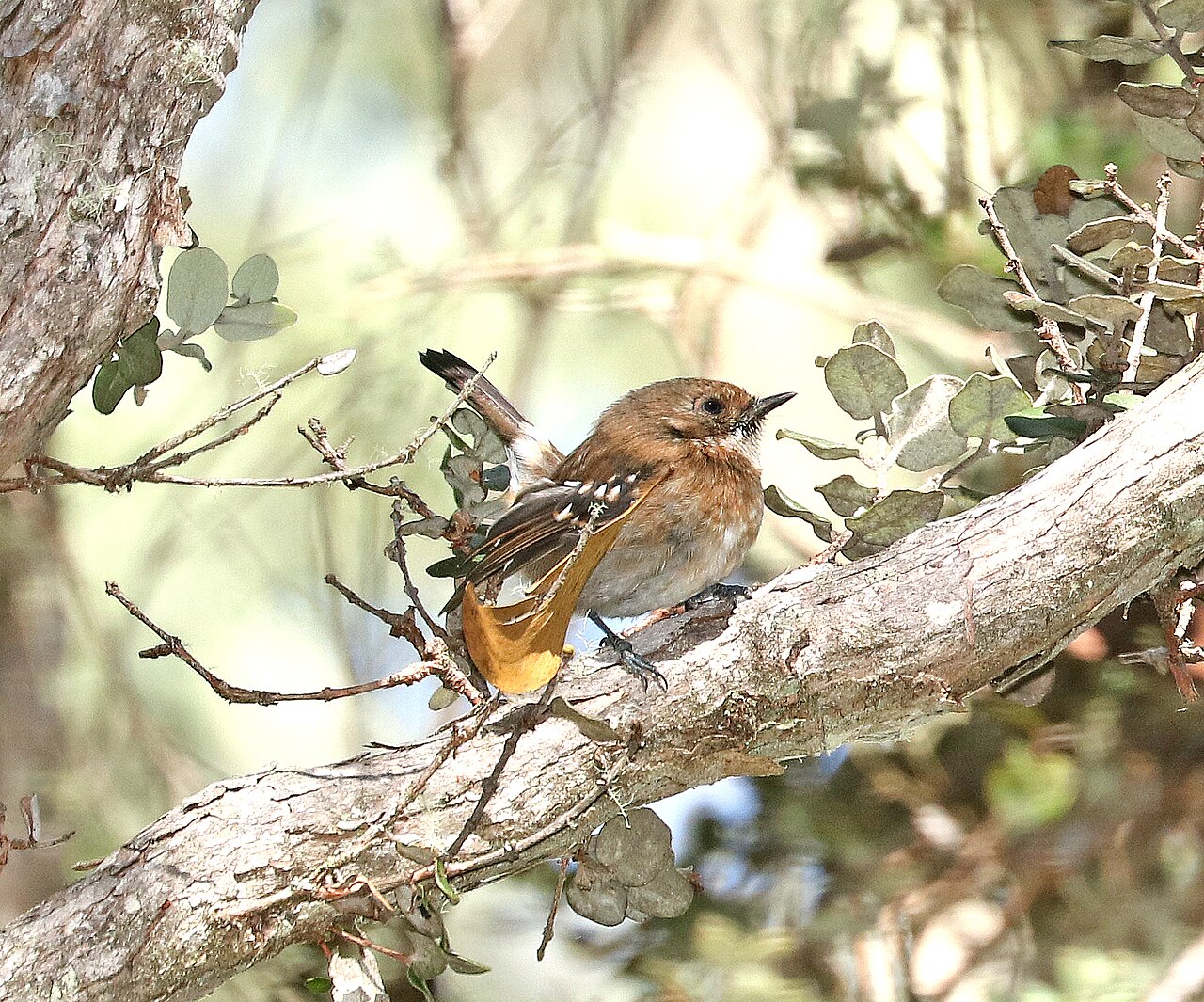
The Hawaiʻi ʻElepaio is a small, restless forest bird with a long tail often held at an angle above the back, and it occurs on the island of Hawaii and nowhere else. It is one of the few native forest birds of that island that also hold on in planted, non-native woodland and in lower, disturbed country — and so often the first a visitor meets.
Voice
The sound that names it is a clear, far-carrying four-syllable whistle with the stress towards the end. There is also a sharp cheep, repeated in quick succession when the bird is agitated, and a dry rattle used to scold an intruder. Song and calls differ from district to district: birds of the wet forest around the volcanoes sound unlike those of the dry western flank, and the differences are consistent enough to hear in the field. Something is heard all year, most of it in the breeding season from January to June, and a soft squeaking noise made by a person is answered almost every time.
Recording: Daniel Lane — CC BY-NC-SA 3.0 · Manuka State Park, Kona coast, Hawai'i (Big , United States · xeno-canto
Identification
Brown above and white below with light streaking, and three marks that stay the same on every bird: a white rump, two white wingbars and white tips to the tail feathers. The throat is mostly black on the male and white on the female. Beyond that the plumage is variable: birds from cool, dry forest are paler and greyer, with an almost white head, while those from warm, humid forest are dark to rufous-brown. Juveniles are grey-brown above and whitish below, with rusty wingbars and a rusty rump. The tail is long and often carried cocked at an angle or straight up, which gives the silhouette away at once.
Confusion species
The two other elepaios, Chasiempis sclateri of Kauaʻi and C. ibidis of Oʻahu, each keep to their own island: anyone who knows where they are standing cannot confuse them. On Hawaii itself the commonest mistake is the Japanese Bush Warbler — as brown, but without white in wing, rump or tail, singing loudly from dense cover and hardly ever in the open. The Hawaiʻi ʻAmakihi (Chlorodrepanis virens) is yellow-green with a short curved bill and usually keeps to flowering crowns, while the ʻelepaio works the middle storey. A young ʻelepaio lacks sharp markings; then look for the cocked tail and the rusty wingbars.
Habitat
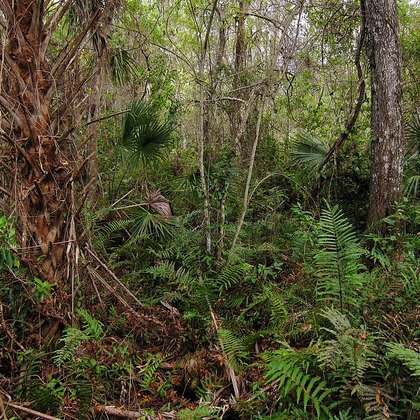
Native montane forest of ʻohiʻa lehua and koa (Acacia koa, a native Hawaiian tree), above all over 1,100 metres, where it is most numerous. Unlike most native forest birds it also stays lower and in drier woodland: the mamane-naio forest on the high slopes of Mauna Kea, half-open growth, and even planted stands of non-native trees and overgrown edges, as long as there is a dense shrub layer and dead wood. It finds its food in the middle storey of the forest: beetles, flies, caterpillars, lacewings and spiders taken from leaves, bark and dead twigs. Treeless ground and young, bare lava it does not use.
Where the bird is most often found, arranged by the USNVC — the vegetation classification of the United States and Canada — and CMECS for sea and coast.

Range and movements
On the island of Hawaii only; on Kauaʻi and Oʻahu it is replaced by the two other elepaios, and on the remaining islands there is none. On the island itself three forms can be told apart: the one of the wet forest around the volcanoes is by far the most numerous, with well over a hundred thousand birds; the one of the drier Kona side numbers some tens of thousands; and the one of the mamane-naio forest on Mauna Kea only two to two and a half thousand. It once occurred all over the island, down into the lowlands, but those lowland forests have been turned into pasture, plantation and town. It does not migrate and barely wanders: where it is, it is all year.
- Resident
Where and when to look
One site is Hawaii Volcanoes National Park: the forest trails at Kilauea and along the Mauna Loa Road, early in the morning. Do not look up into the flowering crowns — that is where the nectar birds are — but at the middle storey and along dead wood, and watch for movement, because the bird rarely sits still for long. A soft squeaking noise works better than patience: it answers almost every time, and the cocked tail then settles the matter.
Conservation
Near Threatened (NT) on the Red List, with an estimated 140,000 mature birds: a common bird in most places, but all of them on one island. The form of the wet forest is comfortable; the Mauna Kea form, with two to two and a half thousand birds in a badly thinned dry forest, is the worry. The black rat is the chief direct threat: it takes incubating females off the nest, and where rats are trapped out nesting success rises measurably. Unlike most honeycreepers the ʻelepaio also holds on below the mosquito line, but the loss of native forest and the damage done by feral cattle and pigs keep eating at its numbers.
Scientific name
Chasiempis sandwichensis | (Gmelin, 1789)
Gmelin described the species in 1789 as Muscicapa sandwichensis, among the Old World flycatchers; because it was later given a genus of its own, author and year stand in parentheses. The genus Chasiempis was introduced by Cabanis in 1847, from Greek khaskō, 'to gape', and empis, 'gnat': the gaping gnat-catcher. sandwichensis refers to the Sandwich Islands, the name Cook gave the archipelago. Only 'Sandwich Islands' is given as the type locality; Henshaw suggested Kealakekua Bay on Hawaii as the likely spot in 1902. In Hawaiian the bird is the ʻelepaio, and Dutch, English and Spanish all take that name over unchanged.