All species › Passerines › Monarchs and allies › Kauaʻi ʻElepaio
Kauaʻi ʻElepaio | Chasiempis sclateri
Kauaʻi-ʻelepaio | ʻElepaio de Kauaʻi
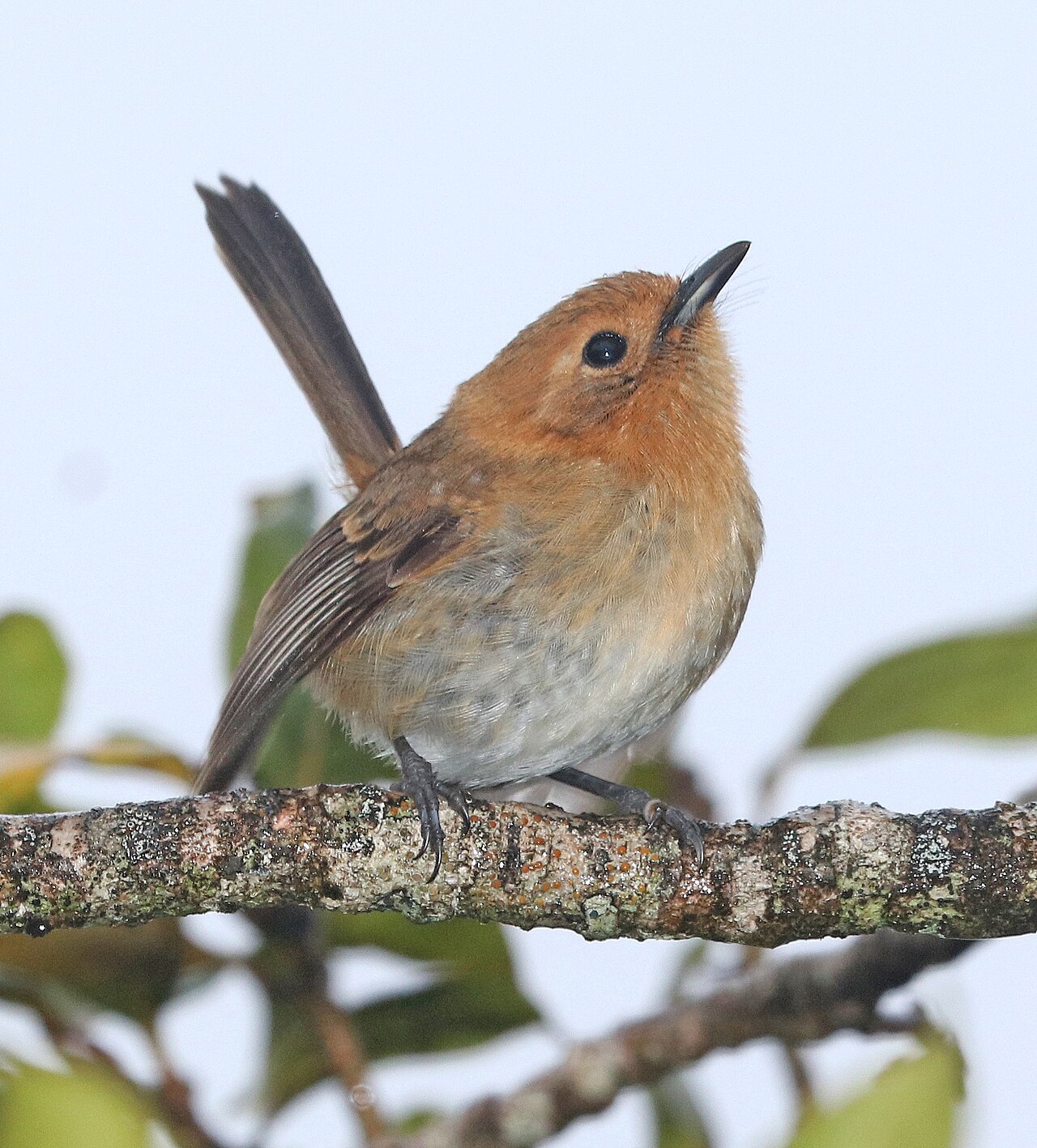
The Kauaʻi ʻElepaio is a monarch flycatcher found on the island of Kauaʻi and nowhere else in the world. It is grey above with a white supercilium, a rusty breast and a white belly, and often carries the tail cocked. It has been treated as a separate species since 2010; before that it counted as a subspecies of the Hawaiʻi ʻElepaio.
Voice
The call is a loud, clear whistle sounding like e-le-PAI-o, from which the Hawaiian name is taken. Besides this there is a rasping, grating note used in territorial disputes, and a series of short sharp notes when alarmed. The bird is vocal through the year and is generally the first native songbird to start in the morning and the last to stop at night. The call carries far through the forest and is usually the first sign that the bird is there.
Recording: Daniel Lane — CC BY-NC-SA 3.0 · Alaka'i Swamp trail, Kaua'i, Hawaii, United States · xeno-canto
Identification
Adults are dark grey to grey-brown on crown and back, with a white supercilium, a rusty wash across the upper breast and white underparts. The wings carry two pale bars and the tail has a white tip, which shows most when the bird raises it. Juveniles differ strongly: they are largely rusty above and white below, with rusty rather than white wing markings. Behaviour is active and restless: the bird forages at all heights, hangs from branches and takes insects in short sallies.
Confusion species
On Kauaʻi no native bird resembles the Kauaʻi ʻElepaio; the other two ʻelepaio species live on Oʻahu and on Hawaii and do not occur here. The introduced Japanese Bush Warbler is about the same size and lives in the same forests, but is plain olive-brown with no supercilium, no rust and no white tail tip, and has an entirely different song of a long held whistle followed by a rapid trill. A juvenile ʻelepaio, largely rusty, is taken for another species more often than an adult is.
Habitat
Native mesic and wet forest of ohia and koa (Acacia koa, a native Hawaiian tree), mainly above 600 metres and commonest above 1100 metres on the Alakai Plateau. Younger growth and forest edge are used as well, as long as the vegetation has several layers. The original range probably covered all wooded parts of the island, from the coast to the summit; the present distribution lies almost entirely in the uplands.
Where the bird is most often found, arranged by the USNVC — the vegetation classification of the United States and Canada — and CMECS for sea and coast.



Range and movements
The entire world range lies on one island: Kauaʻi, about 1430 square kilometres in area with a high point of 1598 metres. The core is the Alakai Wilderness Preserve and the adjoining forests at Kokee and Waimea Canyon. The species does not migrate and does not leave the island, so the seasonal map holds only one meaningful unit: the state of Hawaii. Within that unit the bird occupies a small part of one island, not the archipelago as a whole.
- Resident
Where and when to look
The forest trails at Kokee State Park and the edge of the Alakai Plateau give the best chance, throughout the year. Follow the clear e-le-PAI-o call and stand still; the bird will often approach a motionless observer to within a few metres of its own accord. Bear in mind that a rusty bird with a white belly is a juvenile of the same species.
Conservation
The Red List places the species in the Near Threatened (NT) category; at state level in Hawaii it is treated as imperilled. Numbers were estimated at about 40,000 birds around 1970 and halved during the 1990s; density on the Alakai Plateau has since risen again by some 13 per cent. The pressures are loss and degradation of native forest, predation by introduced rats, cats and owls, and disease. Avian pox lowers both nesting success and adult survival. Avian malaria, carried by the introduced southern house mosquito, has moved further into the uplands with a warming climate; because Kauaʻi reaches only 1598 metres, no mosquito-free high ground remains for much of the year to serve as a refuge. For other Kauaʻi forest birds that is the demonstrated cause of steep decline; for the ʻelepaio itself the effect of malaria has not been measured separately. Since 2024 a mosquito suppression trial using incompatible males has been run on the island.
Scientific name
Chasiempis sclateri | Ridgway, 1882
Robert Ridgway described the species in 1882 from a specimen from Waimea on Kauaʻi; author and year stand without parentheses, since the bird is still in the genus Chasiempis. That name comes from Greek khaskō 'to gape', after the wide bill, and empis 'gnat'. The species name sclateri honours the British zoologist Philip Lutley Sclater. The Hawaiian name ʻelepaio renders the call; canoe builders followed the bird to koa trees and regarded it as a form of their patron goddess Lea. If it pecked at a felled log the wood held insect damage; if it left the log alone the wood was sound.