All species › Passerines › Monarchs and allies › Oʻahu ʻElepaio
Oʻahu ʻElepaio | Chasiempis ibidis
Oʻahu-ʻelepaio | ʻElepaio de Oʻahu
The Oʻahu ʻElepaio is a small monarch flycatcher found on the island of Oʻahu and nowhere else. It is one of the last native songbirds of Oʻahu, with a fragmented range of some 47 square kilometres in two mountain ranges. The species is listed as endangered both federally and by the state of Hawaii.
Voice
The name renders the song: a loud, rolling e-le-PAI-o or ele-PAI-o, repeated from the middle of the canopy. Alongside it come short chip notes, a rattling chatter that is the commonest sound of all, and a sharp alarm call. Females sing as well, though less than males. Song differs between islands: in playback trials ʻelepaio barely respond to the song of birds from another island. The species is the first native bird to sing in the morning and the last to stop at night.
Recording: Dan Lane — CC BY-NC-SA 4.0 · Aiea RIdge Oahu Hawaii, United States · xeno-canto
Identification
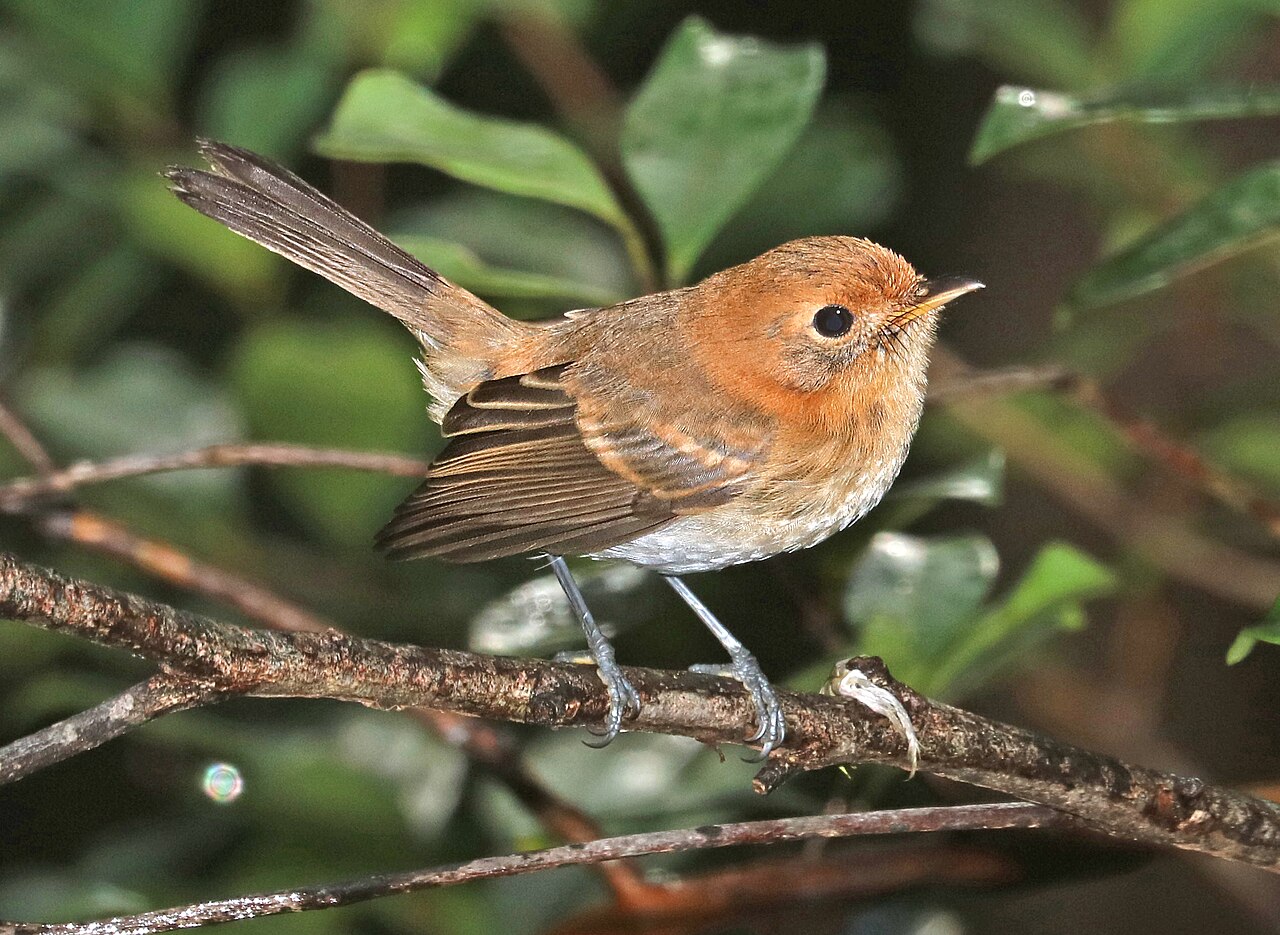
A bird of about fourteen centimetres with a short, blunt black bill and a long tail often carried cocked. The upperparts are dark brown, washed rufous on the head; the underparts are white, with light brown streaking on the breast and white extending onto the flanks. Two white wingbars and white tail tips are the clearest marks at a distance. The chin is black or blue-black, with more black on males than on females. Juveniles are largely reddish brown, with buffy rather than white wingbars.
Confusion species
No other native bird on Oʻahu shows this pattern, so confusion lies mainly with the other two ʻelepaio, and those occur on other islands: the Kauaʻi ʻElepaio (Chasiempis sclateri) and the Hawaiʻi ʻElepaio (Chasiempis sandwichensis). All three were treated as one species until 2010; the split rests on differences in genetics, plumage and song. The Oʻahu bird has more rufous on the head and more white on breast and flanks than the Hawaii bird. Introduced songbirds on Oʻahu, such as Warbling White-eye, are smaller and lack both the white wingbars and the cocked tail.
Habitat
Wet to mesic native forest in valleys, with a closed canopy and a dense understorey; valley floors with tall riparian vegetation hold the highest densities. Native trees such as papala kepau and lama are typical, but the bird also forages in introduced growth of strawberry guava and mango. Very wet forest, windswept ridge crests and dry scrub are avoided. In the Koolau Range it occurs roughly between 100 and 550 metres, in the Waianae Range between 500 and 850 metres.
Where the bird is most often found, arranged by the USNVC — the vegetation classification of the United States and Canada — and CMECS for sea and coast.



Range and movements
The entire range now covers about 47 square kilometres, divided between the Koolau and Waianae ranges. Movement between the two ranges hardly occurs, and within each range the bird sits in a series of separated subpopulations. On the windward side of the Koolau Range about thirty birds remain. The species does not migrate; pairs hold their territory year-round and young birds stay with their parents for up to ten months.
- Resident
Where and when to look
The most accessible sites lie in the valleys behind Honolulu, such as the forest above Manoa, and on the ridges of the Waianae Range. Look between January and July, when singing is at its peak, in the early morning. Go by song rather than by sight: the bird often stays in the dense understorey, but it approaches a whistled imitation or playback of song from its own island.
Conservation
The IUCN has listed the species as Vulnerable (VU) since 2023; in the United States it has been listed as endangered since 2000, with designated critical habitat. The fragmented population is put at 1200 to 1400 birds and is declining. Predation by black rats on nests, eggs and incubating females is the heaviest pressure; nest height has risen over time, which is read as a response to that predation. Avian pox and avian malaria occur, although part of the range lies above the densest mosquito zones. Wildfire, some of it started during military exercises, and the vulnerability of small subpopulations add to this. Rat control on trial plots produced clear increases in nest success and in adult female survival.
Scientific name
Chasiempis ibidis | Stejneger, 1887
Leonhard Stejneger described the species in 1887. The genus Chasiempis comes from Greek khaskein 'to gape' and empis 'gnat', after its manner of catching prey. The species name ibidis almost certainly refers to the journal The Ibis, not to the ibises. The specimen described was a juvenile with no recorded locality; Rothschild assigned it to the Hawaiian Islands in 1893. The Hawaiian name ʻelepaio renders the song. Canoe builders watched this bird: if it pecked at a felled trunk, the wood held boring insects and the trunk was of no use — hence the saying Ua ʻelepaio ia ka waa, 'the canoe has been marked by the ʻelepaio'.