All species › Passerines › Shrikes › Loggerhead Shrike
Loggerhead Shrike | Lanius ludovicianus
Amerikaanse klapekster | Verdugo americano
The Loggerhead Shrike is a songbird that lives like a raptor: it sits on a wire above short grassland, drops onto a grasshopper or a mouse, and then hangs its catch on a thorn or a barb of wire. It is the only shrike confined to North America, and in half a century about three quarters of its numbers have gone.

Voice
The song is a slow string of short, rough motifs — a hoarse choo-weet choo-weet, then a grating cree-cree — each repeated two or three times with seconds of silence in between. It sounds like a mockingbird doing the job slowly and unwillingly. The call is a hard, dry shek, and in excitement a drawn-out rattling krrrr. Both sexes sing; most of it comes in the early morning from February to May, always from the highest wire or the top of a bush and never from cover.
Recording: Manuel Grosselet — CC BY-NC-SA 4.0 · San Juan Guelavía, San Juan Guelavía, Oaxaca, Mexico · xeno-canto
Identification
Grey above, white below, with a broad black mask running from the base of the bill through the eye to behind the ear coverts and continuing across above the bill. The wings are black with a white patch that shows as a short white flash in flight; the black tail has white corners. The bill is short, heavy and hooked at the tip, obvious even in silhouette. Male and female look alike; juveniles are grey-brown with fine vermiculated barring and a duller mask. On a wire the bird sits upright and compact, big-headed, with a long tail that it swings sideways now and then.
Confusion species
The Northern Shrike (Lanius borealis) is the hard one: larger, paler grey, with a narrower mask that does not enclose the base of the bill and a longer, more strongly hooked bill; young birds carry fine vermiculations on the breast. It appears in winter and in the north, precisely where the Loggerhead Shrike has largely gone. The Northern Mockingbird uses the same wires but is slimmer and longer-tailed, lacks the mask, has a thin bill and shows far larger white wing patches in flight. At a distance posture helps: the shrike sits compact and dead still, the mockingbird moves and fans its tail.
Habitat
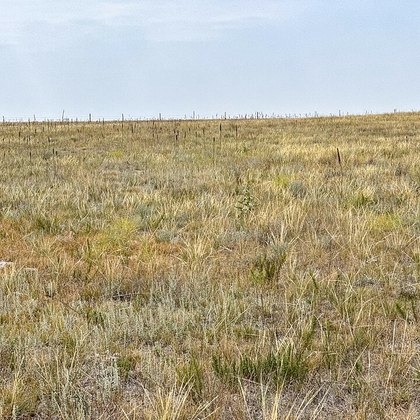
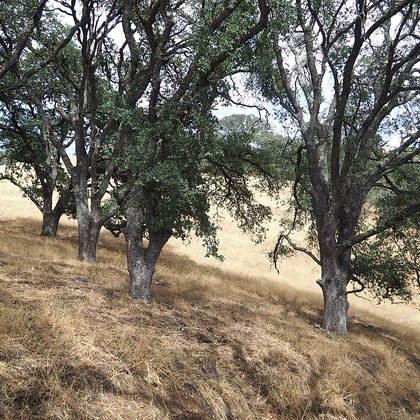
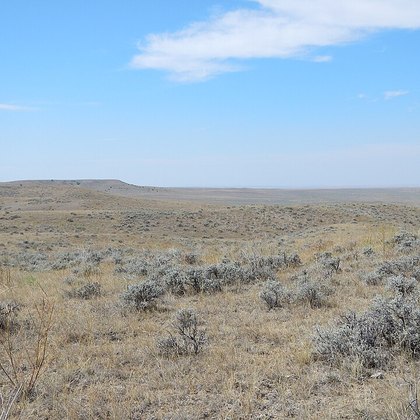
Open, short country with lookout perches and thorny bushes: grazed grassland, prairie with yucca and mesquite (a thorny pod-bearing shrub of the Southwest that forms dense thickets), orchards and field margins, road verges with fencing, and in the southwest desert scrub. It needs three things at once — a clear perch, short or bare ground on which prey can be seen, and something sharp nearby. Tall grass and closed-over scrub make a site useless to it, however many insects there may be. In the southwest it goes into true desert, as long as there are bushes.
Where the bird is most often found, arranged by the USNVC — the vegetation classification of the United States and Canada — and CMECS for sea and coast.


Range and movements
From the southern Canadian prairies to southern Mexico. In the southern and western United States and on the Mexican plateau it is resident; in the northern prairies and the interior northwest it is a summer bird that moves south in autumn. The east is a story of disappearance: in the northeastern United States and eastern Canada it hardly breeds at all any more, and the last few dozen pairs in Ontario are kept going by captive breeding and release. On the Californian island of San Clemente a form of its own survives that had fallen to a few dozen birds and has recovered under an intensive conservation programme.
- Resident
- Breeding (summer)
- Winter
- Passage
- dark = core range, pale = thinly spread
Where and when to look
In winter drive slowly along country roads beside grazed grassland with barbed-wire fences and watch for a compact grey and white bird sitting alone on a wire or a post: it drops away at an angle and then sweeps low to the next perch. An impaled grasshopper, lizard or mouse on a barb or a thorn says the ground is occupied, even when the bird itself is out of sight. Come back to the same spots in spring: pairs hold the same stretch of road for years on end.
Conservation
Near Threatened (NT) on the Red List. Partners in Flight puts the population at about seven million birds, but the Breeding Bird Survey shows a decline of some 2.6 per cent a year between 1966 and 2019, around 75 per cent in all, and far more than that in the northeast. The causes run together: the loss of hayfields, hedgerows and grazed grassland, insecticides that remove the large insects it lives on, and collisions, because the road verges where it hunts are also where it is struck. In Canada the eastern form falls under the strictest protection category.
Scientific name
Lanius ludovicianus | Linnaeus, 1766
Linnaeus described the species in 1766 as Lanius ludovicianus, and because it still stands in that genus, author and year go without parentheses. The genus Lanius he introduced himself in 1758; it is the Latin word for 'butcher'. ludovicianus means 'of Louisiana', after Louisiane, the French territory named for King Louis XIV, and Louisiana is accordingly the type locality. The Dutch name places it beside the Great Grey Shrike (klapekster) of the Old World; the English name Loggerhead Shrike refers to the bird's large head.