All species › Passerines › Shrikes › Northern Shrike
Northern Shrike | Lanius borealis
Noordelijke klapekster | Alcaudón boreal
The Northern Shrike breeds along the edge of the taiga and shows itself south of it only in winter, on the highest wire above a snowy field. It is a songbird with a hooked bill that kills mice and small birds and impales them on a thorn or a barb of wire even when it is not hungry — such a larder often gives it away before the bird itself does.
Voice
On the breeding grounds the male sings from a treetop a long, slow string of harsh and clear motifs, each repeated two or three times with long silences between them, and with imitations of other birds worked in. In winter quarters it sings quietly, almost under its breath, above all on sunny days in February and March; at close range that sounds like a hesitant muttering. The call is a hard, high shek-shek, and a rattling krrr-krrr when the bird is agitated. It also gives a thin, high whistle that draws small songbirds towards it.
Recording: Bill Pyle — CC BY-NC-SA 4.0 · Kodiak Station, Kodiak Island Borough, Alaska, United States · xeno-canto
Identification
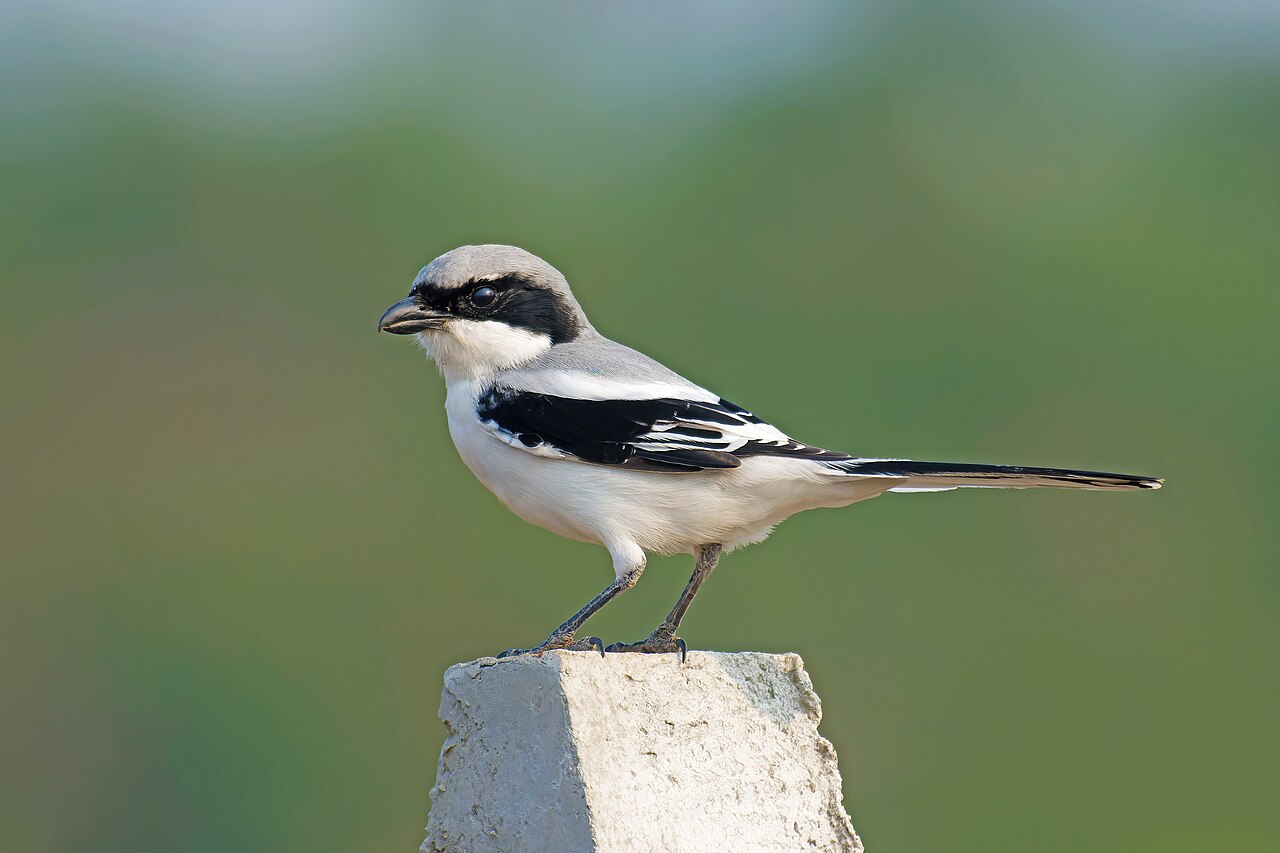
Grey above, white below, with a black mask that runs through the eye but leaves the base of the bill clear, so that a narrow pale line stands above the bill. Fine grey vermiculations lie on breast and flanks and make the white look soiled on fresh birds. The wing is black with a white patch at the base of the primaries; the black tail is long, graduated and broadly white in the corners. The bill is heavy, hooked at the tip and notched on the upper edge; on young birds the base of the bill is horn-coloured and the whole plumage is brown-grey with heavier vermiculation. In flight it undulates low over the ground and then swings up onto a perch, where it sits upright and completely still.
Confusion species
Loggerhead Shrike is smaller and darker grey, and its black mask continues across the base of the bill, so that the face carries an unbroken black band seen from the front; its bill is shorter and less strongly hooked and its breast is clean white. In winter the two overlap only in a narrow belt across the middle of the continent; north of that belt every shrike is a Northern. Northern Mockingbird uses the same wires but is slimmer, longer-tailed and maskless, with a thin straight bill and far larger white wing patches in flight. A young Northern Shrike is brown enough to suggest a thrush; the hooked bill and the black-and-white tail settle it at once.
Habitat
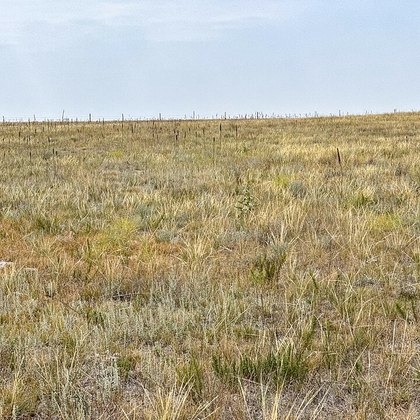
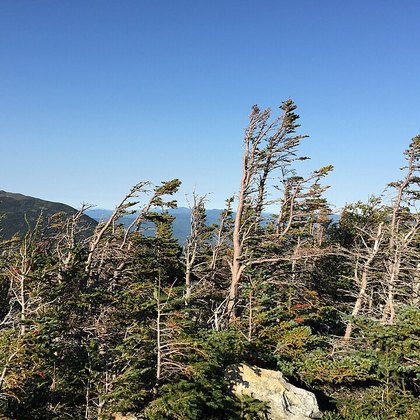
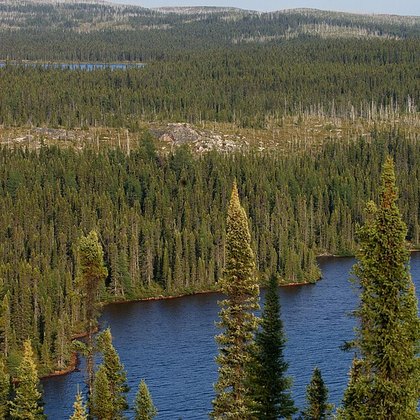
It breeds at the open edge of the conifer forest: scattered spruce and larch in peatland and muskeg (boggy spruce peatland typical of boreal Canada), willow and alder scrub along creeks, and the dwarf shrubs of the treeline. In winter it looks for open country with lookouts — arable land with hedgerows, pasture with barbed wire, abandoned orchards, roadsides with telephone poles, and the thickets of dry river beds. It does not use closed forest, and a field with no post, wire or bush is unusable to it however full of mice it may be. The same winter sites are held year after year by a single bird, which defends its patch against others of its kind.
Where the bird is most often found, arranged by the USNVC — the vegetation classification of the United States and Canada — and CMECS for sea and coast.


Range and movements
Breeds from western Alaska through Yukon, the Northwest Territories and the north of the provinces into Labrador, everywhere along the treeline and not north of it. Winters in southern Canada and the northern half of the United States, south to roughly Colorado, Kansas and the Ohio Valley; how far it comes differs sharply from year to year. Numbers in the south follow the voles and lemmings of the north: in the winter after a rodent crash far more birds turn up everywhere. Until recently it was counted as one species with the Great Grey Shrike (Lanius excubitor) of Eurasia; North America now counts it separately.
- Resident
- Breeding (summer)
- Winter
- Passage
- dark = core range, pale = thinly spread
Where and when to look
Drive a country road through open farmland in December or January and watch the tops: a small pale bird sitting completely still on the highest point of a tree or pole is, in that landscape, almost always a shrike. Shrikes nearly always choose the top, never a branch halfway down. If you find a thorn bush with an impaled mouse, or a beetle wedged on barbed wire, the bird is within a few hundred metres.
Conservation
The world population is estimated at a few hundred thousand birds and the species is listed as Least Concern (LC); its breeding range lies largely beyond the reach of farming and building. Winter counts in the south of the range show a decline over the past half century, but the numbers swing so widely from year to year that a trend is hard to read from them. The breeding range itself is changing above all because the treeline is moving north.
Scientific name
Lanius borealis | Vieillot, 1808
Louis Pierre Vieillot described the species in 1808 as Lanius borealis; because it still stands in that genus, author and year go without parentheses. The genus Lanius was introduced by Linnaeus in 1758 and is the Latin word for 'butcher', after the habit of hanging prey on thorns. borealis means 'northern', after Boreas, the north wind of the Greeks. Vieillot gave only 'North America' as the origin; the American Ornithologists' Union restricted the type locality to New York in 1931.