All species › Passerines › Crows, jays and magpies › Canada Jay
Canada Jay | Perisoreus canadensis
Canadese taigagaai | Arrendajo canadiense
The Canada Jay is the jay of the boreal forest: grey, crestless, short-billed and thickly feathered. It holds the same territory all year, through thirty degrees of frost, and bridges the winter on thousands of small food stores glued to bark with saliva the previous summer. It starts nesting while a metre of snow is still on the ground.
Voice
The repertoire is wide. The best-known sound is a whistled, descending quee-oo; alongside it come clicks, soft chuckles and a gurgling chatter. A threat on the ground brings a series of harsh clicks, a raptor overhead a series of repeated whistles. The species imitates the calls of at least forty bird species, and those of red squirrel and domestic cat as well; imitation of raptors is used in mobbing. Around the nest the birds are silent.
Recording: Jonathon Jongsma — CC BY-SA 4.0 · Blue Bell Campground, Custer State Park, South Dakota, United States · xeno-canto
Identification
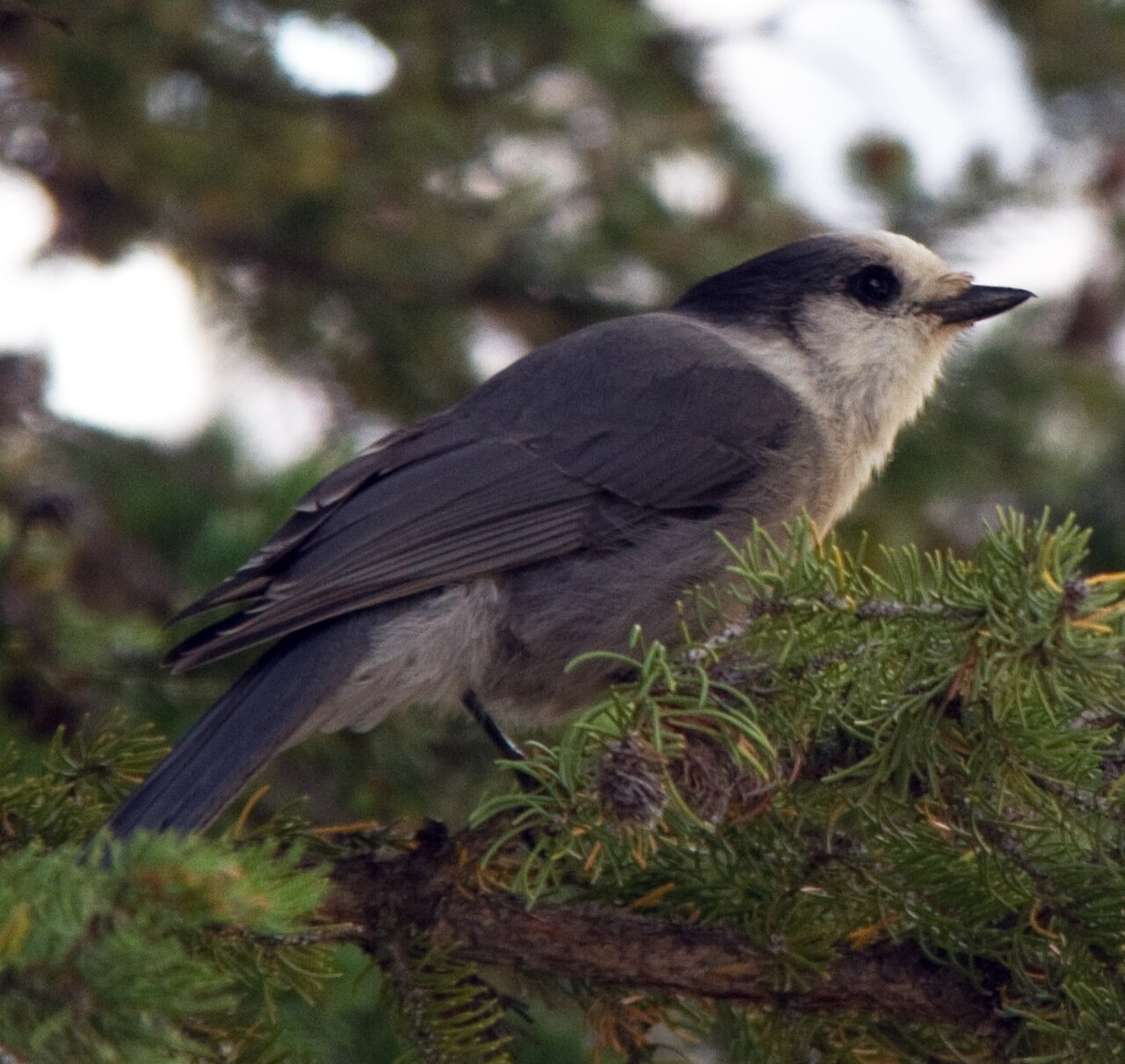
A stocky, crestless jay of 25 to 33 centimetres, with a wingspan around 45 centimetres and a weight of about 70 grams. The back is mid-grey, the underparts paler grey, the head largely white with a dark grey to black nape and hood that reaches further forward in northern birds. Bill and legs are black; the nostrils are feathered. The tail is long and grey with paler tips. Flight is slow and gliding, often from treetop to treetop. Juveniles are uniformly dark grey for their first months and moult into adult plumage only in July or August.
Confusion species
The grey head and crestless outline separate it from every blue jay within the range. Clark's Nutcracker is larger, with a long pointed bill and black-and-white wings and tail, and occupies higher, drier mountain forest. Gray-headed Chickadee is far smaller, with a short tail and a brown crown. Juvenile Canada Jays, still wholly dark grey, are sometimes taken for another species; go by size, the gliding flight and the company of the parents.
Habitat
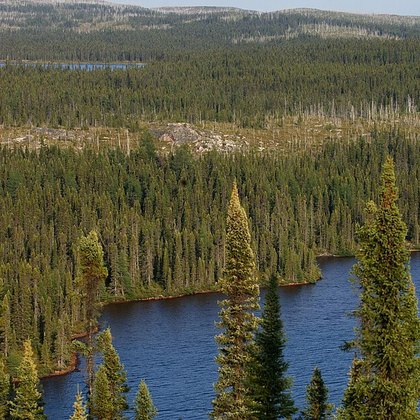
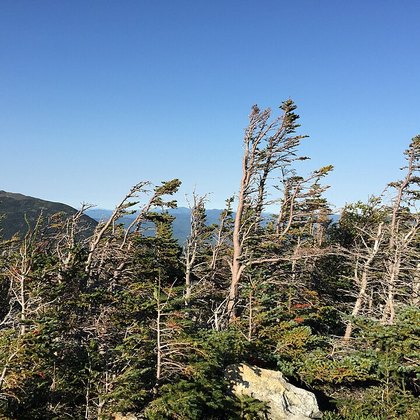
Coniferous forest with black or white spruce, Engelmann spruce, jack pine or lodgepole pine, from the taiga to the subalpine belt. Two things seem to set the limits: winters cold enough to keep its stores from spoiling, and bark with pliable, shingle-like scales behind which food can be tucked. Sitka spruce forest in the coastal lowlands of Alaska and British Columbia is not occupied, and in the Sierra Nevada of California, where spruce is absent, the bird does not occur. Campgrounds, cabins and feeders are visited.
Where the bird is most often found, arranged by the USNVC — the vegetation classification of the United States and Canada — and CMECS for sea and coast.



Range and movements
Resident from northern Alaska and the Yukon east to Newfoundland and Labrador, and south along the mountains to northern California, Idaho, Utah, Arizona, New Mexico, Colorado and the Black Hills of South Dakota. In the east the range reaches northern Minnesota, northern Wisconsin, the Michigan peninsula, the Adirondacks of New York and the mountains of Vermont, New Hampshire and Maine. Migration is minimal; in some winters birds appear further south, to Nebraska, southern Michigan, Pennsylvania and southern New England. Four genetic groups are recognised: boreal, transcascade, Rocky Mountain and Pacific.
- Resident
- Breeding (summer)
- Winter
- Passage
- dark = core range, pale = thinly spread
Where and when to look
Go to a campground or parking area in boreal or subalpine conifer forest and wait: the birds glide in silently and will sometimes land on an outstretched hand. The best chance of breeding behaviour is late February and March, when nests are built with the snow still deep. Look for the pair high in a spruce, on the south side of the crown.
Conservation
The species is assessed as of least concern, with a stable population over a very large and thinly settled range. At the southern edge a decline has been measured and linked to warmer temperatures in the preceding autumn: these speed the spoiling of the stored food on which late-winter nesting partly depends. In the north the species may gain ground where spruce advances into former tundra.
Scientific name
Perisoreus canadensis | (Linnaeus, 1766)
Linnaeus described the species in 1766 as Corvus canadensis, from material out of Canada, later narrowed to Quebec; because it was moved to another genus, author and year stand in parentheses. Bonaparte introduced the genus Perisoreus in 1838, from Greek perisoreuo 'to heap up', after the hoarding of food. The English name was changed in 2018 from Gray Jay to Canada Jay. The folk name whisky jack comes from Wisakedjak, a figure in Cree, Algonquin and Menominee story; in Ojibwe the bird is gwiingwiishi, in Tlingit among other names taatl'eeshdei, 'camp robber'.