All species › Passerines › Crows, jays and magpies › Clark's Nutcracker
Clark's Nutcracker | Nucifraga columbiana
Amerikaanse notenkraker | Cascanueces americano
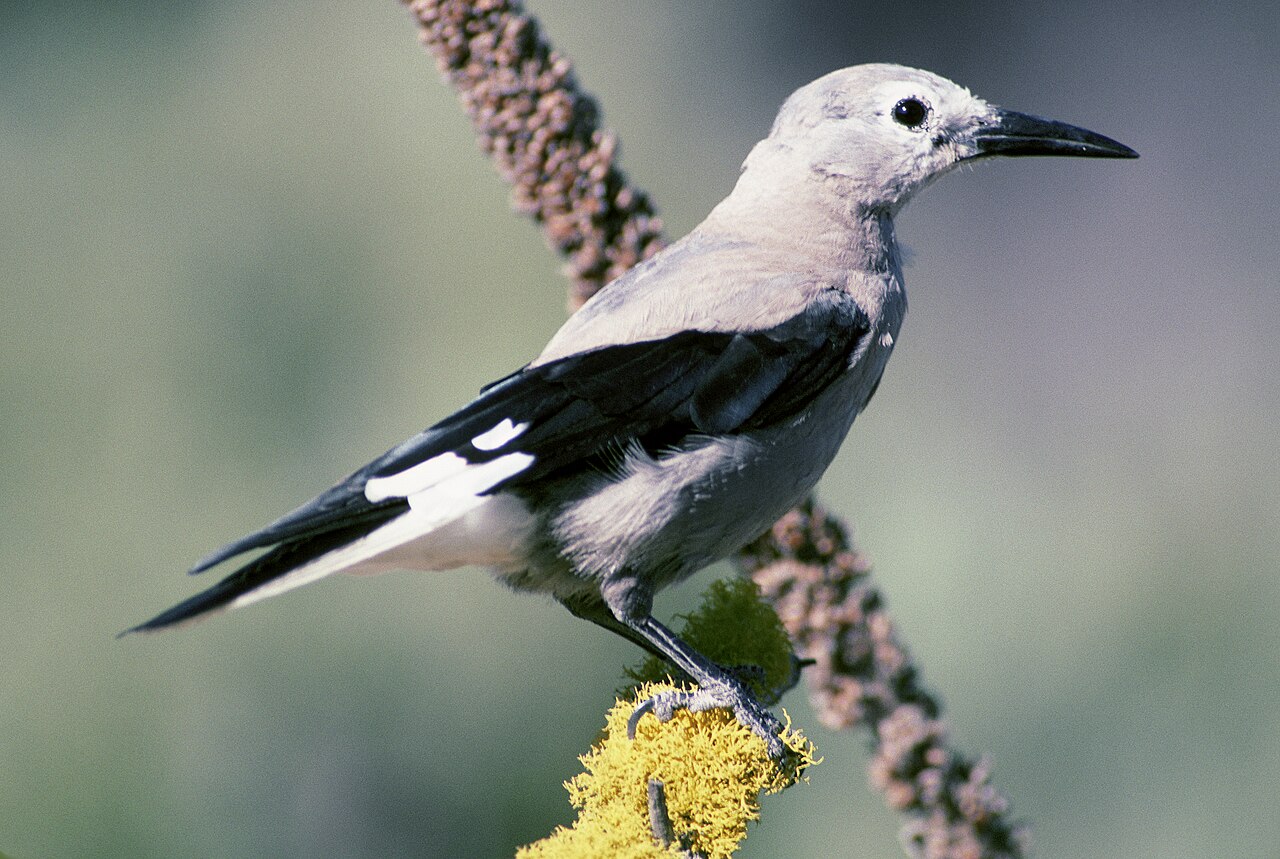
Clark's Nutcracker is the pale grey corvid of the conifer forests high in the western mountains, with black wings, white tail sides and a long, straight, black bill. It lives on pine seed and buries tens of thousands of seeds in the ground every autumn.
Voice
The call is a long, drawn-out, grating kraaa that carries hundreds of metres across open slopes and is usually repeated two or three times. Between eight and thirteen distinct calls have been described. There is also a short clicking or crackling between partners. A song with a fixed phrase is absent, though the bird does give soft, mixed series.
Recording: Diana Doyle — CC BY-SA 4.0 · Mount Shasta, Horse Camp, Siskiyou County, California, United States · xeno-canto
Identification
Pale grey on head, back and belly, with black wings in which the secondaries form a white trailing edge: in flight a white panel sits in the black. The tail is short, with black central feathers and white outer ones. The bill is long, straight and black, tapering to a point and built to prise the scales off a pine cone. The legs are black. The flight uses deep, slow beats and recalls a woodpecker more than a jay. Young birds are slightly browner grey.
Confusion species
Canada Jay is also grey, but has a short bill, soft fluffy plumage with no white in the wing and a longer tail; it flies with glides and swoops. Black-billed Magpie is larger with a far longer tail. Northern Mockingbird is smaller with a slender bill. On a distant bird the wing pattern decides it: a black wing with a white rear panel and white tail corners belongs to no other species in the western mountains.
Habitat
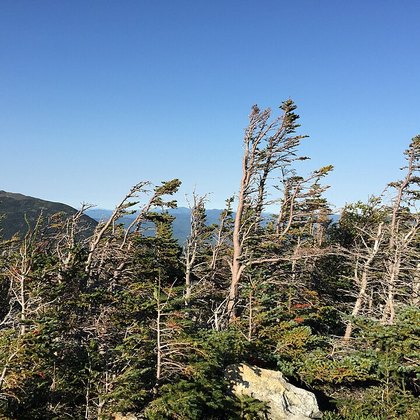
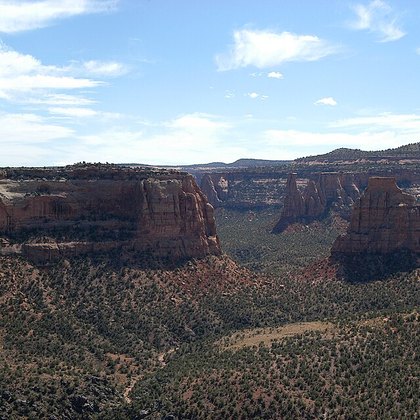
Open montane conifer forest, roughly between 900 and 3900 metres, above all where large-seeded pines grow: whitebark, limber, ponderosa, Jeffrey and pinyon pine. Treeline, krummholz and rocky slopes with scattered trees belong to the picture as well. Out of season it turns up at car parks, picnic grounds and ski areas in the same mountains. In autumn part of the population drops to lower pinyon and juniper belts when the seed crop higher up fails. Food sets the annual cycle: the bird breaks open cones, carries 30 to 150 seeds at a time in a pouch under the tongue over distances of more than twenty kilometres, and buries them in groups of one to fifteen in the soil. In a good seed year a single bird may store up to about 98,000 seeds, spread over thousands of caches. Those sites are relocated by spatial memory, more than nine months later, though accuracy drops off after about six months; experiments show this rests on memory for place and not on chance searching. Breeding starts as early as January or February, on the stores of the previous season. Seeds that are not retrieved germinate: in whitebark pine virtually every tree grows from a buried seed.
Where the bird is most often found, arranged by the USNVC — the vegetation classification of the United States and Canada — and CMECS for sea and coast.



Range and movements
A resident of the western mountains, from central British Columbia and western Alberta south through the Cascades, the Sierra Nevada and the Rocky Mountains to northern Baja California and central New Mexico, with an eastern outpost in the Black Hills of South Dakota. In Mexico there is also an isolated population on Cerro Potosí in Nuevo León, at about 3700 metres, alongside the pinyon endemic there. In years with a poor seed crop birds leave the mountains and appear on the Great Plains, north to Alaska and east to Pennsylvania and Ontario.
- Resident
- Breeding (summer)
- Winter
- Passage
- dark = core range, pale = thinly spread
Where and when to look
Look for it at treeline in August and September, when the cones ripen: passes and viewpoints in Yellowstone, the Sierra Nevada and the Canadian Rockies hold most birds then. Listen first — the grating kraaa usually comes from a dead treetop or a rock point, where the bird sits in view. At a feeder or a picnic table at altitude it often comes within a few metres.
Conservation
The IUCN places the species in the least concern category; Partners in Flight puts numbers at about 230,000 birds, with a decline between 1966 and 2015. The species is the main seed disperser of whitebark pine, which is going back through white pine blister rust, mountain pine beetle outbreaks and the absence of fire; where that pine is the main seed source, as in Glacier National Park, the food base of the nutcracker goes with the tree. Climate change in the subalpine zone works in the same direction.
Scientific name
Nucifraga columbiana | (Wilson, 1811)
Wilson described the species in 1811 as Corvus columbianus, from specimens taken on the shores of the Columbia; because it was later moved to another genus, author and year stand in parentheses. The type locality was restricted by Davis and Stevenson in 1934 to the Clearwater River near Kamiah, Idaho. Nucifraga is from Latin nux 'nut' and frangere 'to break', after the opening of seeds with the bill; columbiana refers to the Columbia. The English name goes back to William Clark of the Lewis and Clark expedition, who recorded the bird on the Salmon River in 1805 and at first took it for a woodpecker.