All species › Passerines › Crows, jays and magpies › Fish Crow
Fish Crow | Corvus ossifragus
Viskraai | Cuervo pescador
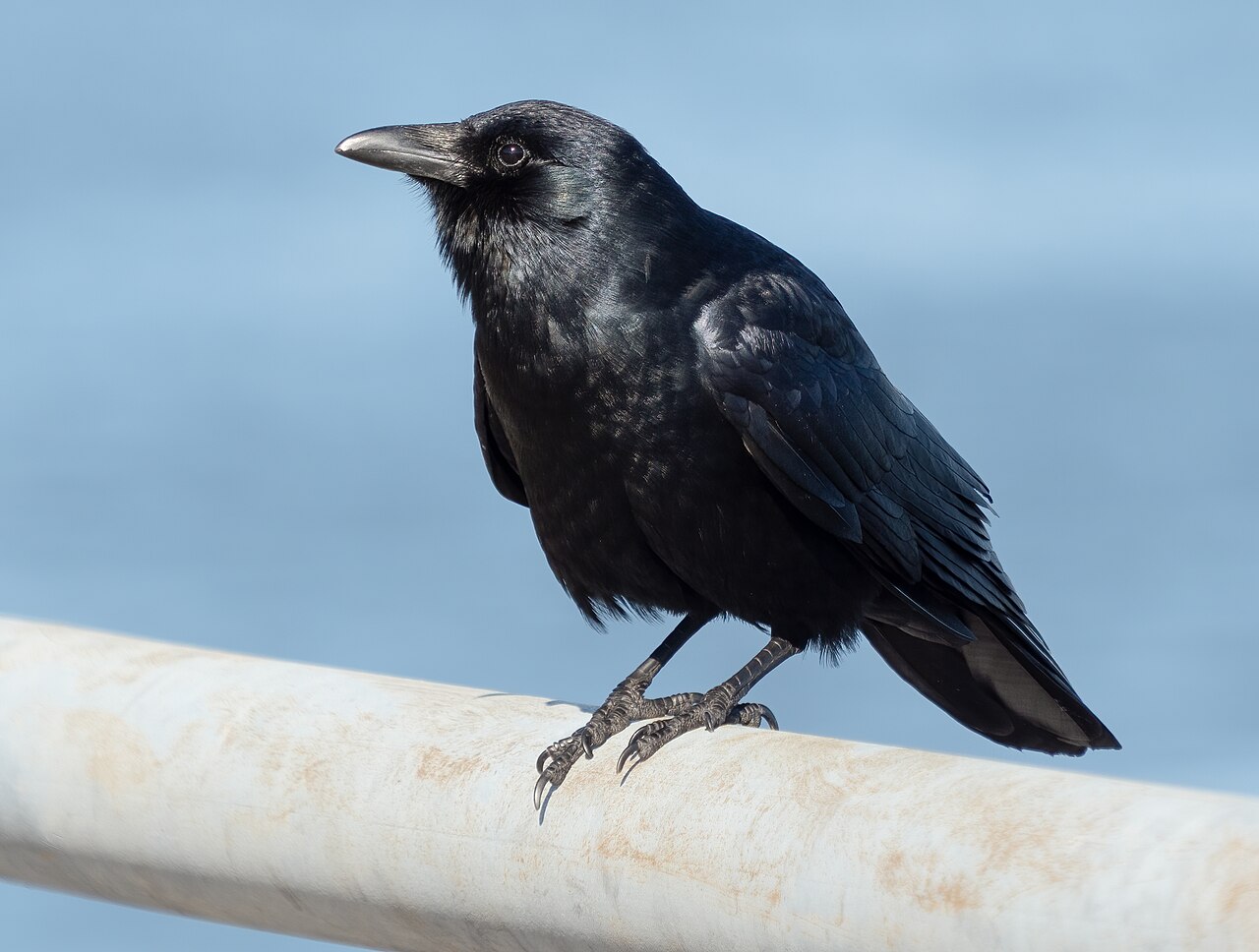
The Fish Crow is the smaller black crow of the eastern United States, tied to water: coastal marshes, estuaries and the large river valleys. From American Crow it can be told almost only by voice — a high, nasal uh-uh instead of a clear caw.
Voice
This is the one reliable field mark. The usual call is a nasal, short ca or kwok, mostly followed by a second note, lower and pinched off: together it sounds like a denying uh-uh. The pitch is higher and far more nasal than in American Crow, which gives a clear, open, longer caw. While calling the bird fluffs out its throat feathers. Note that young American Crows beg with a nasal call resembling a Fish Crow, above all in late summer; a single nasal call is then no proof. There is also a begging waw-waw and a drawn-out cahrr.
Recording: Russ Wigh — CC BY-NC-SA 4.0 · Skidaway Island, Chatham County, GA USA, United States · xeno-canto
Identification
All black, with a blue to blue-green gloss above and a greenish sheen below. The bird is smaller and slimmer than American Crow, with a more slender bill and slenderer feet, a proportionally slightly longer tail and narrower wings. In flight the beat is faster and it glides more often; the tail is more rounded at the tip. On a single bird with nothing to compare it to all of these marks are unusable, and many observers leave silent crows in the overlap zone unidentified.
Confusion species
American Crow is the problem, and visual identification is often wrong. The difference lies in the voice: nasal and two-noted against clear and open. With two birds side by side, the Fish Crow is about a fifth smaller, with a distinctly finer bill lacking the heavy, slightly curved upper mandible of American Crow, and with legs that look shorter as it walks. Northern Raven is far larger, with a wedge-shaped tail, a heavy bill and a low, rolling call. At the southwestern end of the range the area borders that of Tamaulipas Crow, which is smaller and gives a croaking sound.
Habitat
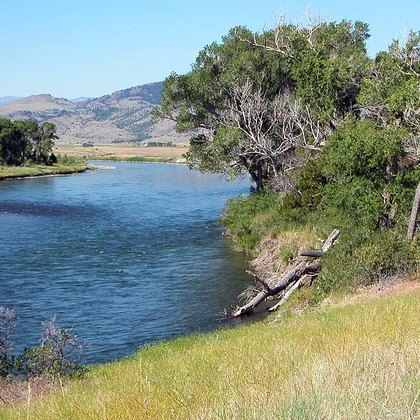
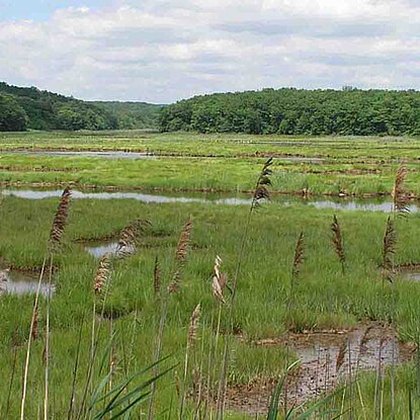
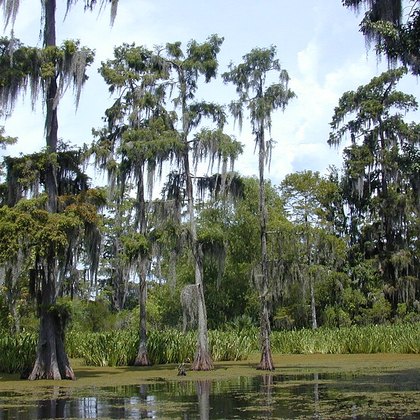
Almost always within reach of water: salt marsh, beach, estuary and lagoon along the coast, and inland the banks of large rivers, lakes and swamp forest. It breeds in loose colonies, in a flat stick basket in a tree from one and a half to over twenty metres up. It forages on foot along the waterline for crabs, shrimp, small fish, eggs and nestlings of other birds, insects and fruit, and takes grain, peanuts and refuse in harbours, car parks and at landfills. Shellfish are sometimes dropped from height onto a hard surface. Outside the breeding season it uses large communal roosts, often shared with American Crows.
Where the bird is most often found, arranged by the USNVC — the vegetation classification of the United States and Canada — and CMECS for sea and coast.



Range and movements
From southern New England along the Atlantic coastal plain to the Florida Keys and on along the northern Gulf Coast to east Texas. Since the early twentieth century the species has moved inland along the large rivers: the Mississippi into Missouri and Illinois, the Ohio and the Kanawha, the Arkansas, the Tennessee and the Hudson. In the north and inland the birds are breeders that partly move south in winter; along the coast the species stays all year. Recently settlements have been recorded on Lake Ontario in Canada and in the Bahamas.
- Resident
- Breeding (summer)
- Passage
- dark = core range, pale = thinly spread
Where and when to look
In March and April visit a bridge, harbour or fishing spot along the Atlantic coast or the Gulf Coast and wait for a crow to call; in those months the species is at its noisiest and young American Crows are not yet begging. At a group of crows by the water, go by voice rather than looks, and leave a silent bird unidentified.
Conservation
The IUCN places the species in the Least Concern (LC) category. The range expanded inland and northward over the past century, the species making use of bridges, reservoirs, fish processing and refuse in coastal towns. Like other corvids it is susceptible to West Nile virus, which caused local mortality after 2002. Because Fish Crow and American Crow are not always separated in surveys, trend figures for both species in the overlap zone are less sharp.
Scientific name
Corvus ossifragus | Wilson, 1812
Alexander Wilson described the species in 1812 as Corvus ossifragus, from a specimen from Great Egg Harbor in New Jersey; since it still stands in the original genus, author and year carry no parentheses. Corvus is the Latin word for raven or crow. The species name ossifragus means 'bone-breaker', from os 'bone' and frangere 'to break'; it is a classical name for a large bird of prey and does not describe this bird's behaviour. The English and Dutch names refer to its foraging along the water.