All species › Grebes › Grebes › Horned Grebe
Horned Grebe | Podiceps auritus
Kuifduiker | Zampullín cuellirrojo
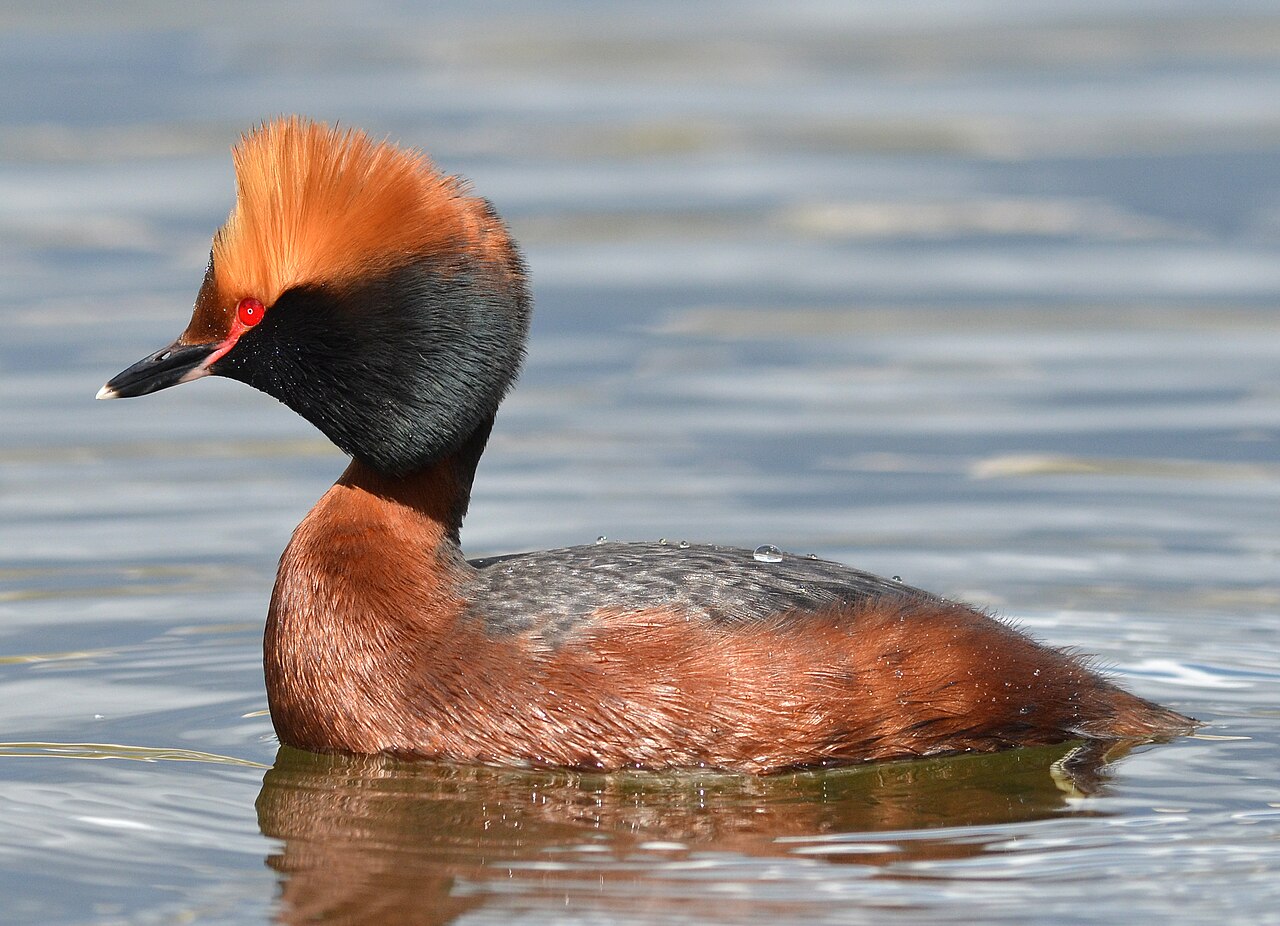
Horned Grebe is the small grebe of the far north: in breeding plumage rufous and black, with a broad golden stripe running from the bill across the red eye to the nape, which the bird can raise into two horns. In winter it is a crisp black-and-white bird drifting in small parties just off the shore. Of all the grebes of the continent it has fallen back the hardest over the past half century; since 2015 it has been listed as Vulnerable (VU).
Voice
On the breeding water it gives a loud, nasal aaarh that falls in pitch and ends in a rattling trill; across a quiet pond it carries hundreds of metres. Pairs often deliver that trill together, so it comes over the water as a rough duet. Disturbed birds add a short, high keek, and begging young peep continuously like chicks. Away from the breeding grounds it is all but silent: on the sea and on the reservoirs it is not heard at all.
Recording: Alan Dalton — CC BY-NC-SA 4.0 · Sörmlandsleden etapp 4 - Tyresta by, Haninge Municipality, Stockholms län, Sweden · xeno-canto
Identification
In breeding plumage the neck, upper breast and flanks are chestnut and the head and back are black, with a broad golden stripe running from the base of the bill across the red eye to the nape. In winter the bird is black and white: black crown and hindneck, a cleanly bordered white cheek, a white foreneck and a grey back. The crown is flat and its highest point lies above the eye; the bill is straight, thin and pale-tipped. Male and female cannot be told apart; young birds resemble the winter adult but have a dingier cheek and a greyer neck. It flies rarely, and then low over the water with fast beats, a white patch in the wing and the feet trailing behind the tail.
Confusion species
Eared Grebe (Podiceps nigricollis) is the most similar in winter: it has a peaked crown, a slightly upturned bill and a blurred grey transition between cheek and crown, where Horned Grebe has a flat crown, a straight bill and a clean border. Red-necked Grebe is almost half as long again and much heavier, with a long yellow bill and a dusky rather than white foreneck. Pied-billed Grebe (Podilymbus podiceps) is brown rather than grey, has a short, thick bill and shows no white in the wing in flight. Least Grebe is smaller and darker and has a yellow eye.
Habitat
It breeds on small, shallow freshwater ponds fringed with reed, sedge or bulrush: prairie potholes, bog pools and the sheltered corners of larger lakes, where the nest is built as a floating heap of plant matter within a few metres of the shore. Deep, clear, fish-rich lakes are barely used, and running water is avoided. Outside the breeding season it lies on shallow salt water: bays, inlets, harbour mouths and the band just beyond the surf. Inland it then uses large reservoirs and deep lakes, and on migration any sizeable open water will do for a day or two.
Where the bird is most often found, arranged by the USNVC — the vegetation classification of the United States and Canada — and CMECS for sea and coast.




Range and movements
It breeds in Alaska and across western and central Canada east to north-western Ontario, and south in a narrow belt from north-eastern Washington to Minnesota; separate from all that, a small population sits on the Îles-de-la-Madeleine in the Gulf of St. Lawrence. Beyond North America the species also breeds in northern Europe and northern Asia. It winters on both coasts: from southern Alaska to California and the northern Gulf of California, and from Nova Scotia to Texas, with smaller numbers on inland lakes and reservoirs. The southern edge of the breeding range moved north during the twentieth century; across the prairie states it no longer nests on many sloughs where it was ordinary a hundred years ago.
- Resident
- Breeding (summer)
- Winter
- Passage
- dark = core range, pale = thinly spread
Where and when to look
Look for it between November and March in a sheltered bay or a harbour mouth, where it floats in parties of a few birds that dive all at once. Watch the flat crown and the sharply bordered white cheek: that is what separates it from Eared Grebe at distance and against the light. For the breeding plumage, go to the prairie potholes of Alberta or Saskatchewan in late April or early May, when the birds are pairing and calling.
Conservation
The IUCN moved the species from Least Concern to Vulnerable (VU) in 2015: the world population fell by about thirty per cent in three decades, and by nearly eighty per cent in North America. Partners in Flight puts the continental breeding population at some 620,000 birds. In Canada the western population is listed as of special concern and the birds of the Îles-de-la-Madeleine as endangered. Disturbance and logging around the breeding ponds, fluctuating water levels, the stocking of fishless lakes with trout, drowning in fishing nets and oil in coastal waters are the causes named most often.
Scientific name
Podiceps auritus | (Linnaeus, 1758)
Linnaeus described the species in 1758 as Colymbus auritus; because it was later moved to another genus, author and year stand in parentheses. Podiceps comes from Latin podex ('rump') and pes ('foot'), after the far-back leg placement shared by all grebes. auritus means 'eared', from auris ('ear'), after the golden tufts on the head. The type locality is Sweden.