All species › Grebes › Grebes › Red-necked Grebe
Red-necked Grebe | Podiceps grisegena
Roodhalsfuut | Somormujo cuellirrojo
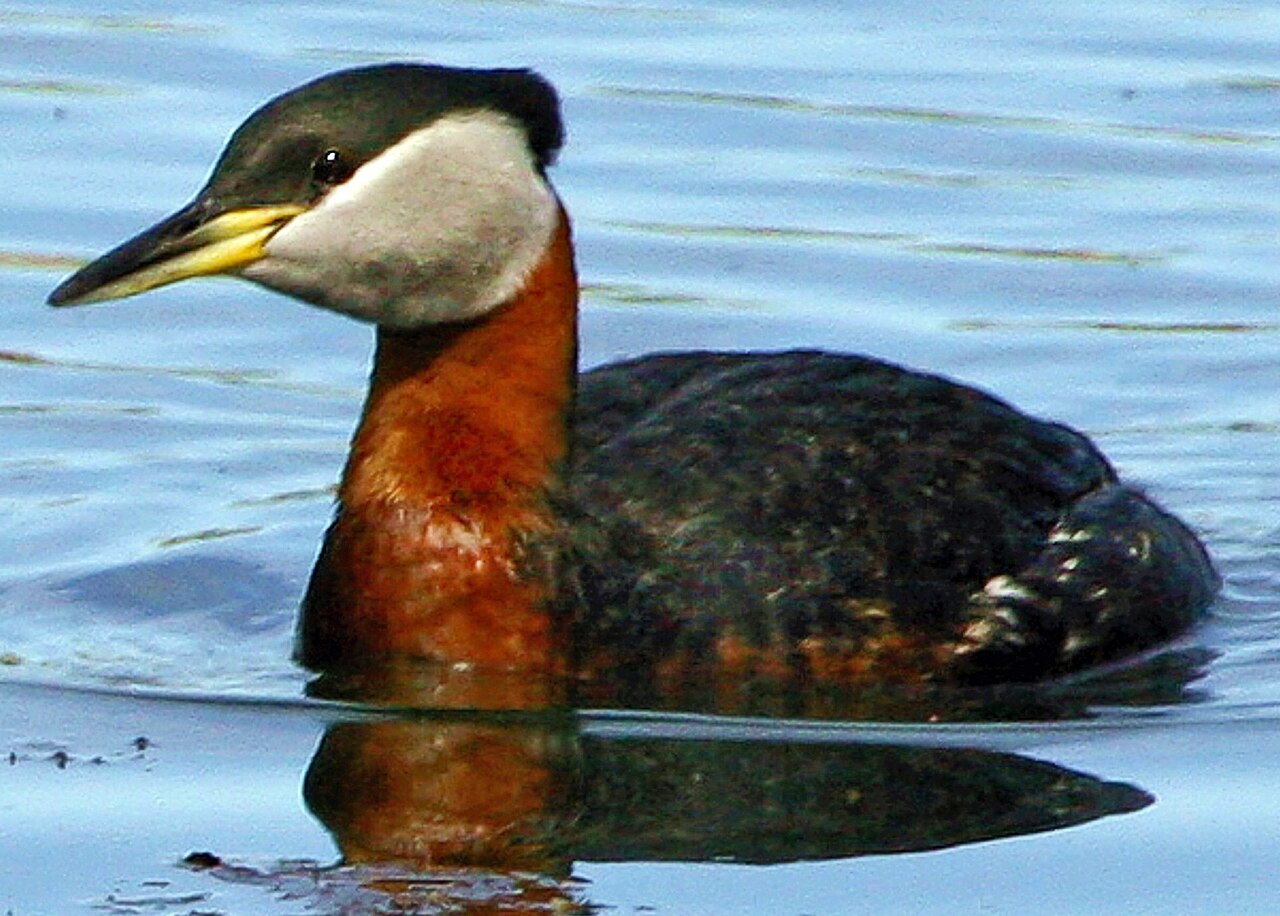
Red-necked Grebe is the heaviest grebe of the genus Podiceps in North America, with a thick neck, a long yellow dagger of a bill and, in breeding plumage, a rufous neck below a white cheek. It nests on the forest lakes and prairie sloughs of the north, where it is one of the noisiest of waterbirds, and winters in silence on cold coastal water. Anyone who knows it only in winter sees a dull grey bird that gives little away of the calling summer bird of June.
Voice
On the breeding grounds it is heard almost without pause: a long series of nasal, whinnying notes, ah-ooh ah-ooh ah-ooh, that speeds up and runs into a braying rattle. Pairs call across one another, so a lake holding a few pairs sounds as though it held many more. There is also a wailing, cat-like meeow, and a short hard kek when something is wrong. On migration and in winter it is silent; at sea one hears little more than wings slapping in a quarrel.
Recording: Stanislas Wroza — CC BY-NC-SA 4.0 · Tolpanniemi, Finland · xeno-canto
Identification
In breeding plumage the neck and upper breast are rufous, the cheek and throat pale grey to white and sharply bordered, and the crown black and slightly peaked. The bill is long, heavy and pointed, black with a bright yellow base, and that yellow shows all year. In winter the bird is grey-brown with a dingy neck, a pale crescent behind the cheek and a much less clean head pattern. Male and female are alike; young birds keep dark stripes across the cheek into the autumn. In flight it looks heavy and long, with two white patches in each wing and the feet far behind the tail.
Confusion species
Horned Grebe (Podiceps auritus) and Eared Grebe are both far smaller and show a clean white foreneck in winter, where Red-necked Grebe stays dusky; their bills are also thin and lack any yellow. Western Grebe is as long but much slimmer, with a long white neck, a thin straight bill and a clean black-and-white head pattern. Pied-billed Grebe is smaller, brown and short-billed. At distance in winter it can suggest a small loon, but a loon has a heavier chest, a dark bill with no yellow, and does not hold its head so high on such a thick neck.
Habitat
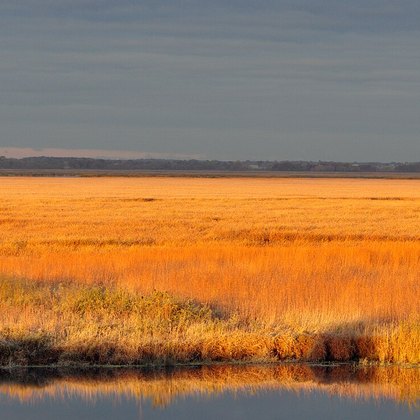
It breeds on shallow lakes and bog pools in the forest and prairie country, with a fringe of reed, sedge or bulrush to anchor the floating nest and enough open water for take-off. Quiet, little-used waters are preferred over large busy lakes, and very small pools are no good: it needs a run. Outside the breeding season it uses cold, shallow sea water — bays, straits and sheltered coastlines — and the Great Lakes. On migration it stops on larger inland lakes and reservoirs, often in the company of diving ducks.
Where the bird is most often found, arranged by the USNVC — the vegetation classification of the United States and Canada — and CMECS for sea and coast.



Range and movements
Its North American breeding range lies in Alaska and right across western and central Canada, with a southern edge in Montana, the Dakotas, Minnesota and Wisconsin; beyond the continent the species also breeds in Europe and Asia. In winter it sits on the Pacific from the Aleutians to California and on the Atlantic from Newfoundland to Virginia and North Carolina, with smaller numbers on the open parts of the Great Lakes. Migration is largely nocturnal and overland, and autumn passage is late: the biggest numbers pass the Great Lakes only in November. Between 2005 and 2015 North American numbers rose by a few per cent a year, while the southern edge of the breeding range shifted north at the same time.
- Resident
- Breeding (summer)
- Winter
- Passage
- dark = core range, pale = thinly spread
Where and when to look
Look for it in November on a large lake or a sheltered coast: a bulky grey grebe on its own, holding its head high on a thick neck, with yellow catching the light at the base of the bill. On the breeding grounds the ear finds it sooner than the eye — go to a marshy lake in Alberta or Minnesota at sunrise and follow the whinnying. Always check the bill: long, heavy and yellow-based, it names the species in any plumage.
Conservation
Partners in Flight puts the world breeding population at some 160,000 birds, and the species is listed as Least Concern (LC). Drowning in gill nets, oil and other pollution in coastal waters, and the loss or disturbance of marshy breeding lakes are the threats named most often. Because much of the population crowds into a few sheltered coastal stretches in winter, a single oil spill can reach a considerable share of it.
Scientific name
Podiceps grisegena | (Boddaert, 1783)
Pieter Boddaert described the species in 1783 as Colymbus grisegena; because it was later moved to another genus, author and year stand in parentheses. Podiceps comes from Latin podex ('rump') and pes ('foot'), after the far-back legs of the grebes. grisegena is built from griseus ('grey') and gena ('cheek') and so means 'grey-cheeked', after the pale cheek of the breeding plumage. No locality was given in the description; Hartert and others designated France as the type locality in 1912.