All species › Grebes › Grebes › Eared Grebe
Eared Grebe | Podiceps nigricollis
Geoorde fuut | Zampullín cuellinegro
Eared Grebe is the most numerous grebe in the world and, in North America, the bird of the shallow saline lakes of the west. In late summer almost the entire North American population gathers on a handful of salt lakes, where the birds eat so much brine shrimp that their flight muscles shrink and they cannot fly for months. Only when the food runs out do they rebuild those muscles and leave in a single night flight south.
Voice
At the colony a high rising poo-eek with a short click on the end sounds almost continuously, more like a frog than a bird. Pairs at the nest also give a fast, rattling chatter as a greeting. Displaying birds call with a long, plaintive whistle that carries right across the water. Away from the breeding grounds it is nearly silent: on the salt lakes, where tens of thousands drift together, little more than a low murmur is audible.
Recording: Julien Piette — CC BY-NC-SA 4.0 · Arrondissement de Dunkerque (near Gravelines), Nord, Hauts-de-France, France · xeno-canto
Identification
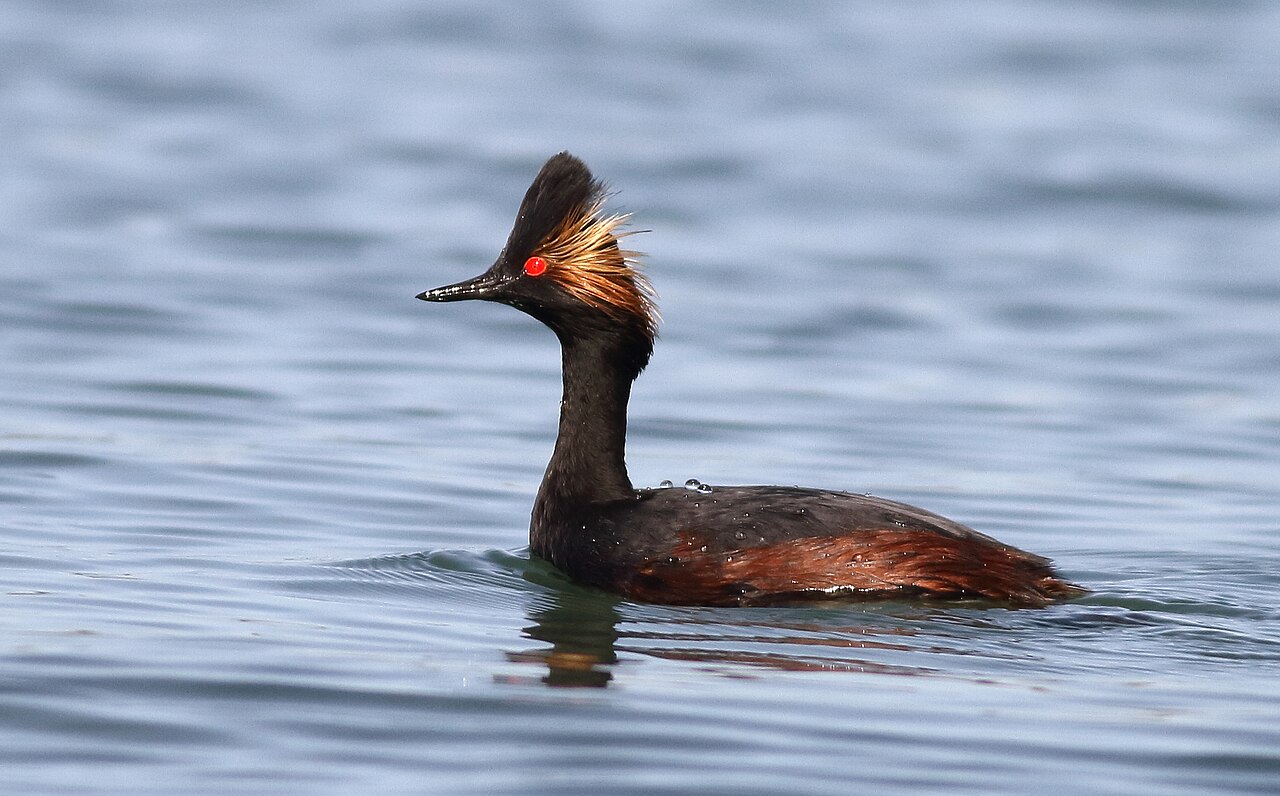
In breeding plumage the head, neck and back are black and the flanks chestnut, with a spray of golden feathers fanning out over the ear coverts behind the red eye. The crown rises to a peak, the bill is thin and slightly upturned, and the rear end forms a high, fluffy cushion. In non-breeding plumage the bird is grey with a white throat; the dark cheek grades into the dark crown with no clean border, and the neck keeps a dingy grey wash. Male and female cannot be told apart; young birds resemble the non-breeding adult but are browner, with a paler cheek. In flight — and it flies rarely — a white wing stripe shows and the feet trail behind the tail.
Confusion species
Horned Grebe (Podiceps auritus) is the most similar species in winter: it has a flat crown, a straight bill with a pale tip, a sharply bordered white cheek and a white foreneck, where Eared Grebe has a peaked crown, an upturned bill and a blurred grey transition. In breeding plumage Horned Grebe carries a broad golden stripe running from the bill to the nape and has a rufous neck; on Eared Grebe the neck is black and the gold stands out as a loose fan over the ear. Pied-billed Grebe is brown rather than grey and has a thick, blunt bill. With a group on the water, watch the posture: Eared Grebe rides higher, with the rear end well clear of the waterline.
Habitat
It breeds in colonies on shallow, productive lakes and marshes with reeds, sedge or bulrush, building the nest on a floating heap of plant matter; brackish and alkaline water is preferred over clear fresh water. Lakes without fish are often the best, because the invertebrates it lives on build up to great densities there. Outside the breeding season it uses large salt lakes, reservoirs, shallow coastal bays and lagoons. It makes no use of fast-flowing water, closed forest or deep, cold mountain lakes.
Where the bird is most often found, arranged by the USNVC — the vegetation classification of the United States and Canada — and CMECS for sea and coast.




Range and movements
In North America it breeds from the prairies of Alberta, Saskatchewan and Manitoba south to California, Nevada and New Mexico, almost entirely west of the Mississippi; beyond the continent the species also occurs in Europe, Asia and southern Africa. In late summer the great majority move to Mono Lake in California and the Great Salt Lake in Utah, where hundreds of thousands to several million birds stay for weeks to moult and put on fat. They then leave in one or a few night flights for the Salton Sea, the Gulf of California and the Pacific coastal waters; smaller numbers winter on the Gulf coast of Texas and Louisiana. Breeding sites shift from year to year with water levels: a prairie pothole full of nests one summer may dry out and stay empty the next.
- Resident
- Breeding (summer)
- Winter
- Passage
- dark = core range, pale = thinly spread
Where and when to look
In October and November scan a large salt lake or reservoir in the west for dark specks packed into dense floating patches that dive all at once. With a single bird, watch the outline of head and rear: the peaked crown and the high, fluffy stern identify it even when the colours are lost against the light. In winter along the Salton Sea or the bays of California they sit just off the shore, usually beyond the surf line.
Conservation
The world population runs into the millions and the species is listed as Least Concern (LC). That almost every North American bird sits on two or three salt lakes at the same time each autumn does leave the population exposed: falling water levels and rising salinity in the Great Salt Lake threaten the brine shrimp the migration depends on. Die-offs of tens of thousands of birds have been recorded repeatedly at the Salton Sea and the Great Salt Lake, caused by botulism and avian cholera.
Scientific name
Podiceps nigricollis | Brehm, 1831
Christian Ludwig Brehm described the species in 1831 as Podiceps nigricollis; it still stands in that genus, which is why author and year carry no parentheses. Podiceps comes from Latin podex ('rump') and pes ('foot'), after the far-back leg placement shared by all grebes. nigricollis means 'black-necked', after the breeding plumage. The type locality is Germany. The international English name is Black-necked Grebe, which refers to that black neck; in North America it is called Eared Grebe, after the golden ear feathers.