All species › Grebes › Grebes › Western Grebe
Western Grebe | Aechmophorus occidentalis
Zwanenhalsfuut | Achichilique Común
Western Grebe is the largest grebe in North America: black above, white below, with a long thin neck and a red eye set in the black cap. In spring two birds rise side by side and run upright across the water, necks arched and wings held stiffly back — a performance that can carry them tens of metres. It nests in colonies on the big lakes of the west and moves to the coast for the winter.

Voice
The usual contact call is a shrill, creaking two-syllable cree-creet that carries right across a lake and draws an answer from other birds. That answer is what sets the display going: two birds that find each other by calling may run across the water together a moment later. At the nest there are soft clucking and ticking notes by which parents and young keep contact. In winter, at sea, it is all but silent.
Recording: Bruce Lagerquist — CC BY-NC-SA 4.0 · Coal Banks Campground, Chouteau County, Montana, United States · xeno-canto
Identification
A long, narrow bird whose neck takes up almost half its length, black above and white below, with a clean border running down the side of the neck. The black cap reaches below the eye, so the red eye sits in black, and the lores between eye and bill are dark as well. The bill is long, straight and thin, dull yellow to greenish-yellow. Male and female look alike, though the male is a little longer-billed; young birds are greyer with a less clean head pattern, and the downy chicks are grey. In flight the neck droops slightly forward, the wingbeats are fast and shallow, and a long white stripe runs along the rear of the wing.
Confusion species
Clark's Grebe (Aechmophorus clarkii) is the real problem: on that bird the black cap stops above the eye, so the red eye sits in white, the lores are pale, the bill is orange-yellow and the flanks are a lighter grey. In winter the difference blurs in both species and not every bird can be named; the voice does help, because Clark's Grebe calls with a single syllable. Red-necked Grebe is as long but far thicker-necked, with a yellow-based bill and a dusky neck. A loon has a much heavier chest, a short thick neck and a dark bill.
Habitat
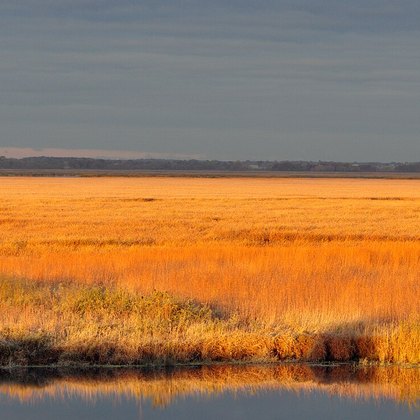
It breeds in colonies on large, productive freshwater lakes and marshes with broad belts of bulrush and reed, in which the floating nests are anchored in shallow water; open water holding fish has to lie right alongside. After breeding the birds move to moulting lakes, where for a time they cannot fly. In winter most sit on salt or brackish water: sheltered bays, inlets, river mouths and the band just beyond the surf. A smaller share stays on large reservoirs and deep inland lakes, as long as those do not freeze over.
Where the bird is most often found, arranged by the USNVC — the vegetation classification of the United States and Canada — and CMECS for sea and coast.



Range and movements
It breeds in the west of the continent, from central British Columbia, Alberta, Saskatchewan and western Manitoba south through the Great Basin to California, Colorado and Nebraska, and locally into northern Mexico. In winter the centre of gravity lies along the Pacific, from British Columbia to Baja California and the Gulf of California, with smaller numbers on the reservoirs of the southwest. Colony sites shift with water levels: a lake with hundreds of pairs may stand empty after a dry year while another fills up. Between 1968 and 2015 numbers fell by about two per cent a year, above all in the southern part of the breeding range.
- Resident
- Breeding (summer)
- Winter
- Passage
- dark = core range, pale = thinly spread
Where and when to look
Go at sunrise between April and June to a large bulrush-fringed lake in the west — Klamath, Bear River, Tule Lake — and wait for the two-syllable call; the running across the water may follow soon after. With every bird, look at the eye first: red set in black means this species. In winter look for it from a pier or a headland on the Pacific, where strings of long white necks drift just beyond the waves.
Conservation
Partners in Flight puts the world population at about 87,000 breeding birds and places the species on the yellow watch list, although the IUCN lists it as Least Concern (LC). Numbers fell by some two per cent a year between 1968 and 2015. Loss of marshes, fluctuating water levels and disturbance of colonies by boats weigh heaviest; birds also drown in gill nets, and the coastal wintering grounds are exposed to oil.
Scientific name
Aechmophorus occidentalis | (Lawrence, 1858)
George Newbold Lawrence described the species in 1858 as Podiceps occidentalis; because it was later moved to another genus, author and year stand in parentheses. The genus Aechmophorus was introduced by Elliott Coues in 1862 and comes from Greek aichme ('spear point') and phoros ('bearing'), after the long, pointed bill. occidentalis is Latin for 'western'. The described specimen came from Fort Steilacoom in Washington.