All species › Grebes › Grebes › Clark's Grebe
Clark's Grebe | Aechmophorus clarkii
Clarks Fuut | Achichilique de Clark
Clark's Grebe is the paler counterpart of Western Grebe: as long, as thin-necked, but with an orange-yellow bill and a black cap that stops above the red eye, so that the eye sits in white. For more than a century it counted as a pale form of that bird; since 1985 it has been counted separately. It is much scarcer and lies further south, with its centre in the southwest and on the highland lakes of Mexico.

Voice
The call is a shrill, creaking single-syllable creet, where Western Grebe gives two; in a mixed colony that is the only difference that works reliably at distance. Birds call and answer across the whole lake, and such an answer is often followed by two birds running away together over the water. At the nest there are soft ticking and clucking notes between parents and young. Away from the breeding season it is seldom heard.
No freely licensed recording has been found for this species yet; what to listen for is described below.
Identification
Black above and white below, with a long thin neck taking up almost half the length, exactly as in Western Grebe. The difference is in the head: the black cap stops above the eye, the lores between eye and bill are white or off-white, and the red eye therefore sits in a white face. The bill is long, straight and thin and orange-yellow, brighter than in Western Grebe. The flanks are a lighter grey, which makes the bird look whiter on the water; male and female are alike, and the downy chicks are white rather than grey. In flight it cannot be separated from Western Grebe: the same long white stripe along the rear of the wing and the same forward-drooping neck.
Confusion species
Western Grebe (Aechmophorus occidentalis) is the only real confusion species: on that bird the black runs below the eye, the lores are dark and the bill is dull yellow to greenish-yellow. In winter the black moves down in both species and young birds in particular become unnameable; anyone who is not sure leaves the bird unnamed. The two breed on the same lakes, and a few mixed pairs and intermediate birds occur that follow neither set of characters completely. Red-necked Grebe is far thicker-necked and has a dusky rather than white foreneck.
Habitat
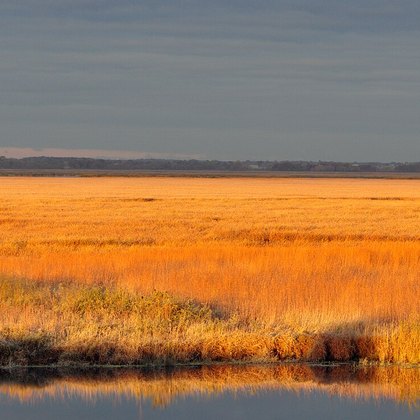
It breeds on large freshwater lakes and marshes with bulrush and reed, in the same colonies as Western Grebe and with the same floating nest, often a little further from shore and in somewhat more open, deeper or more alkaline water. Here too, open water holding small fish has to lie alongside. After breeding the birds gather on moulting lakes and move to the coast: sheltered bays, lagoons and river mouths. In the south of the range a share stays all year on the same inland lakes and reservoirs.
Where the bird is most often found, arranged by the USNVC — the vegetation classification of the United States and Canada — and CMECS for sea and coast.



Range and movements
The breeding range runs from southern British Columbia, Montana and the Dakotas south through the Great Basin to California, Nevada, Utah, Colorado and New Mexico, and on over the highland lakes of northern and central Mexico, where it is resident. In winter it lies on the Pacific from central California to Baja California and the Gulf of California, and on the reservoirs of the lower Colorado. Northwards it thins out fast: in Canada at most a few dozen pairs nest among the far more numerous Western Grebes. In mixed colonies the ratio shifts steadily in its favour towards the south.
- Resident
- Breeding (summer)
- Winter
- Passage
- dark = core range, pale = thinly spread
Where and when to look
In a colony, use the ear first: one syllable is Clark's Grebe, two is Western Grebe, even when the birds are too far off for the head to be seen. Then look at the narrow strip between eye and bill — if it is pale, you have it. Do this between May and July for preference, because in winter plumage the distinction is unreliable and even experienced counters are careful with it.
Conservation
Partners in Flight puts the world population at about 11,000 breeding birds and places the species on the yellow watch list, chiefly because the range is small. Numbers fell by roughly eight per cent between 1970 and 2017. Threats are the loss of marshes, fluctuating water levels, pesticides, disturbance of colonies by motor boats, drowning in gill nets and oil in coastal waters.
Scientific name
Aechmophorus clarkii | (Lawrence, 1858)
George Newbold Lawrence described the species in 1858 as Podiceps clarkii; because it was later moved to another genus, author and year stand in parentheses. The genus Aechmophorus comes from Greek aichme ('spear point') and phoros ('bearing'), after the long, pointed bill. The species name honours John Henry Clark, surveyor and collector on the boundary survey between the United States and Mexico. The type locality was first given broadly as California and New Mexico and was restricted by Dickerman in 1963 to Laguna Santa María in Chihuahua.