All species › Waders, gulls and terns › Auks, puffins and murres › Horned Puffin
Horned Puffin | Fratercula corniculata
Gehoornde papegaaiduiker | Frailecillo corniculado
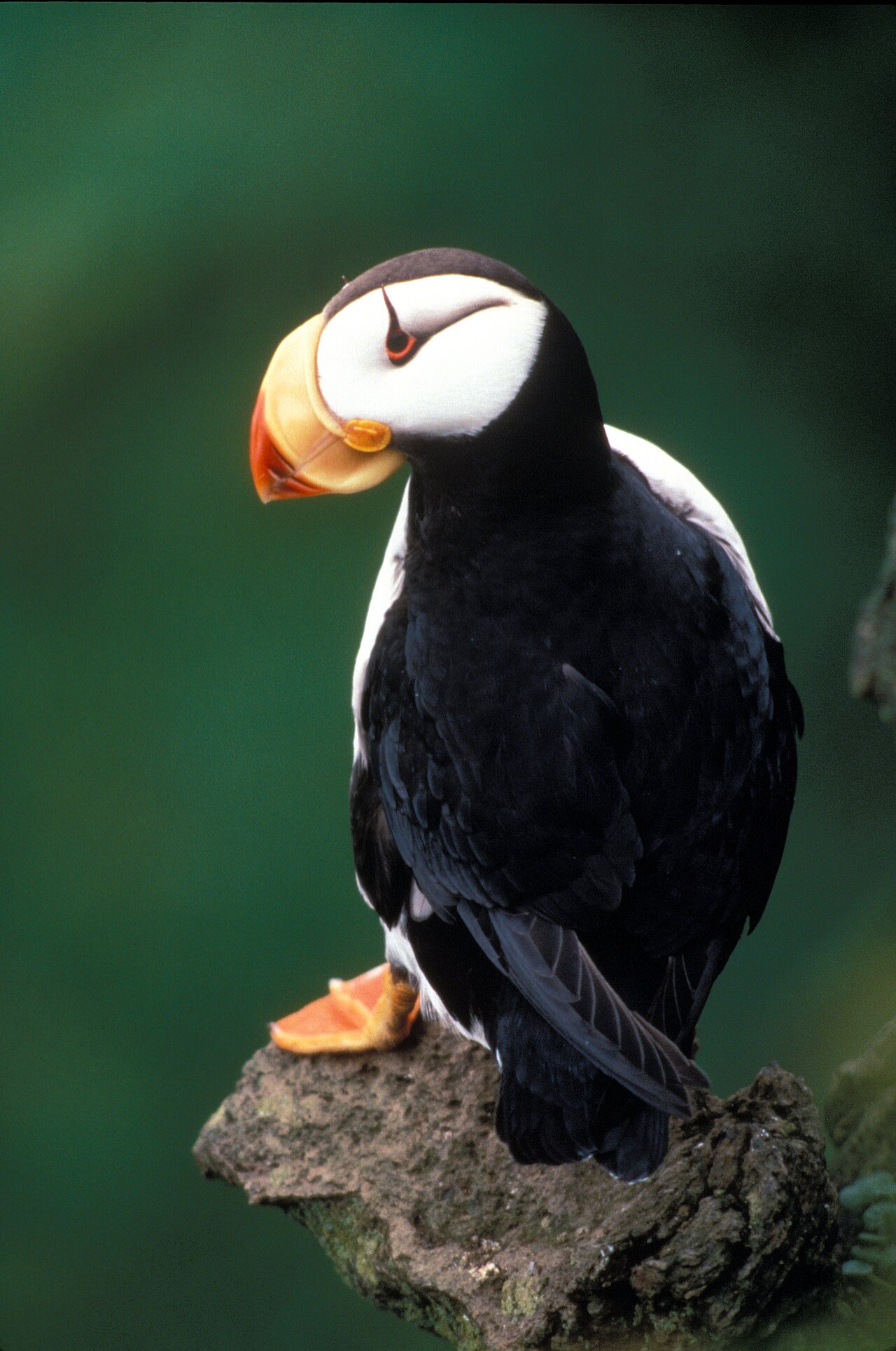
Horned Puffin is the puffin of the North Pacific: black above, white below, with a deep triangular bill that in summer is yellow with a red tip. The horn it is named for is a small black fleshy spike standing straight up above the eye, which you see only at close range. By far the most of them breed in Alaska, on the islands of the Bering Sea and along the Aleutians.
Voice
At the colony the sound comes out of the rock crevices: a low, purring orrr-orrr that swells and dies away again and at distance suggests an engine. In front of the nest hole there is a short, growling arr when another bird comes too close. At sea it is silent, and even in the flights that circle before the cliff in the evening you hear nothing but the rush of wings. The chick, deep in the crevice, is barely audible.
Recording: Andrew Spencer — CC BY-NC-SA 4.0 · Fort Abercrombie State Historic Park, Kodiak Island, Alaska, United States · xeno-canto
Identification
In breeding plumage the upperparts, crown and a broad collar are black, and face, breast and belly are white; the division between them is sharp. The bill is deep, flattened from the side and almost triangular, yellow at the base and red at the tip, with a yellow fleshy rosette at the gape. A small black fleshy horn stands upright above each eye, and a dark line runs back from the eye; the legs are orange-red. Outside the breeding season the face turns grey to dark grey, the coloured outer plates of the bill are shed, and a smaller, duller bill is left. The sexes are alike; young birds have a dark face and a low, dark bill. In flight it is stocky and short-tailed, with fast whirring beats and the orange feet held wide apart behind.
Confusion species
Tufted Puffin (Fratercula cirrhata) breeds on the same islands and has the same white face in breeding plumage, but is entirely black below and carries two long straw-yellow tufts; the white belly is the quickest difference at range. Rhinoceros Auklet (Cerorhinca monocerata) is dark brown with a dirty white belly, has a pointed pale yellow bill with a horn at its base and two white lines across the face. Atlantic Puffin (Fratercula arctica) looks much like it but does not occur in these waters. Outside the breeding season, with a grey face and small bill, it most resembles the auks and murres it drifts among at sea; the thick head and the deep base of the bill remain the hold.
Habitat
Cold, productive sea water over the shelf and around islands, where it dives to tens of metres for young fish and crustaceans. It breeds on islands free of foxes and rats and lays its single egg in a crack between boulders or in a fissure in a cliff face — unlike Tufted Puffin, which digs a burrow in the turf above the cliff. Outside the breeding season it stays far offshore, spread over the open sea, and hardly comes within sight of land. It does not use sheltered inland waters or sandy coasts.
Where the bird is most often found, arranged by the USNVC — the vegetation classification of the United States and Canada — and CMECS for sea and coast.



Range and movements
Breeds along the North Pacific, from Wrangel Island and Kamchatka through the Bering Sea and the Aleutians to the south coast of Alaska, and patchily south to British Columbia. The centre of gravity lies in Alaska: virtually the whole North American population sits there, on island groups such as the Pribilofs, St. Lawrence and the Aleutians. After the breeding season the birds move out onto the open ocean and winter far from land, some as far as the middle of the Pacific. In some springs they reach the waters off Washington, Oregon and California, at times a small number together.
- Breeding (summer)
- Passage
- dark = core range, pale = thinly spread
Where and when to look
The best place is a boat along a cliff coast in the Aleutians or near Kodiak in July: do not watch the ledges themselves but the water below them, where the birds gather in small parties before going in. A bird with a billful of fish held crosswise comes in low over the water and disappears into a crevice without hesitating. From shore the late light is best: only then can the yellow base and the red tip of the bill be told apart.
Conservation
The species is listed as Least Concern (LC); the world population is put at more than a million birds, by far the most of them in Alaska. Introduced foxes and rats emptied whole island colonies during the twentieth century, and since those animals were removed from dozens of the Aleutians the birds have been returning. Oil at sea, drowning in gill nets and the failure of fish stocks in warm years remain the main threats: in the winter of 2016 to 2017 thousands of starved puffins washed ashore at the Pribilof Islands, mostly Tufted Puffins but birds of this species as well.
Scientific name
Fratercula corniculata | (Naumann, 1821)
Naumann described the species in 1821 as Mormon corniculata, in the genus in which the puffins then stood; because it was later placed in Fratercula, author and year stand in parentheses. Fratercula is Medieval Latin for 'little brother', after a black and white plumage that suggests a monk's habit; the genus was introduced by Brisson in 1760. corniculata is Latin for 'having a little horn', after the black fleshy spike above the eye. The type locality is Kamchatka: the species was therefore described from the Russian side of the ocean.