All species › Waders, gulls and terns › Auks, puffins and murres › Atlantic Puffin
Atlantic Puffin | Fratercula arctica
Papegaaiduiker | Frailecillo atlántico
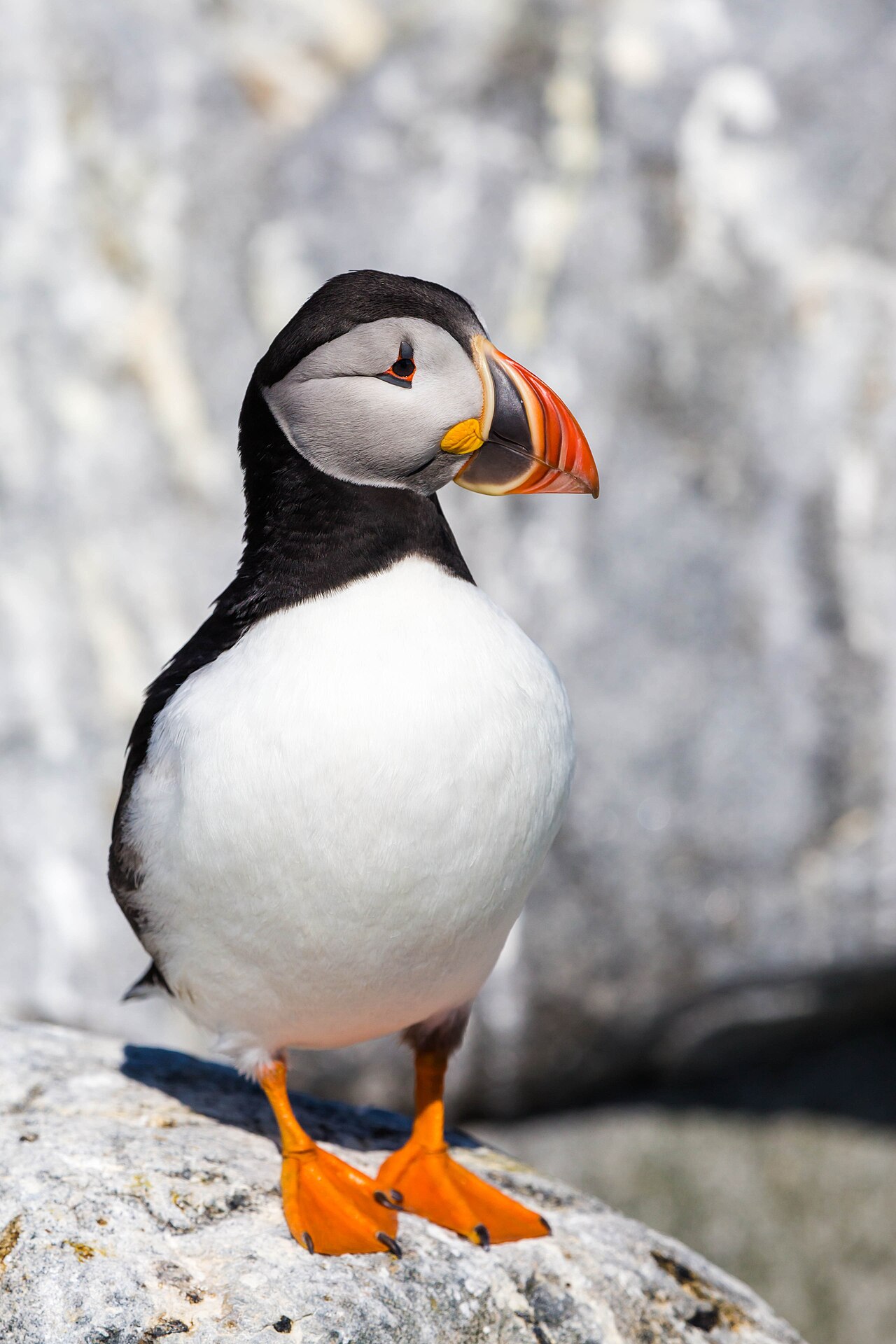
The Atlantic Puffin is a small, stocky auk with a deep three-coloured bill, orange feet and a face that reads as a mask from a distance. It breeds in burrows on islands in the northern Atlantic and spends the rest of the year far offshore, never touching land. In the United States it breeds only in Maine, where it had all but disappeared by the start of the twentieth century.
Voice
At sea it is silent. In the colony a low, sustained growl comes out of the burrow, like a muted chainsaw, with the stress always at the front: arr-arr-arr. At the entrance males add a piglike grunt while throwing the head back. A colony therefore sounds nothing like a gull colony, but like a low humming that comes out of the ground.
No freely licensed recording has been found for this species yet; what to listen for is described below.
Identification
Black above and white below, with a big head, a short neck and a triangular bill that is deep and narrow in profile. In the breeding season that bill is orange, yellow and blue-grey with sharp grooves, and the face is pale grey with a dark triangle above the eye. Outside the breeding season face and eye region turn dark grey and the bill sheds its yellow and blue plates; it becomes smaller and duller, but stays triangular. Juveniles have a distinctly narrower, wholly dark bill and a grey face. Male and female look alike. The flight is low over the water with very fast beats; underwater the same wings serve as paddles.
Confusion species
Razorbill (Alca torda) is bigger and longer, with a black, laterally flattened bill crossed by a white line, a pointed tail and an entirely dark head. Dovekie (Alle alle) is far smaller, with a short blunt bill and a squat, almost neckless shape. Black Guillemot (Cepphus grylle) has red feet and a large white wing patch, and in winter plumage a pale marbled upperside. The hardest are juvenile puffins and birds in winter plumage: the bill is then small and dark, but its depth and triangular shape remain unlike that of any other auk in the Atlantic.
Habitat
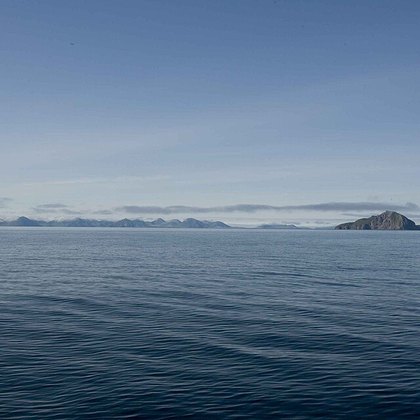
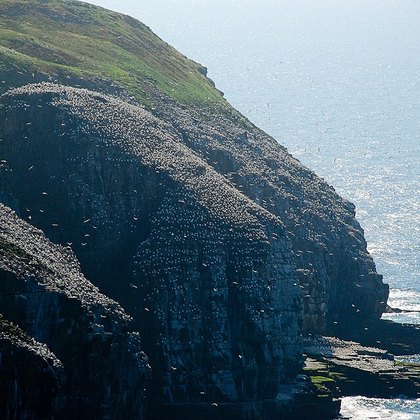
It breeds on islands and clifftops with a layer of turf or with loose boulders, where it can dig a burrow or take over a crevice. What decides the site is ground free of rats and foxes, and cool, clear water with small schooling fish within reach. For the rest of the year it lives on the open sea, usually over deep water beyond the continental shelf. It makes no use of wooded shores, sandy beaches or brackish inland waters.
Where the bird is most often found, arranged by the USNVC — the vegetation classification of the United States and Canada — and CMECS for sea and coast.
Range and movements
In the western Atlantic it breeds from Greenland and northern Hudson Bay south along Labrador and Newfoundland to the Gulf of St. Lawrence, Nova Scotia, New Brunswick and Maine; by far the most pairs are in Newfoundland and Labrador. On the other side of the ocean it breeds from Iceland and the Faroes to Norway, Svalbard and Novaya Zemlya. After breeding the birds scatter over the open ocean, from the edge of the pack ice to the Gulf Stream off North Carolina, and do not come ashore for months. In Maine, hunting for meat and feathers had reduced it to a single island by about 1900; since 1973 chicks from Newfoundland have been raised on abandoned islands, and more than two thousand birds breed there again.
- Resident
- Breeding (summer)
- Passage
- dark = core range, pale = thinly spread
Where and when to look
The surest place is a boat trip to a colony between mid-May and early August: Machias Seal Island or Eastern Egg Rock off Maine and New Brunswick, Witless Bay in Newfoundland, or the Mingan Islands in Quebec. Towards evening, watch the rafts on the water off the island; there the birds wait until it is dark enough to feed their chick. After mid-August the colony is empty and the chance of a puffin from land is close to nil.
Conservation
There are about twelve million birds worldwide, of which between 750,000 and 760,000 breed in North America. Even so the species is listed as vulnerable: numbers are falling across much of Europe, and the main cause is warmer sea water, which puts the small fish the chicks need in the wrong place or at the wrong time. On breeding islands introduced rats and cats are the second cause; oil and gill nets take their share at sea.
Scientific name
Fratercula arctica | (Linnaeus, 1758)
Linnaeus described the species in 1758 as Alca arctica, among the auks; because it was later placed in Fratercula, author and year stand in parentheses. The genus Fratercula was introduced by Brisson in 1760 and is Late Latin for 'little friar', after the black-and-white plumage that recalls a monk's habit. arctica means 'of the north', from arktos, the bear: the constellation that stands over the North Pole. Linnaeus gave the seas of northern Europe as the type locality; this was later restricted to Norway.