All species › Waders, gulls and terns › Auks, puffins and murres › Tufted Puffin
Tufted Puffin | Fratercula cirrhata
Kuifpapegaaiduiker | Frailecillo coletudo
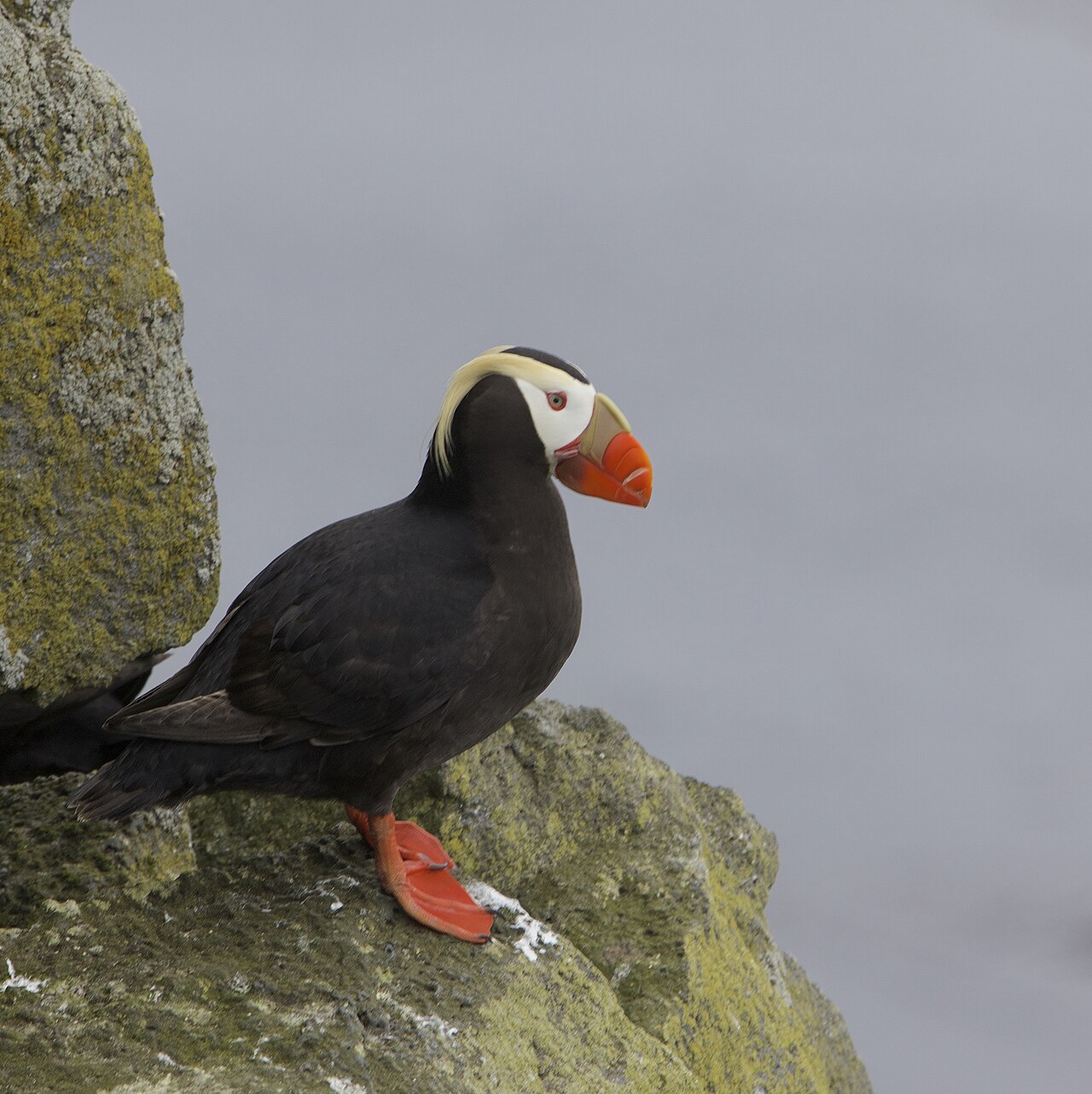
In breeding dress the Tufted Puffin is unmistakable: jet black, with a white mask, an orange-red bill like a painted plate, and two long straw-yellow tufts curling back from the eyes. For the rest of the year it carries none of that and drifts far offshore as a plain dark bird.
Voice
At sea it is entirely silent; everything it has to say, it says underground. From the burrow comes a low, drawn-out errrr-orrr, a sound closer to a distant engine than to a bird, muffled by the layer of earth above it. Walk across a colony and you hear it coming up from under your feet without a single bird in sight. Out of the burrow it is all but mute, even when it passes close by your head.
No freely licensed recording has been found for this species yet; what to listen for is described below.
Identification
In breeding plumage the body is wholly sooty black, with a sharply cut white face and a deep, heavy bill in orange-red and yellow-green. From each eye a bundle of long straw-yellow feathers sweeps back over the neck and lifts in the wind. The feet are bright orange and trail far behind at take-off. Outside the breeding season all of that goes: the face turns dark grey, the tufts disappear and the bill is smaller and duller, so that the bird at sea is barely recognisable as the same species. Male and female are alike; young birds are a dull blackish brown with a paler belly and a small dark bill. In flight it is a thickset, short-tailed black bird going fast and low over the water.
Confusion species
Horned Puffin (Fratercula corniculata) shares the white face but has a white belly, no tufts and a smaller bill; where the two breed together the underparts are the quickest thing to look at. Rhinoceros Auklet (Cerorhinca monocerata) is as dark and as stocky, but has a pale yellow pointed bill with a horn at its base and two white lines across the face. Atlantic Puffin (F. arctica) does not occur in these waters at all and is white below in any case. At distance the combination of an all-black underside and a thick pale head is unique.
Habitat
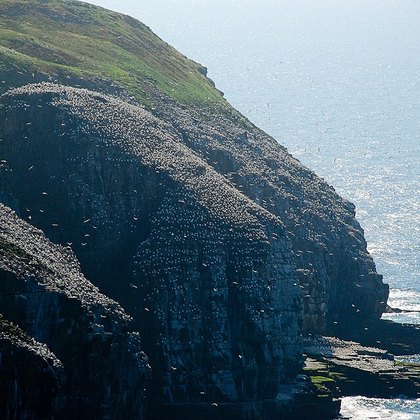
It breeds on steep islands and headlands where a layer of soil and grass tussocks lies over the rock, deep enough to dig a burrow in; bare cliff ledges without soil it does not use. Feeding is done at sea, over shallows and along edges where the current packs fish together, sometimes tens of kilometres from the colony. Outside the breeding season it leaves the coast altogether and lives on the open ocean, well out of sight of land. Colonies only hold on islands without rats or foxes.
Where the bird is most often found, arranged by the USNVC — the vegetation classification of the United States and Canada — and CMECS for sea and coast.



Range and movements
In North America it breeds from the Bering Sea and the Aleutians along the coast of Alaska south through British Columbia, Washington and Oregon into California, where the last colonies lie at the Farallon Islands. The stronghold is Alaska; southwards it thins out fast. Along that southern edge the number of colonies has shrunk sharply in a century — in Washington from forty-four known breeding sites to nineteen. Outside the breeding season the whole population spreads over the northern Pacific and is nowhere to be found on land; the map therefore shows only the coast where it nests.
- Breeding (summer)
- Passage
- dark = core range, pale = thinly spread
Where and when to look
Between May and August take a boat to a colony island and watch in the first hours after sunrise: that is when the birds come back from the sea, circle in wide loops in front of the slope and land with their bills full of fish. Later in the day most are in their burrows and the island looks empty. From the mainland it is seldom seen at all; now and then a late-summer storm carries a bird within reach of a headland.
Conservation
The world population is put at over two million breeding birds, by far the most of them in Alaska, and the Red List treats the species as of least concern. Along the southern edge the picture is different: in Washington the count fell from over twenty-three thousand birds around 1980 to barely three thousand in 2009, and there it stands as endangered on the state list. A request for federal protection in the United States was turned down in 2020, on the grounds that the range as a whole remained intact. The threats are introduced rats and foxes on breeding islands, warming water that shifts the fish, and plastic in the food.
Scientific name
Fratercula cirrhata | (Pallas, 1769)
Pallas described the species in 1769 as Alca cirrhata; since it was placed with Fratercula, author and year stand in parentheses. Fratercula is Medieval Latin for 'little brother', after a black-and-white plumage that recalls a monk's habit; the genus was introduced by Brisson in 1760. cirrhata comes from the Latin cirrus, 'lock of hair', and refers to the yellow tufts. The type locality is the sea between Kamchatka, America and the Kuril Islands — the bird was described, in other words, from the Russian side of the Pacific.