All species › Waders, gulls and terns › Auks, puffins and murres › Rhinoceros Auklet
Rhinoceros Auklet | Cerorhinca monocerata
Neushoornalk | Alca unicórnea
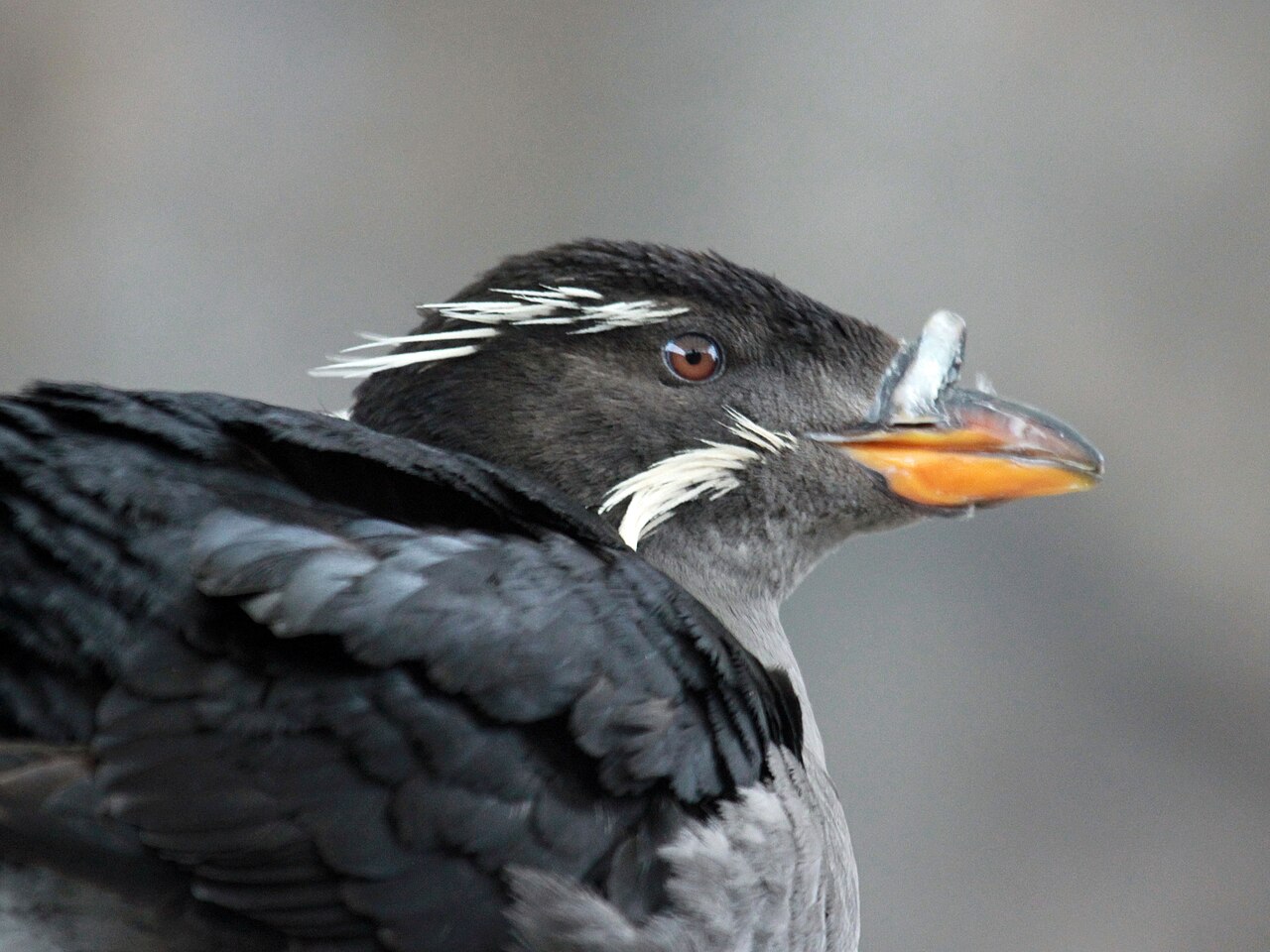
The Rhinoceros Auklet is the first auk in this guide: a squat, sooty-grey seabird of the northern Pacific with a heavy orange bill. Breeding birds carry an upright horn on that bill and two thin white plumes on the head, both only in summer. By day it sits far offshore; it comes to its colony only after dark.
Voice
At the colony it is noisy at night: low, nasal, mooing calls mixed with barking, growling, braying, squeaking and trumpeting, out of the burrows and from the ground. Standing on a breeding island in the dark you hear a chorus that suggests cattle rather than birds. It also rattles its bill. At sea it is silent.
Recording: KEISUKE KAGOSHIMA — CC BY 4.0 · Miyagi pref. Onagawa-town, Japan · xeno-canto
Identification
A heavy, short-necked auk with a thick head, broad pointed wings, short legs and large webbed feet. The plumage is a cloudy grey-brown, darker on the back than on the flanks and belly, with no sharp borders. In breeding plumage two thin white plumes stand on the head — one above the eye, one behind the base of the bill — and a pale upright horn rises from the orange-yellow bill. Outside the breeding season the horn is shed and the white plumes are far weaker; the bird is then almost uniform. Juveniles resemble winter adults but have a smaller, dark bill. Male and female cannot be told apart; males are about a tenth heavier.
Confusion species
Tufted Puffin (Fratercula cirrhata) is larger and blacker, and its juveniles have a dark bill just as the Rhinoceros Auklet does — the difference lies in the puffin's deeper, heavier bill and far darker underparts. Cassin's Auklet (Ptychoramphus aleuticus) is less than half the size, paler grey, with a pale iris and a white arc above the eye. Common Murre (Uria aalge) is longer and slimmer, with a long pointed bill and sharply defined white underparts. At a distance the flight helps: the Rhinoceros Auklet flies heavily and low with fast beats, and needs a long run over the water to get up.
Habitat
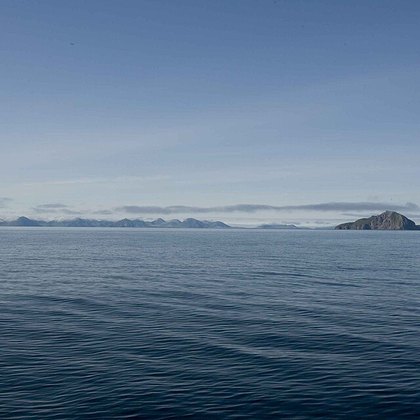
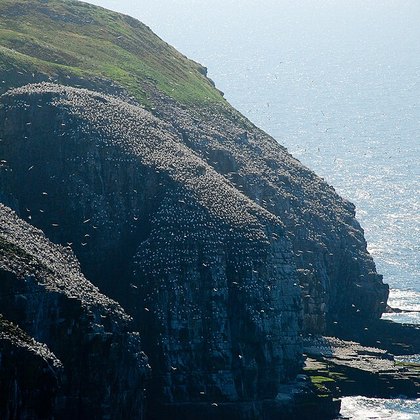
It breeds on islands off the coast, in burrows it digs itself in the soil of grassy or wooded slopes, sometimes hundreds of metres from the water. In the breeding season it feeds close to the colony, at tide rips and upwellings where small fish are driven together. Outside the breeding season it moves to deeper water over the shelf and the shelf slope, usually out of sight of land. It passes over densely wooded islands with no open ground, and it does not breed on mainland shores with foxes or rats.
Where the bird is most often found, arranged by the USNVC — the vegetation classification of the United States and Canada — and CMECS for sea and coast.

Range and movements
It breeds around the northern Pacific, from Sakhalin, the Kurils and northern Japan to the Aleutians, southern Alaska, British Columbia, Washington, Oregon and California. The largest colonies are on Triangle Island off Vancouver Island and on Protection Island and Destruction Island in Washington. In winter the northern birds leave and spread through coastal waters south to northern Baja California. In the south of the range part of the population stays near the colony all year, so there it can be found on the water in any month.
- Resident
- Breeding (summer)
- Winter
- Passage
- dark = core range, pale = thinly spread
Where and when to look
Look for it from a ferry or a whale-watching boat in the Salish Sea, off Monterey, or off the Oregon coast: it sits low on the water in small parties and dives away as soon as the boat comes too close. In June and July, in the last hour before dark, breeding birds gather on the water off the island with a crosswise row of small fish in the bill — that is the best moment to see the horn. On land it cannot be found by day; everything happens after sunset.
Conservation
The world population was put at about one and a half million birds in 2017 and the species is listed as Least Concern (LC). Its threats are those of any burrow-nesting auk: introduced rats, foxes and raccoons on breeding islands, drowning in gill nets, oil at sea, and fish stocks shifting away in warm water. Where introduced predators have been taken off an island, the birds come back.
Scientific name
Cerorhinca monocerata | (Pallas, 1811)
Pallas described the species in 1811 as Alca monocerata; because it was later placed in a genus of its own, author and year stand in parentheses. That genus, Cerorhinca, was introduced by Bonaparte in 1828 and means 'horn-bill', from the Greek keras (horn) and rhynchos (bill). monocerata means 'one-horned' and refers to the same growth. Pallas gave Cape St. Elias and Kodiak, both in Alaska, as the type locality.