All species › Waders, gulls and terns › Jaegers and skuas › South Polar Skua
South Polar Skua | Stercorarius maccormicki
Zuidpooljager | Págalo polar
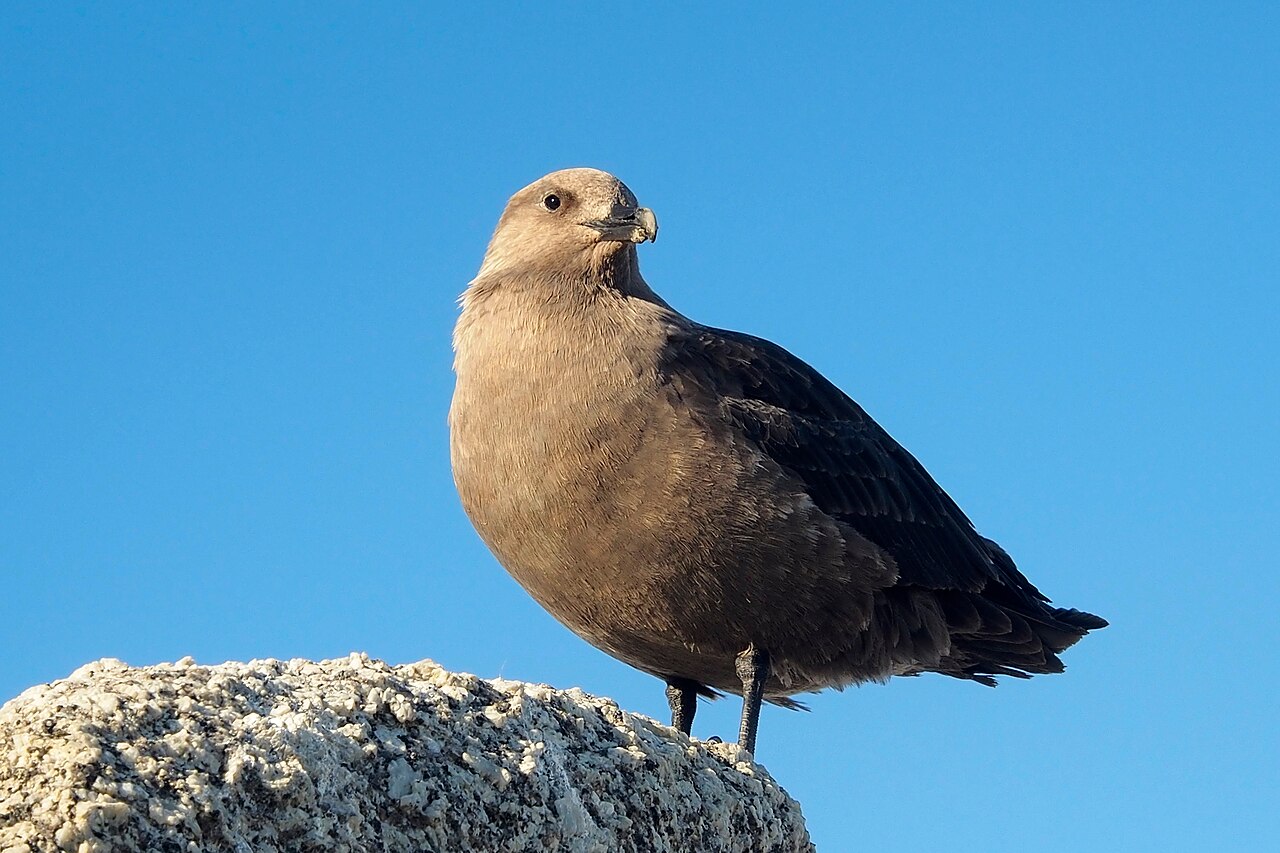
The South Polar Skua breeds on the coast of Antarctica and reaches North American waters in the northern summer — one of the longest return journeys any seabird makes. It is a heavy, short-tailed skua with bold white wing flashes, seen regularly well offshore on both coasts. It does not breed here.
Voice
In North American waters it is almost always silent. At the colony in Antarctica it gives a rattling, chattering call, often with the wings raised in greeting to its mate. Anyone who sees one at sea sees it mute: the noise comes from the shearwaters and gulls it is chasing.
Recording: steve — CC BY-SA 4.0 · Cuverville Island, Antarctica · xeno-canto
Identification
A heavy, broad-chested skua with broad wings, a short tail and a heavy black bill. The plumage comes in three tones: pale birds have a whitish head, neck and underparts standing out sharply against the dark wings, intermediates are straw-coloured, and dark birds are a cold grey-brown. In all three the body is uniform, without the light streaking of the Great Skua, and a paler nape contrasts with the darker back. Each wing carries a large white flash at the base of the primaries, equally bright above and below. Male and female look alike; juveniles are colder grey with a blue-grey base to the bill.
Confusion species
Great Skua (Stercorarius skua) is the hardest: it is a warmer brown, lightly streaked and mottled all over, without the pale nape, and it is in North American waters in the winter half of the year. Pomarine Jaeger (Stercorarius pomarinus) is slimmer, has a white belly with a dark breast band in adult plumage and a narrower wing flash, and flies more lightly. Dark Pomarine Jaegers are the trickiest at a distance; then watch for the barrel chest and the broad, short wing base of the South Polar Skua. The date almost always helps: between May and October a Great Skua off the American coast is unlikely and a South Polar Skua the ordinary answer.
Habitat
Outside the breeding season it lives entirely on the open sea, over cold and warm water alike, crossing the tropics in the process. In North America it stays far offshore, usually over the shelf edge or further out still; from the beach it is almost never seen. It breeds on ice-free ground along the coast of Antarctica, often right beside penguin colonies. It makes no use of harbours or inland water.
Where the bird is most often found, arranged by the USNVC — the vegetation classification of the United States and Canada — and CMECS for sea and coast.

Range and movements
It breeds along the Antarctic coast, above all around the Ross Sea, and on the South Shetland and South Orkney Islands. After breeding it moves north far into the northern hemisphere: in the Pacific to the waters off Japan and the west coast of North America, in the Atlantic to the Gulf Stream off the east coast. On the west coast it is most numerous off southern California in late spring and off northern California, Oregon and Washington in early autumn; on the east coast mainly off New England in early summer. How these journeys run in detail is still only partly known, because the birds are almost never seen from land.
- Breeding (summer)
- Passage
- dark = core range, pale = thinly spread
Where and when to look
The best chance is a pelagic trip well out from the coast: off Monterey and Bodega Bay in August and September, off southern California in May, and out of Cape Cod or Hatteras in June and July. Watch for the spot where shearwaters suddenly scatter or bunch over a single point. With a photograph the question is always the same: streaked and warm brown, or uniform with a pale nape?
Conservation
The species is listed as of least concern. Its breeding grounds lie far from human settlement, and the number of breeding pairs across the whole range has never been counted well. What happens in Antarctica to the penguin and petrel colonies it lives off there decides its fate more than anything that happens at sea.
Scientific name
Stercorarius maccormicki | Saunders, 1893
Saunders described the species in 1893 as Stercorarius maccormicki; author and year stand without parentheses, because it is still in the genus in which it was described. Stercorarius is Latin for 'of dung', from the old misunderstanding that skuas ate the droppings of the seabirds they chase. maccormicki honours Robert McCormick, ship's surgeon and naturalist on James Clark Ross's Antarctic voyage with the Erebus and the Terror. The type locality is Possession Island in Victoria Land, at 71° 14' south.