All species › Passerines › Finches, euphonias and allies › Kauai Amakihi
Kauai Amakihi | Chlorodrepanis stejnegeri
Kauai-amakihi | Amakihi de Kauai
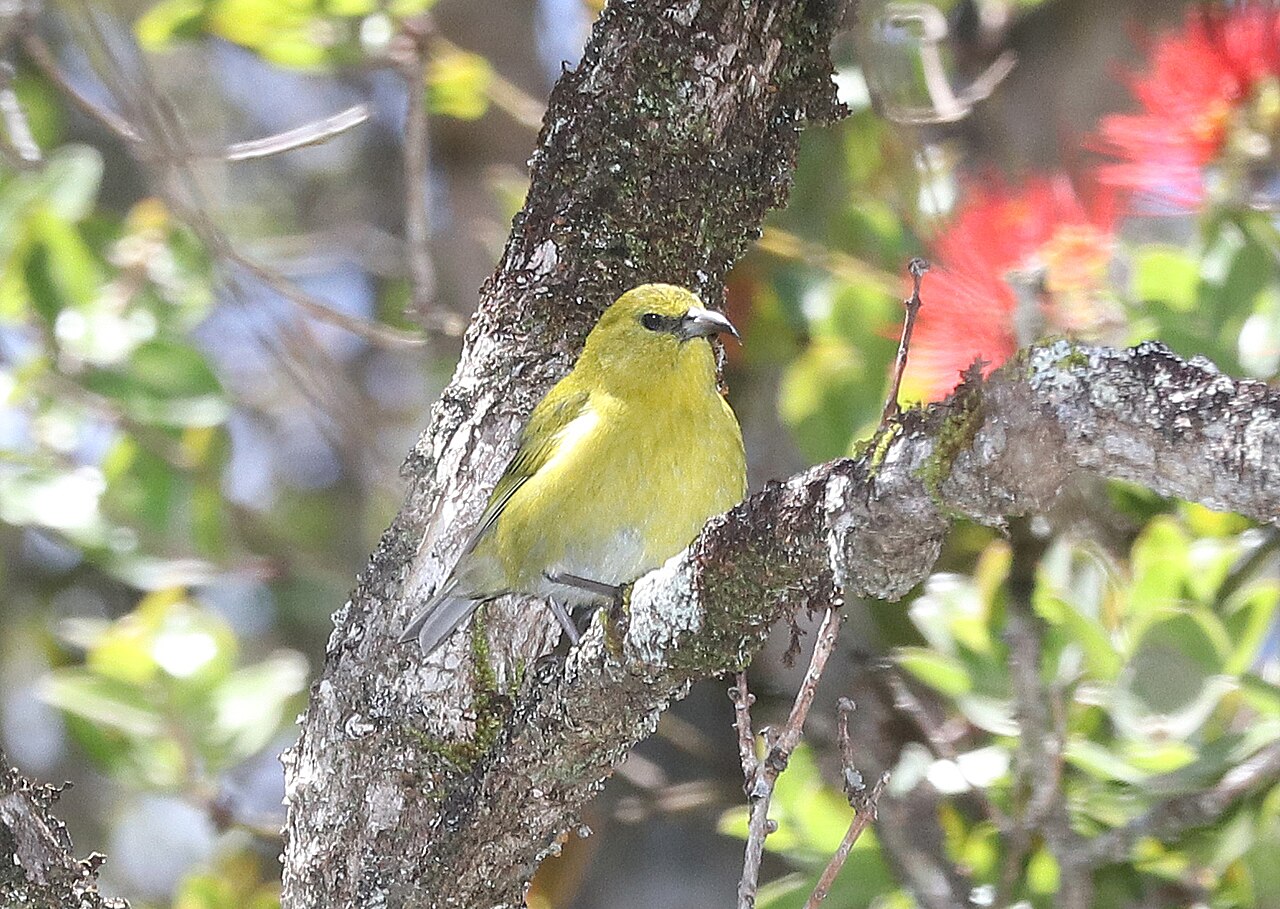
The Kauai Amakihi is the largest and the rarest of the three surviving amakihi, and occurs only on Kauai. It has a heavier, more strongly curved bill than its relatives and has been pushed back into the wet montane forest of the Alakai Plateau and the ridges around it.
Voice
The song is a short, musical trill of one or two seconds that holds its pitch and speed, often given from the top of an ohia. The call is a nasal, clipped chip, repeated at intervals while foraging; in the mist of the Alakai it is often the only sign that a bird is there. The female calls as often as the male but sings little.
No freely licensed recording has been found for this species yet; what to listen for is described below.
Identification
About eleven centimetres, bulkier than the other amakihi, with a pale, notably long and strongly decurved bill. The upperparts are olive green, the underparts yellow, and a dark lore mark sits between bill and eye. The male is brighter and has a clearly larger bill than the female, which is duller green-grey. The bird works along trunks and side branches and regularly hangs upside down.
Confusion species
The Akekee, which shares the same forest, has a short conical blue-grey bill with the tip bent to one side, a yellow crown and a forked, notched tail; the Kauai Amakihi has a long curved bill and a square tail. The Anianiau is smaller, brighter yellow, without a dark lore and with a shorter, far less curved bill. The Warbling White-eye has a white eyering and a thin straight bill.
Habitat
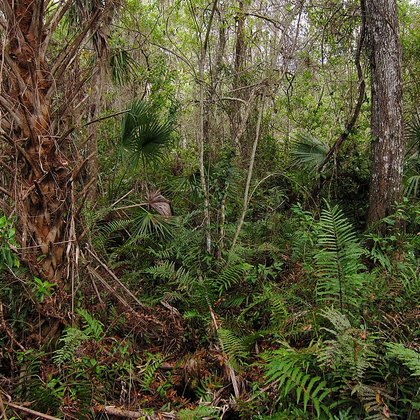
Moist and wet montane forest of ohia and koa, in practice above six hundred metres and most numerous above eleven hundred, where mosquitoes are absent for most of the year. It forages mainly along trunks, heavy limbs and through moss and lichen for insects and spiders, and also drinks nectar and takes small fruit. It pierces the base of a flower to reach nectar rather than visiting it from the front.
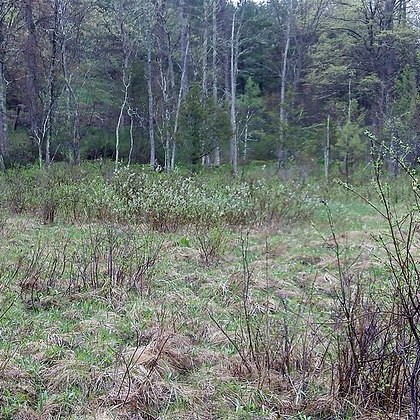
Where the bird is most often found, arranged by the USNVC — the vegetation classification of the United States and Canada — and CMECS for sea and coast.
Range and movements
The range covers the northwest and interior of Kauai: the Alakai Wilderness, the Kokee area and Waimea Canyon, the rim of the Napali Plateau and the Makaleha Mountains. It formerly reached the lowlands; that part of the range is gone. The population is put at roughly 2,200 to 4,400 mature birds and is declining, and the upper forest no longer offers an escape as mosquitoes push higher.
- Resident
- Passage
- dark = core range, pale = thinly spread
Where and when to look
The Pihea Trail and the Alakai Swamp Trail at Kokee State Park give the best chance; go in a clear spell early in the morning, because the forest stays silent in persistent fog. Watch the bill and the way the bird feeds: a green-yellow bird working up a trunk with a long curved bill is this species, one picking at the outermost leaf clusters is more likely an Akekee.
Conservation
The species is listed as Endangered. Avian malaria and avian pox, carried by the introduced southern house mosquito, are the decisive pressure; as the climate warms, the mosquito season moves higher into the forest year by year, shrinking the disease-free part of Kauai. Damage to the forest by pigs and goats, invasive plants and predation by rats add to this. Since 2025 sterile male mosquitoes have been released on Kauai to break transmission; the effect on bird numbers has not yet been measured.
Scientific name
Chlorodrepanis stejnegeri | (Wilson, 1890)
Scott Barchard Wilson described the species in 1890 as Himatione stejnegeri; because it was later moved to another genus, author and year stand in parentheses. The species name honours Leonhard Stejneger, the Norwegian-American zoologist of the Smithsonian. The genus Chlorodrepanis was introduced in 1899 by Robert Perkins, from Greek khloros 'green' and drepanis 'sickle'. The Hawaiian ʻamakihi refers to the curve of the bill.