All species › Passerines › Finches, euphonias and allies › Oʻahu ʻAmakihi
Oʻahu ʻAmakihi | Chlorodrepanis flava
Oʻahu-ʻamakihi | ʻAmakihi de Oʻahu
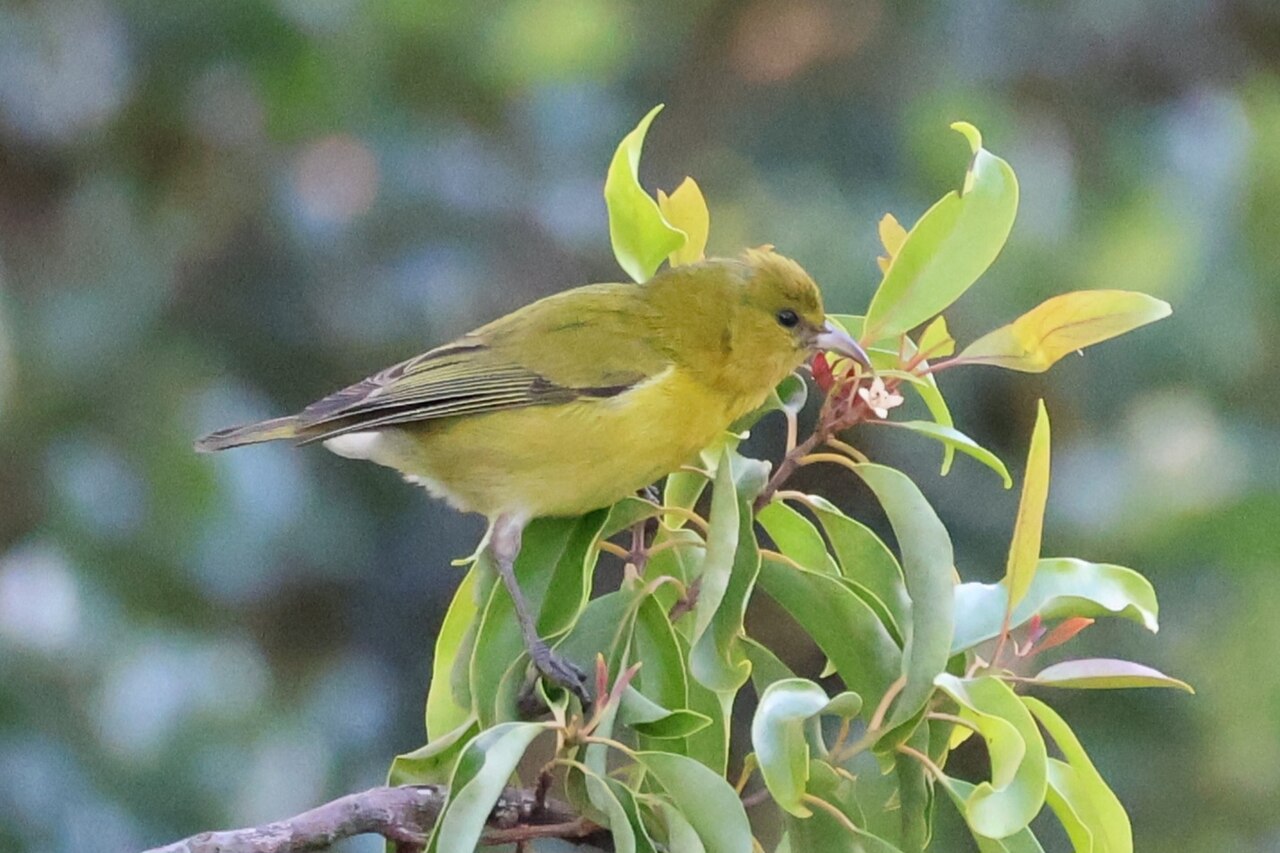
The Oʻahu ʻAmakihi is a small green and yellow honeycreeper found only on Oʻahu. Of all the surviving Hawaiian honeycreepers it is holding its ground best: while most of its relatives have been pushed back into forest above a thousand metres, this one still breeds in valleys just above the houses.
Voice
The male's song is a short, dry trill that holds the same pitch and the same speed from start to finish — a rattling tr-r-r-r-r of a second or two, delivered from a high perch. The call is a nasal, upslurred chee, repeated while foraging and in dense foliage often the first sign of the bird. Both sexes call; the female rarely sings.
Recording: Sean Erroll MacDonald — CC BY-NC-SA 4.0 · Waipahu, Honolulu County, Hawaii, United States · xeno-canto
Identification
A bird of about eleven centimetres with a short, clearly decurved bill. The male is yellow-green above and yellow below, with a black lore between bill and eye that reads as a small dark mask. Female and immature are greyish green above and dingy white below, with two pale wingbars and a fainter lore patch. The male's bill is heavier than the female's.
Confusion species
The Warbling White-eye, abundant across Oʻahu, has a bold white eye-ring, a thin almost straight bill and no dark lore; the ʻamakihi has that lore mark and a thicker, curved bill. The ʻApapane is deep red with black wings and tail and white undertail, so confusing only in silhouette. The Oʻahu ʻElepaio is larger, browner and often holds its tail cocked.
Habitat
Wet montane forest of ohia and koa (Acacia koa, a native Hawaiian tree) is the core, but the species also uses stands of introduced trees, wooded parks and gardens against the foot of the mountains. It occurs mainly above five hundred metres and in several valleys lower than that, down close to the edge of Honolulu. It moves quickly through leaves and thin branches, takes nectar from ohia and banana flowers, and gleans insects and spiders from leaf axils.
Where the bird is most often found, arranged by the USNVC — the vegetation classification of the United States and Canada — and CMECS for sea and coast.




Range and movements
The entire range lies on Oʻahu: the wet southeastern slopes of the Koolau Range, the valleys near Wahiawa and Mililani, and the country around the Honouliuli Preserve in the Waianae Range. It is the most numerous native forest bird on the island, with estimates in the tens of thousands. Unlike most honeycreepers, its range has spread downwards since the 1990s, into lowland where avian malaria circulates year round.
- Resident
Where and when to look
Wa'ahila Ridge above Honolulu and the Aiea Loop Trail are two sites; go early in the morning, when song is at its peak. Listen first and look second: the level trill separates it from the white-eye, which gives a higher, rising babble. Once you have the bird, watch for the black lore — it stays visible even in poor light.
Conservation
The species is listed as Near Threatened (NT). Part of the lowland population has been shown to carry resistance to avian malaria; those birds survive an infection that is lethal elsewhere in Hawaii, which explains the spread into lower forest. Loss of native forest, rats and cats, and competition with introduced songbirds remain the main pressures. The range is small and confined to one island, so an outbreak or a large fire reaches the whole population.
Scientific name
Chlorodrepanis flava | (Bloxam, 1827)
Andrew Bloxam described the species in 1827 as Nectarinia flava, from material collected on the voyage of HMS Blonde; because it was later moved to another genus, author and year stand in parentheses. The genus Chlorodrepanis was introduced in 1899 by Robert Perkins, from Greek khloros 'green' and drepanis 'sickle', after the curved bill. The species name flava is Latin for 'yellow'. The English name takes over the Hawaiian ʻamakihi, which refers to the curve of the bill.