All species › Waterfowl › Ducks, swans and geese › King Eider
King Eider | Somateria spectabilis
Koningseider | Éider real
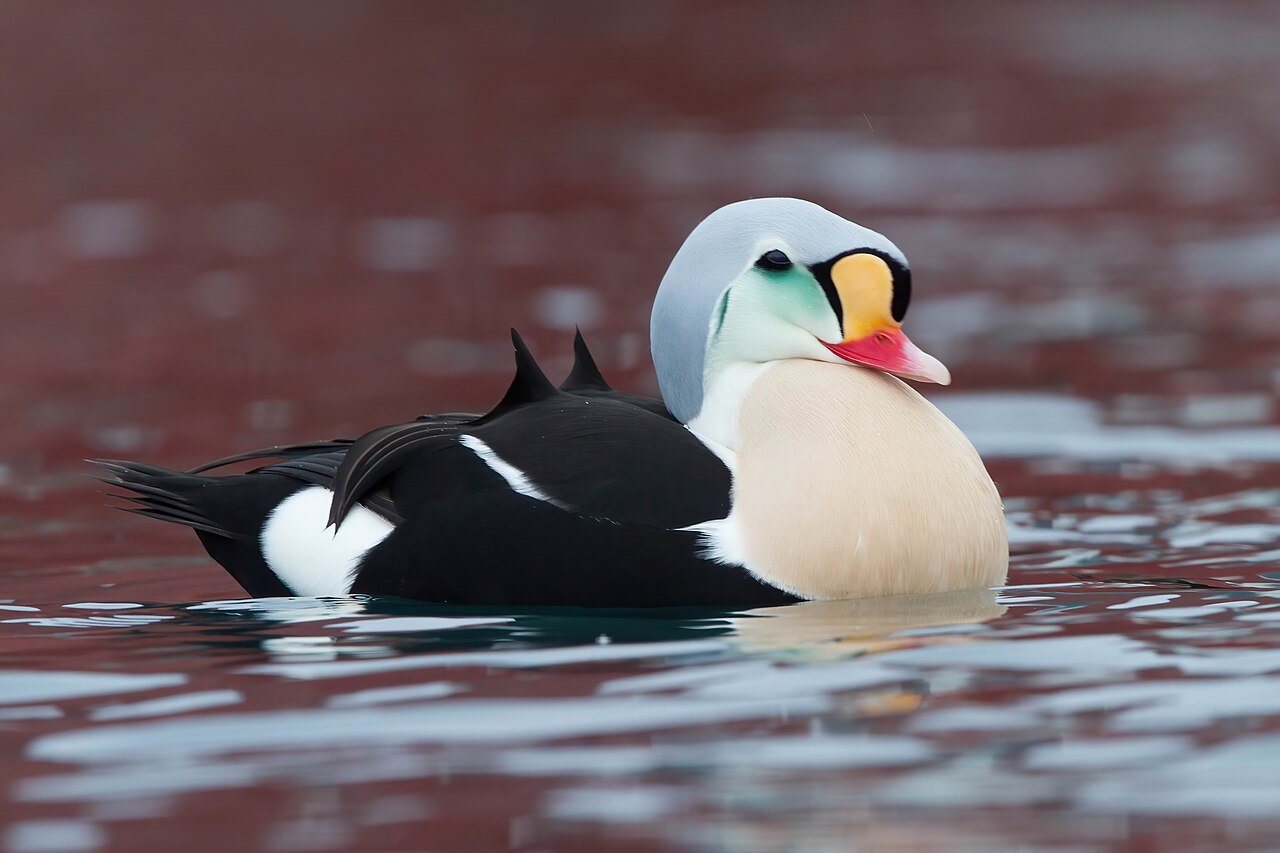
King Eider is the eider of the high Arctic: it breeds further north than the other three species and is the only one that truly ranges right around the pole, from Alaska through Canada and Greenland to Russia. In summer the male wears a blue-grey head with a green cheek and a large, swollen orange bill shield — the 'crown' the name refers to — above an otherwise black-and-white body. Of the four eiders this is the only one listed as not threatened, though here too the trend has fallen sharply over the past fifty years.
Voice
During courtship the male gives a soft, dove-like rooo-ooo-oo, often repeated, which sounds gentle and muted compared with the calls of other sea ducks. The female answers with a low kwak in alarm, and on the breeding grounds growling, croaking and murmuring calls from both sexes are also heard. Birds that appear far south of their normal range, outside the breeding season, usually show themselves in silence.
No freely licensed recording has been found for this species yet; what to listen for is described below.
Identification
The male in breeding plumage has a blue-grey crown, a greenish cheek and a large orange bill shield forming a bulge on the forehead above the red bill; the body is otherwise mostly black, with white patches on the back, underwing, flank and upperwing. The female is warm rusty brown with coarse black barring over the whole body, a dark bill and a characteristic, gradually sloping transition between forehead and bill. Immature males are dark brown with a white breast and an orange bill, lacking the adult's head pattern. The bill is relatively short but heavy, and the male's bill shield takes several years to reach full size.
Confusion species
Spectacled Eider (Somateria fischeri) has no blue-grey head and no orange bill shield, but white, black-rimmed eye patches on an olive-green head; females of the two species are harder to separate, but King Eider shows coarser, more curved black barring than the more finely marked Spectacled Eider. Common Eider (Somateria mollissima), the most numerous of the four eiders in this region, is larger, with a long, sloping bill lacking a shield in the male; female Common Eiders are even more coarsely marked than female King Eiders and lack the gradually sloping forehead profile. In flight a flock of King Eiders is told by its more compact build and faster wingbeat.
Habitat
Breeds on bare to lightly vegetated Arctic tundra, usually close to a small lake or stream, where plants such as crowberry, bearberry, Labrador tea and dwarf willow cover the ground. Outside the breeding season the species is entirely marine: after moulting it gathers in large flocks at sea, off the western Beaufort Sea or near Greenland and Baffin Island, and winters along the edge of the sea ice or in large open leads, diving to the seabed for shellfish, sea urchins and starfish. On the Great Lakes, where small numbers winter, the introduced zebra mussel now forms a significant part of the diet.
Where the bird is most often found, arranged by the USNVC — the vegetation classification of the United States and Canada — and CMECS for sea and coast.




Range and movements
Breeds circumpolar in the high Arctic: on the Arctic Coastal Plain of Alaska, on the islands of northern Canada, along the coast of northern and central Greenland, and in Russia from east of the White Sea to Chukotka. The US population winters mainly in the Bering Sea and around the Aleutians, with smaller numbers as far as Newfoundland, southern Greenland, Iceland and northern Norway; on the Great Lakes and in Hudson Bay a few birds turn up each winter, too few and too scattered to count as a regular wintering ground.
- Resident
- Breeding (summer)
- Winter
- Passage
- dark = core range, pale = thinly spread
Where and when to look
The best chance outside Alaska is in winter along the coast of Newfoundland and Labrador, where small numbers winter among flocks of Common Eiders and scoters; look then for the more compact build and, in males, the unmistakable orange bill shield. On the breeding grounds in the high Arctic, beyond the reach of most observers, June is the best month, when males still sit in full breeding plumage beside the small lakes.
Conservation
King Eider is not threatened worldwide, with a large and still substantial population, but the 2025 State of the Birds report names the species an Orange Alert Tipping Point species after a decline of more than half in fifty years. Climate change, hunting and oil and gas development on the breeding grounds are regarded as the main risks for the future.
Scientific name
Somateria spectabilis | (Linnaeus, 1758)
Linnaeus described the species in 1758 as Anas spectabilis, among the ducks; because it was later moved to another genus, author and year stand in parentheses. The genus Somateria was introduced by Leach in 1819 and is Greek for 'woolly body', from soma, 'body', and erion, 'wool', after the eiders' thick down. The species name spectabilis is Latin for 'notable' or 'remarkable', after the male's colours. The type locality lies in Canada and Sweden.