All species › Waterfowl › Ducks, swans and geese › Spectacled Eider
Spectacled Eider | Somateria fischeri
Brileider | Éider de anteojos
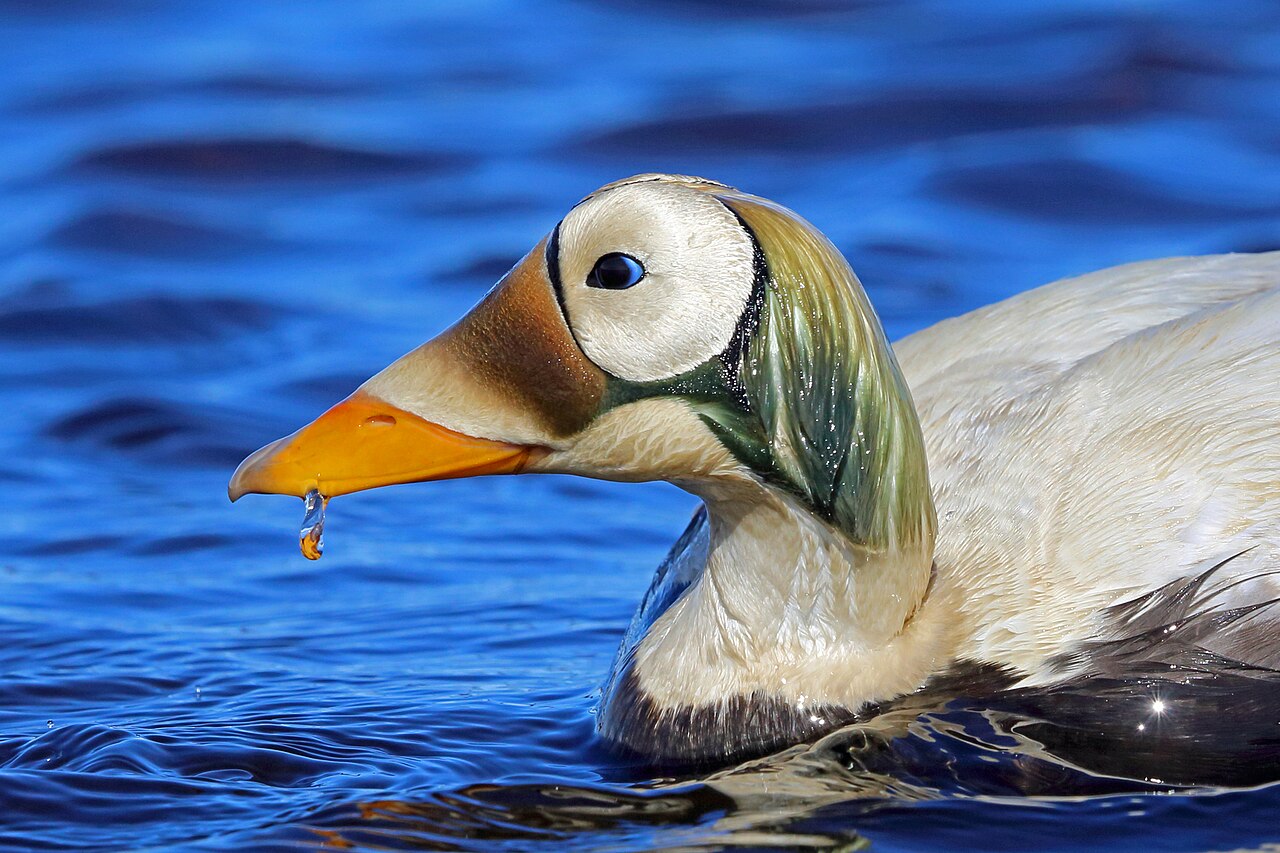
Spectacled Eider takes its name from the broad, white-rimmed patches around the male's eyes, which look painted onto an otherwise olive-green head like a pair of goggles. Until deep into the twentieth century the species vanished without trace after the breeding season; only satellite telemetry in the 1990s revealed that nearly the entire world population winters in a handful of permanent openings in the pack ice in the middle of the Bering Sea. On the Yukon-Kuskokwim Delta, historically the core of the Alaska breeding population, numbers have fallen sharply since the 1970s.
Voice
During courtship the male gives a weak, groaning croon, similar to but softer than that of other eiders. The female answers with a harsh croak. Outside courtship the species is largely silent, and at the wintering grounds in the pack ice, far from land and observers, there is almost never anyone there to hear it.
No freely licensed recording has been found for this species yet; what to listen for is described below.
Identification
The male has the broad white, black-rimmed eye patches that give the species its name, set on an otherwise olive-green and brown head; the body is white above and mostly black below, with a large, sloping orange bill. The female is warm reddish-brown with fine dark markings over the whole body and a faint, pale-brown version of the male's eye patch, on a dark rather than orange bill. The bill is heavy in both sexes, with feathering extending halfway to the tip. In size the species falls between Surf Scoter and Common Eider.
Confusion species
Steller's Eider (Polysticta stelleri) is smaller and the male entirely lacks the broad eye patches; confusion arises mainly with females, both plain brown — look then for the heavier bill and the faint pale-brown eye patch of Spectacled Eider. The male King Eider is distinguished at once by colour: no blue-grey head with an orange bill shield, but white-and-black with the characteristic goggles. Female King and Spectacled Eiders are harder to separate at a distance, but Spectacled Eider is finer and darker marked, without the coarser, more curved black barring of King Eider.
Habitat
Breeds on the tundra of western Alaska and on the Arctic Coastal Plain, favouring small, sedge-covered islands in shallow tundra lakes, close to the water's edge. Outside the breeding season the species almost entirely disappears into the sea: after gathering in coastal lagoons it moves to the pack ice of the northern Bering Sea, where in fixed polynyas — permanent openings between St. Lawrence and St. Matthew Islands — it dives several tens of metres deep for shellfish on the seabed.
Where the bird is most often found, arranged by the USNVC — the vegetation classification of the United States and Canada — and CMECS for sea and coast.



Range and movements
Breeds in two separate areas: the Yukon-Kuskokwim Delta in western Alaska and the Beaufort Sea coast in the north, and further in Siberia from the Lena Delta to Chukotka. Almost the entire world population winters in the same polynyas in the northern Bering Sea, regardless of where the birds bred — a concentration only established by satellite tags in 1995 and 1996. The US breeding population is estimated at three to four thousand pairs, with the Russian population now considerably larger than the Alaska one.
- Breeding (summer)
- Passage
- dark = core range, pale = thinly spread
Where and when to look
This species is essentially out of reach for most observers: the wintering ground lies in the middle of the Bering Sea pack ice, far from any coast. On the breeding grounds, especially the Yukon-Kuskokwim Delta, the best chance is in June, as pairs settle on the tundra lakes; away from Alaska, and without a boat or aircraft to the pack ice, the species remains unreachable for almost everyone.
Conservation
The IUCN lists the species as Near Threatened, and the 2025 State of the Birds report counts it among the Red Alert Tipping Point species after a decline of more than half in fifty years. On the Yukon-Kuskokwim Delta, historically the core of the Alaska breeding population, numbers have fallen by more than 96 percent since the 1970s. The species has been listed as threatened under the US Endangered Species Act since 1993, and oil and gas development near key breeding areas such as Teshekpuk Lake remains a future risk.
Scientific name
Somateria fischeri | (Brandt, 1847)
Brandt described the species in 1847 as Fuligula (Lampronetta) Fischeri, in a subgenus of the pochards; it has since been placed in another genus, hence the parentheses around author and year. The genus Somateria was introduced by Leach in 1819 and is Greek for 'woolly body', from soma, 'body', and erion, 'wool' — a reference to the eiders' thick down. The species name honours the German zoologist Johann Gotthelf Fischer von Waldheim. The type locality is St. Michael, Alaska.