All species › Waterfowl › Ducks, swans and geese › Steller's Eider
Steller's Eider | Polysticta stelleri
Stellers eider | Éider menor
Steller's Eider is the smallest of the four eiders and the only one that does not belong to the genus Somateria. It breeds in small numbers on the tundra of northern Alaska and in far greater numbers in Siberia, and winters almost entirely around the Alaska Peninsula and the Aleutians. No North American duck has lost as much ground in recent decades: the Alaska breeding population has been listed as threatened since 1997.
Voice
Steller's Eiders call considerably less than the other eiders. During courtship the male gives a soft, murmuring croon, similar to but softer than that of Common Eider, and rarely heard at any distance. The female answers with a soft qua-haaa or cooay. Outside courtship the sound consists mainly of low, growling and barking calls, and in flight a whistling made by the wings — similar to that of goldeneyes — often gives away a flock before any call from the bill does.
No freely licensed recording has been found for this species yet; what to listen for is described below.
Identification
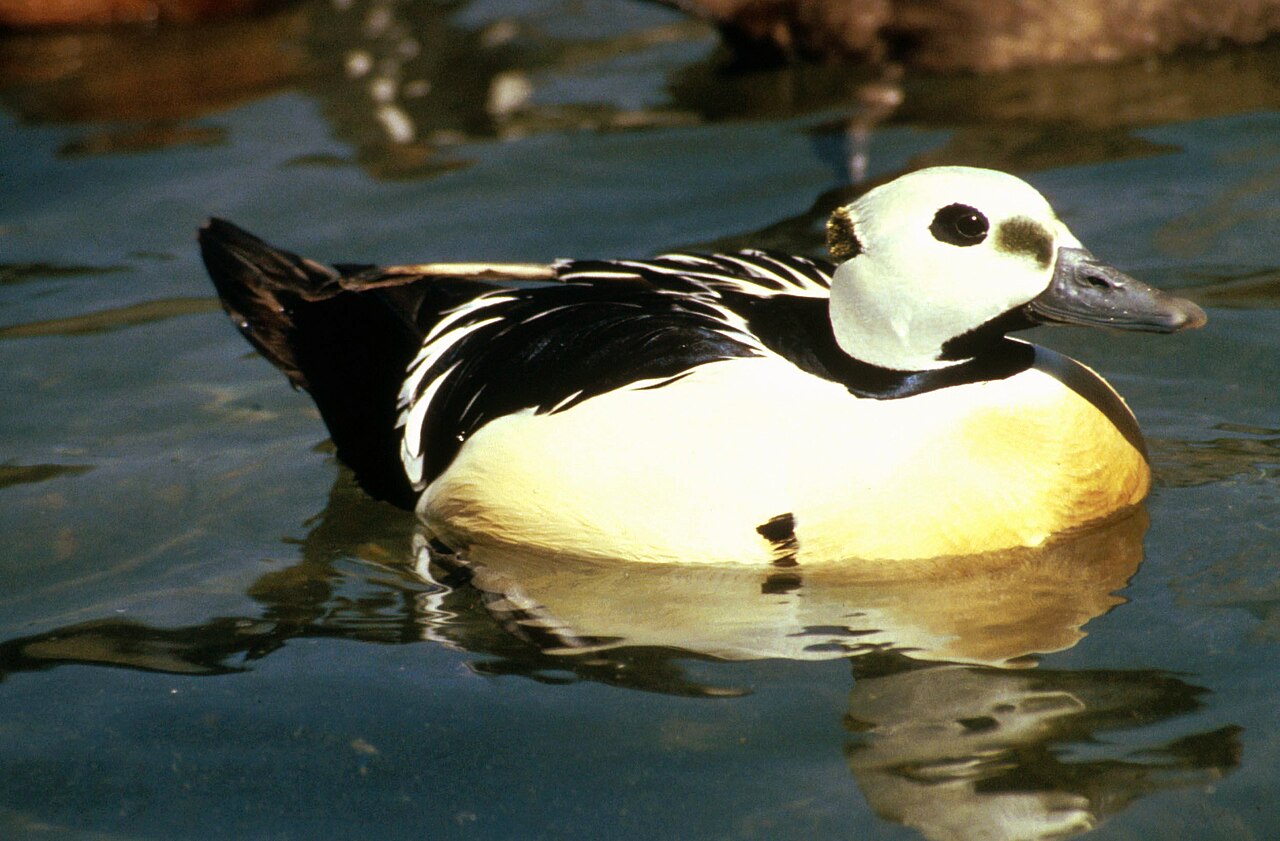
The male in breeding plumage has a mostly white head with a green patch on the hindcrown and in front of the eye, an orange-buff breast and belly with a black spot on the flank, a black collar around the neck, and a blue-black back with white feather edges. The bill and head are small for an eider, with a flat crown and a short, heavy bill. The female is warm chestnut to dark brown with a faint white eyering, lacking the male's striking head pattern. Immature males look like a paler brown version of the female. In flight the male shows a largely white forewing panel, the female blue-black flight feathers bordered in white and white underwings.
Confusion species
Spectacled Eider (Somateria fischeri) is larger, with a heavier bill and an entirely different head pattern; confusion arises mainly with females and immature males, which look plain brown at a distance. Harlequin Duck is smaller and shares no head marking at all with the male Steller's Eider, but in silhouette — small, round, short-billed — a female can cause confusion; look for the plain, unmarked brown flanks of Steller's Eider against the spotted flanks of a Harlequin. At the shared wintering grounds around the Alaska Peninsula the species often swims in mixed flocks with Spectacled Eider, which makes comparison easier.
Habitat
Breeds on marshy Arctic tundra rich in water sedge and pendant grass, choosing the slightly drier spots with moss and lichen for the nest within that. Outside the breeding season the species is almost entirely marine: after moulting in sheltered Arctic lagoons the Alaska birds move to the Aleutians, wintering from Kodiak in the east to Unalaska in the west, in sheltered bays and shallow coastal water over eelgrass beds. It avoids deep open water and fresh water outside the breeding season.
Where the bird is most often found, arranged by the USNVC — the vegetation classification of the United States and Canada — and CMECS for sea and coast.




Range and movements
Most of the world population breeds in northwestern and northeastern Siberia; in North America only a small, isolated number breeds on the Arctic Coastal Plain of northern Alaska. Nearly the entire North American population winters around the Alaska Peninsula and the Aleutians, with a small number further east to the Kola Peninsula and the Baltic Sea on the Siberian side. The Alaska breeding population has shrunk sharply since the 1980s and was listed as threatened under the US Endangered Species Act in 1997.
- Breeding (summer)
- Winter
- Passage
- dark = core range, pale = thinly spread
Where and when to look
The most reliable place is the wintering flock around the Alaska Peninsula and the eastern Aleutians, where the species can be found from late autumn into spring in sheltered bays, often among Spectacled Eiders. Look for the small size and flat, rounded head, and on males watch for the combination of a white head with green patches — a pattern no other North American duck shares.
Conservation
The 2025 State of the Birds report counts the species among the Red Alert Tipping Point species: the world population has fallen by more than half in fifty years, to an estimated two hundred thousand birds. The Alaska breeding population has been listed as threatened since 1997. Overfishing, oil and gas development on the breeding grounds, and entanglement in fishing nets are regarded as the main threats.
Scientific name
Polysticta stelleri | (Pallas, 1769)
Pallas described the species in 1769 as Anas stelleri, among the ducks, from a specimen collected on Kamchatka; because it was later moved to another genus, author and year stand in parentheses. The genus Polysticta was introduced by the English naturalist Thomas Eyton in 1836 and is Greek for 'much spotted', from polys, 'many', and stiktos, 'spotted'. The species name honours the German explorer and naturalist Georg Wilhelm Steller, who collected on Kamchatka and during Bering's second expedition. The type locality is the Kamchatka Peninsula, in the far east of Russia.