All species › Waterfowl › Ducks, swans and geese › Long-tailed Duck
Long-tailed Duck | Clangula hyemalis
IJseend | Pato havelda
The Long-tailed Duck is the North American duck with the longest tail: in the male the central tail feathers project up to a third of the body length beyond the rest. It breeds in the high Arctic and winters at sea and on the Great Lakes, far to the south, in dense, calling flocks. No other duck changes its plumage as often: over a year a Long-tailed Duck wears as many as four clearly different plumages.
Voice
In flocks the male gives a loud, musical yodelling call, often rendered as ow-ow-owdle-ow, which earned the species its old English name 'old squaw' and which gives away a wintering flock at sea from far off. Females answer with a hoarser, lower ga-ga-ga. In flight there is otherwise little sound, and on the Arctic breeding grounds the males' yodelling is often the only bird sound on an otherwise silent tundra. Outside the breeding season most flocks are quiet except during courtship, which begins already in winter.
Recording: Petter Westberg — CC BY-NC-SA 4.0 · Kiruna Municipality, Norrbottens län, Sweden · xeno-canto
Identification
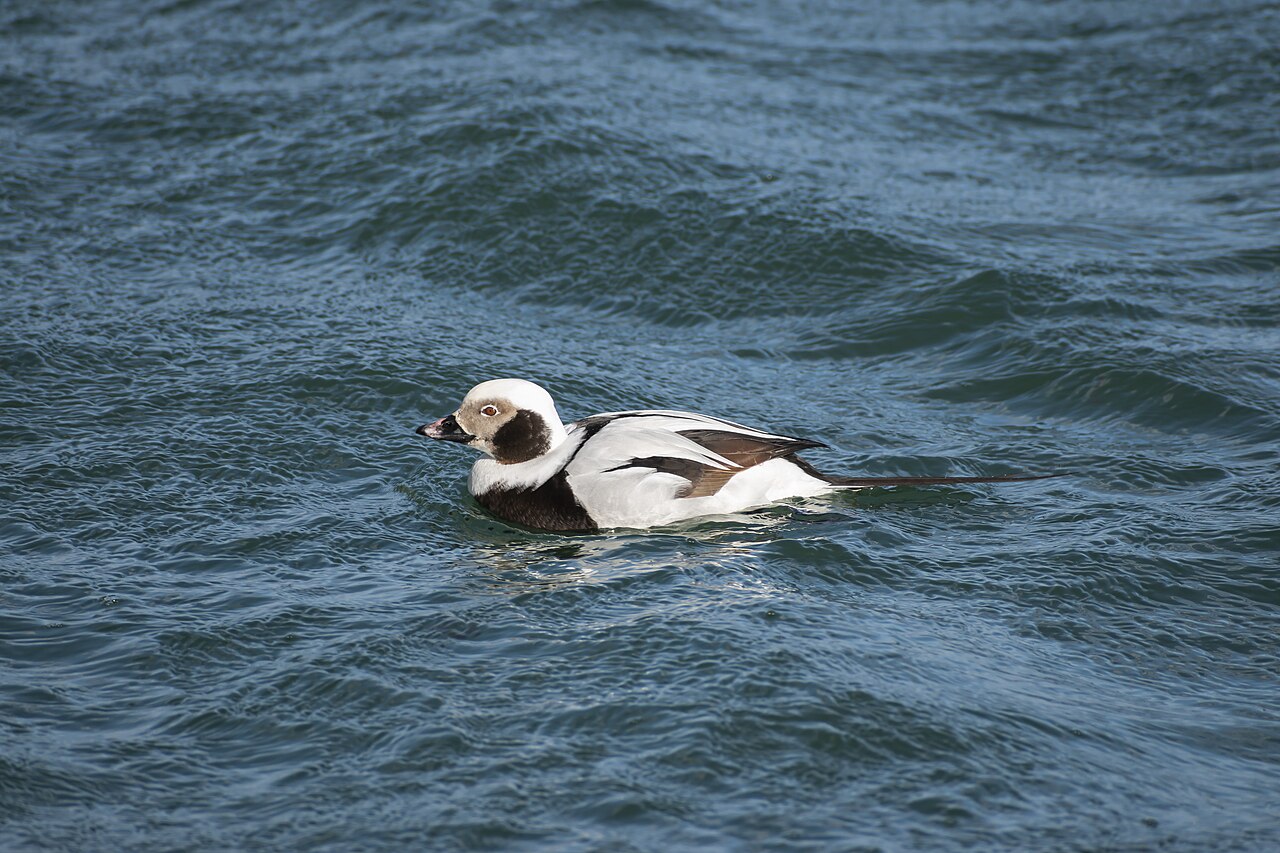
In winter the male is mostly white with a dark patch on the neck and a dark breast, a short, pointed black bill with a pink band, and the characteristic long black tail feathers that project well past the wings at rest. In summer, rarely seen in this region, that pattern is almost reversed: head, neck and body turn mostly dark, with only a pale patch around the eye. The female is mottled pale brown all year with a white face and a short, pointed tail without elongated feathers; in summer her head is darker. Young birds resemble winter females but with a less sharply marked face. Both sexes have a small, round head and a compact body.
Confusion species
The closest match is Bufflehead (Bucephala albeola) in winter plumage, but that species entirely lacks the long tail feathers and has a larger, triangular head with a clear white patch by the bill. At greater distance a flock in flight can suggest scoters, but the Long-tailed Duck flies low over the water in irregular, low-swerving groups rather than tight lines. Females and young birds, without the long tail, are most often confused with female Bufflehead; look then for the smaller, rounder head and the finer bill of the Long-tailed Duck.
Habitat
Breeds on Arctic tundra, usually close to freshwater pools the ducklings swim in as soon as they hatch. Outside the breeding season the Long-tailed Duck is almost entirely a sea duck: it winters on open sea, in bays and on the Great Lakes, diving to depths of several tens of metres for shellfish and crustaceans on the bottom. Shallow, sheltered water with a soft bottom is preferred; it avoids freshwater marsh and rivers except as a breeder on the tundra itself.
Where the bird is most often found, arranged by the USNVC — the vegetation classification of the United States and Canada — and CMECS for sea and coast.



Range and movements
Breeds right around the Arctic, from Alaska and northern Canada to Greenland; in North America it winters both on the Great Lakes and along both coasts, from New England to North Carolina in the east and from the Aleutians to California in the west. The species has been listed as Vulnerable since 2015, after the Baltic winter count, by far the largest in the world, fell by an estimated two-thirds within a few decades; for North America itself the evidence for a comparable decline is less clear-cut, but the global status applies to the species as a whole.
- Resident
- Breeding (summer)
- Winter
- Passage
- dark = core range, pale = thinly spread
Where and when to look
Look for it in late autumn and winter on open water along the coast or on a large lake, and listen before you look: the yodelling chorus of a flock of males carries for kilometres over calm water. On the Great Lakes, where the species can winter in the thousands, a scope from a breakwater or pier is often the best way to scan the flocks at a distance.
Conservation
The IUCN has listed the species as Vulnerable (VU) since 2015, above all because of the steep decline in the wintering population of the Baltic Sea, where entanglement in fishing nets is a major cause of death. In North America too, fishing nets, oil pollution and lead poisoning are regarded as risks, though the precise cause of the worldwide decline is not fully understood.
Scientific name
Clangula hyemalis | (Linnaeus, 1758)
Linnaeus described the species in 1758 as Anas hyemalis, among the ducks; because it was later moved to another genus, author and year stand in parentheses. The genus Clangula was introduced by Leach in 1819, a diminutive of Latin clangor, 'resounding call', after the loud calling. The species name hyemalis is Latin for 'of winter'. The type locality lies in arctic Europe and America, restricted by Linnaeus himself to northern Sweden in 1761.