All species › Waterfowl › Ducks, swans and geese › Common Shelduck
Common Shelduck | Tadorna tadorna
Bergeend | Tarro blanco
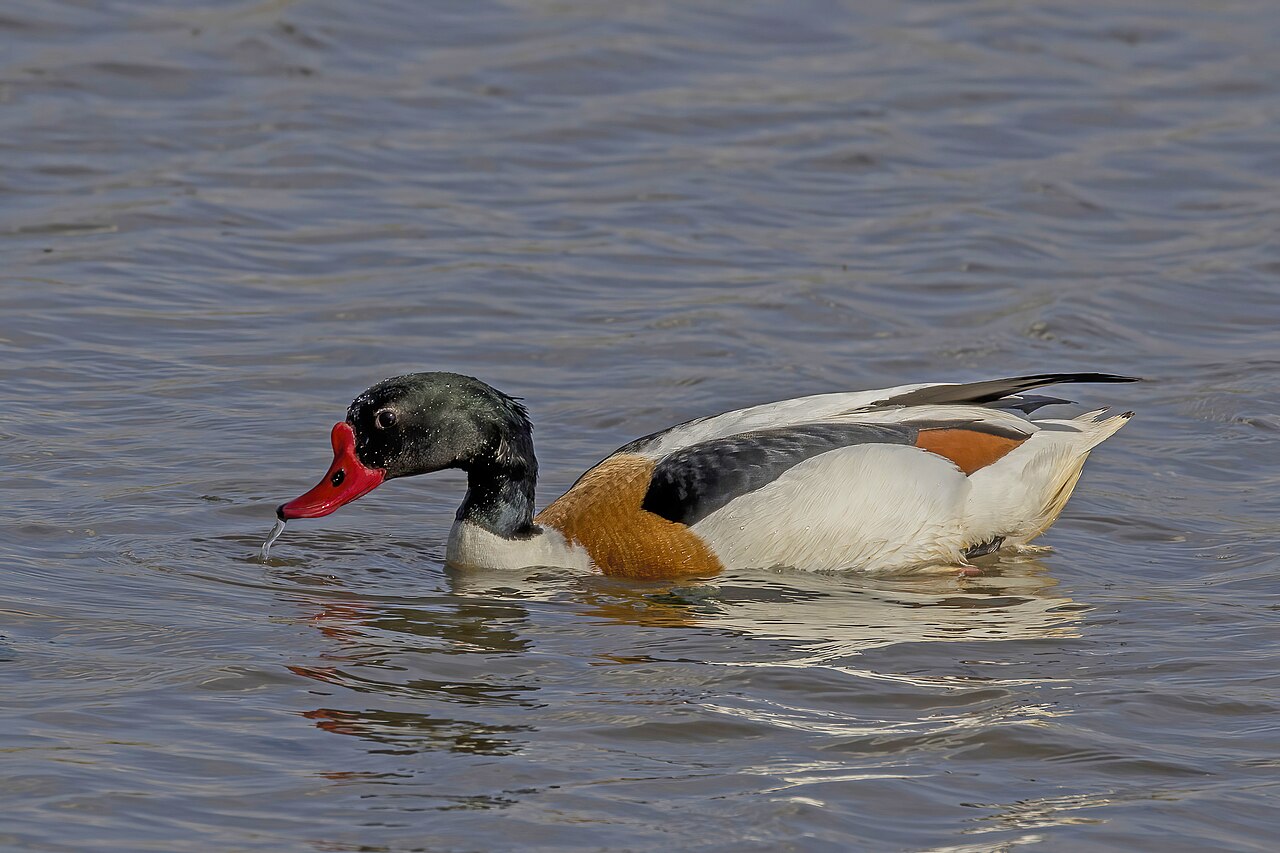
The Common Shelduck is a common breeding bird of coasts and inland waters across Europe and Asia; in North America it is none of that — here it is a rare vagrant, with the first accepted record only in 2014, in Newfoundland. Its three-colour pattern — white body, glossy green head and a chestnut band across the breast — together with the red bill, makes it distinctive anywhere, even far from its own continent. Birds that turn up elsewhere in North America, especially in Florida and west of the Mississippi, are generally considered escaped ornamental waterfowl rather than genuine vagrants.
Voice
The male gives a clear, far-carrying whistle, a sustained sioo sioo heard above all during courtship and excitement. The female answers with a hard, rapidly cackling bark, a series of gag-ag-ag-ag notes audible from a distance in a group. Outside the breeding season both sexes are considerably quieter. A vagrant in North America usually appears in silence: the handful of birds recorded here were mostly alone, with no others to call to, and no sound has been noted for most of them.
Recording: Jarek Matusiak — CC BY-NC-SA 4.0 · Półwysep Helski, Poland · xeno-canto
Identification
Both sexes are white with a glossy, dark bottle-green head and neck, a broad chestnut band across the breast running onto the back, and a narrow black stripe down the centre of the belly. The bill is bright red, and in summer the male carries a swollen red knob at its base that the female lacks or shows only faintly. The female often also shows a small white patch around the base of the bill. Juveniles are far duller: grey-brown above, white below, lacking the sharp breast band and with a greyish rather than red bill. In flight the largely white wings stand out, with black flight feathers and a greenish speculum.
Confusion species
Within its own continent the Common Shelduck is hardly confusable with anything else, but a stray bird in North America often turns up among feral park ducks and geese of mixed origin, and there it is exactly the combination of red bill, green head and chestnut breast band — a set no North American duck shares — that proves a genuine Common Shelduck. Juveniles, duller and lacking a clear breast band, suggest some plain goose-like waterbird but carry the diagnostic reddish bill base. The larger problem is not confusion with another species but the question of whether a bird is wild at all: Common Shelducks are also kept loose in bird parks and on farms, and an escaped bird looks no different from a wild one.
Habitat
On its own continent the Common Shelduck breeds on saltmarsh, tidal flats and brackish lagoons, often well inland on farmland, nesting in rabbit burrows or under outbuildings. The handful of birds recorded in North America sat invariably on coastal water: a bay, an estuary or a shallow lagoon, always in the company of native ducks and geese. Fresh water deep inland has never been reported for this species here.
Where the bird is most often found, arranged by the USNVC — the vegetation classification of the United States and Canada — and CMECS for sea and coast.



Range and movements
Breeds from western Europe east into central Asia and winters from North Africa to South Asia; with that range North America is essentially out of reach for the Common Shelduck, and yet the species is one of the few European ducks that occasionally crosses the ocean. The first accepted record for the continent dates from April 2014, when a bird was found in Newfoundland; occasional reports have followed since, concentrated in the northeast — Newfoundland, the Canadian Maritimes and Massachusetts — consistent with the strongly grown Icelandic breeding population as a possible source. Birds in Florida and west of the Mississippi are almost always considered escapees. The map therefore shows no unit as established; Newfoundland is marked as passage, the one area where the chance of a genuine wild bird is judged real.
Where and when to look
For almost everyone the chance of finding a Common Shelduck in North America is nil; anyone looking anyway does best in autumn and spring on coastal water in Atlantic Canada, among flocks of Brant and eiders. Always question the origin: a Common Shelduck with a leg band, in the company of other escaped ornamental waterfowl, or far inland, is almost certainly of captive origin.
Conservation
Worldwide the Common Shelduck is not threatened (LC); the European and Asian population is large and stable. For North America there is nothing to conserve — the species does not breed here, and the handful of vagrants form no population. Accepting a record as a wild bird carries a heavy burden of proof here, precisely because the species is so commonly kept in captivity.
Scientific name
Tadorna tadorna | (Linnaeus, 1758)
Linnaeus described the species in 1758 as Anas Tadorna, among the ducks; because it was later moved to another genus, author and year stand in parentheses. The genus Tadorna was introduced by Boie in 1822 and goes back to French tadorne, a name the French naturalist Pierre Belon already used for this species in 1555; the word may derive from Celtic, meaning 'pied waterfowl', the same sense as English shelduck. The species name simply repeats the genus name. The type locality lies on the European coast, restricted by Linnaeus himself to Sweden in 1761.