All species › Waterfowl › Ducks, swans and geese › Egyptian Goose
Egyptian Goose | Alopochen aegyptiaca
Nijlgans | Ganso del Nilo
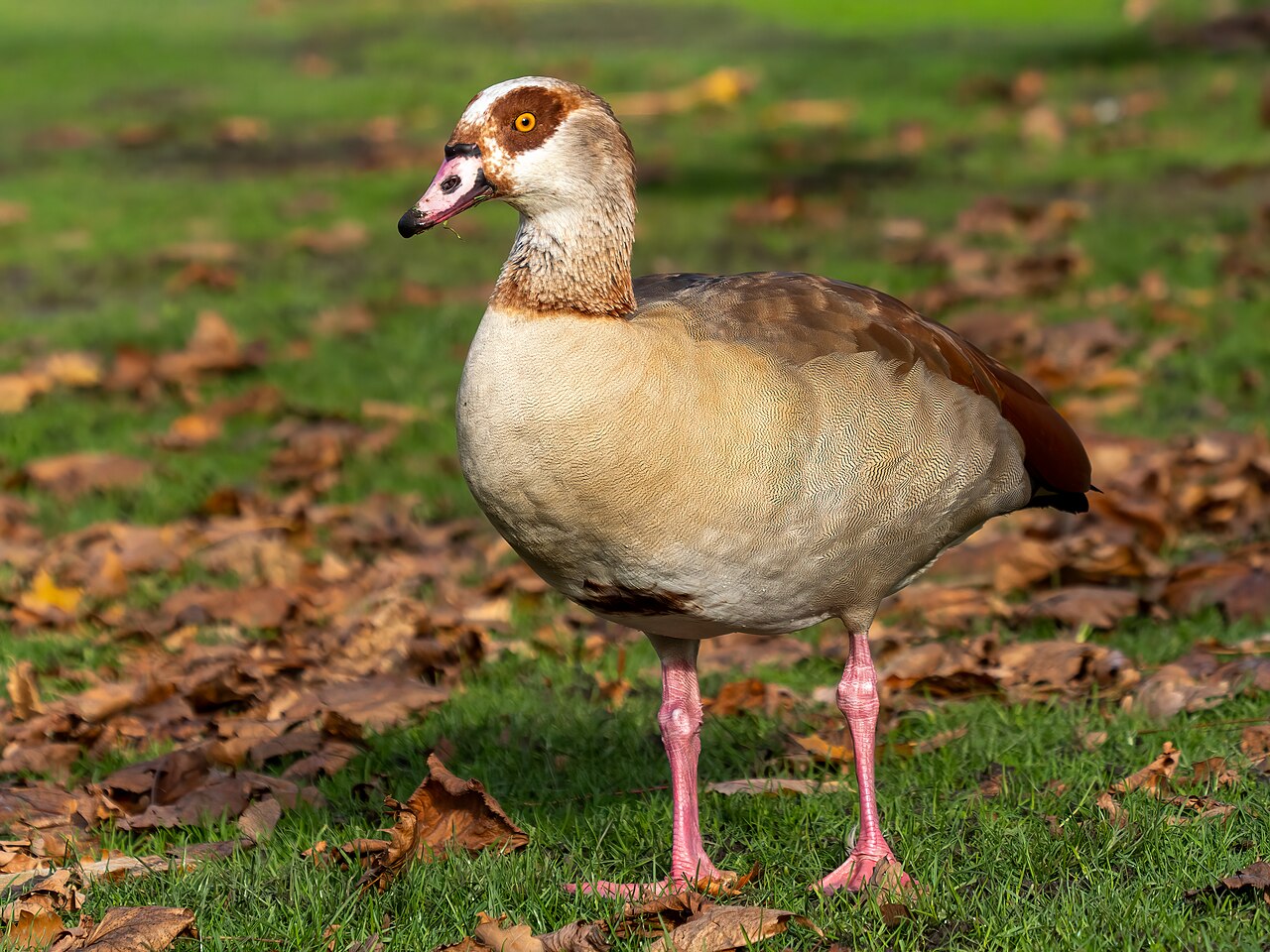
The Egyptian Goose in North America has a split history: in Africa a native waterbird found on almost any body of water, here an escaped ornamental waterfowl that has established wild populations in several places since the 1980s. A reddish-brown patch around the eye on an otherwise pale head, together with long pink legs, identifies it on any pond at a glance. In ancient Egypt the bird was held sacred and appears on temple reliefs; in Florida and California it now counts mainly as an increasingly familiar sight on golf courses and in parks.
Voice
The repertoire is limited but strictly divided by sex: only the male gives a hoarse snarl, only the female a harsh, cackling grunt, and both sexes hiss in alarm and honk loudly on taking flight. In flight the wingbeats themselves hum audibly, a low buzzing sound that announces an approaching bird from far off; during a territorial display flight over the water that hum turns into a repeated, swishing whoosh. On the ponds where most North American birds gather, sitting quietly in small groups, it usually goes no further than the hissed protest of a bird approached too closely.
Recording: Walter Wallner — CC BY-NC-SA 4.0 · Mossel Bay Local Municipality (near Great Brak River), Garden Route District Municipality, Western Cape, South Africa · xeno-canto
Identification
The plumage is a fine mix of grey and ochre-brown, with a chestnut patch in the middle of the breast and a similar patch around the base of the tail. A reddish-brown patch surrounds the pale-yellow eye on an otherwise pale head, the mark by which the species is fastest recognised. Bill and legs are pink, the legs noticeably long for a waterbird of this size. Male and female are marked alike; the male is larger and slightly brighter, but in the field the difference is seldom certain. Young birds lack the sharp eye patch and are duller marked. In flight, large white wing patches stand out, bordered by otherwise black flight feathers with a greenish speculum between them.
Confusion species
The Egyptian Goose looks like a goose but stands taxonomically closer to Common Shelduck (Tadorna tadorna) and the other shelducks, betrayed by its straight, high-set legs and its restless, quarrelsome manner on the water. Confusion with native geese is rarely a problem: Canada Goose (Branta canadensis) entirely lacks the eye patch and has a black rather than pale head and neck. On a pond in Florida or Texas the Egyptian Goose more often sits among feral park geese and ducks of mixed origin, where above all the pink legs and bill and the chestnut breast patch settle the matter. At greater distance, when only the silhouette is visible, the long legs and the upright, watchful posture decide it.
Habitat
In Africa, where the species is native, it uses almost any open water: rivers, lakes, marshes, sewage ponds and temporary pools on the savanna, with foraging trips onto adjacent grassland and farmland. In North America the same pattern repeats on a smaller scale: artificial ponds on golf courses and in office parks, retention basins, city parks with open lawn close to water. It avoids closed forest and unsheltered saltwater, and always seeks a combination of short turf for grazing and an edge of open water to retreat to. Nesting takes place in a tree cavity, on a building or simply on the ground by the water, and the family then moves to the nearest lawn.
Where the bird is most often found, arranged by the USNVC — the vegetation classification of the United States and Canada — and CMECS for sea and coast.





Range and movements
The Egyptian Goose is native to the Nile Valley of Egypt and Sudan and to almost all of Africa south of the Sahara. The North American population goes back to escaped and released ornamental waterfowl: breeding was first reported in the 1980s near Tampa Bay, followed by a lasting establishment in Martin County, Florida, in the early 1990s. Since then the species has become widespread across Florida and continues to expand; smaller, locally established populations arose around Los Angeles and Orange County in California, around Houston in Texas, and at Gentry in Arkansas, in each case from escaped park birds. As in western Europe, where the species followed the same path through escaped ornamental birds, it continues to expand its range here.
- Resident
- Breeding (summer)
- Winter
- Passage
- dark = core range, pale = thinly spread
Where and when to look
Look for it on any pond with a well-kept lawn around it — a golf course or office park in Florida is close to a sure thing — and watch from a distance for the upright, watchful posture among the low-grazing ducks and geese. The brightest colours and the fullest range of behaviour, including the persistent, noisy chasing of other waterbirds from a territory, show in spring, as pairs settle.
Conservation
Worldwide the Egyptian Goose is listed as Least Concern (LC) and the African population is large and stable. The North American population is small but growing, with the core in Florida numbering in the hundreds and smaller, isolated groups elsewhere. As in Europe, the species is regarded here with some caution as potentially invasive, because of competition for nest cavities and food with native waterbirds; for now, however, formal control remains limited to local initiatives.
Scientific name
Alopochen aegyptiaca | (Linnaeus, 1766)
Linnaeus described the species in 1766 as Anas aegyptiaca, among the ducks; because it was later moved to another genus, author and year stand in parentheses. The genus Alopochen was introduced by Stejneger in 1885 and is Greek for 'fox-goose', a contraction of alopex, 'fox', and chen, 'goose', after the reddish-brown colour of the back. The species name aegyptiaca is Latin for 'Egyptian'. The type locality is Egypt, after the region the first described specimens came from.