All species › Waterfowl › Ducks, swans and geese › Wood Duck
Wood Duck | Aix sponsa
Carolina-eend | Pato joyuyo
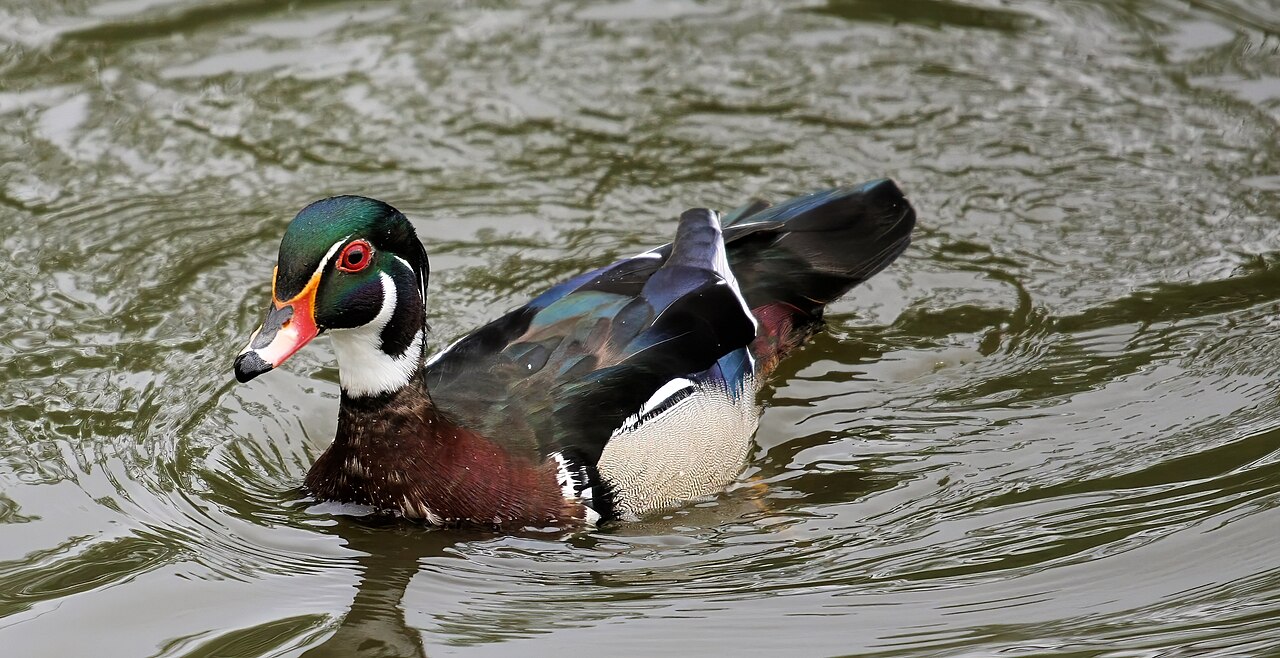
The Wood Duck is one of the most colourful waterbirds in North America: the male carries a glossy green-and-purple head with white striping, a chestnut breast and bright red eyes. Around 1900 unregulated hunting and the loss of old forest with hollow trees had brought the species close to disappearing; a century of protection and thousands of nest boxes turned it back into one of the continent's most numerous ducks. As one of the few ducks that nests in tree cavities, it often breeds far from open water.
Voice
The female gives a loud, drawn-out shriek on flushing, oo-eek oo-eek, often the first sign of a disturbed bird in dense woodland. The male is far quieter, giving a thin, rising and falling whistle, jeeet, mainly during courtship. When calling newly jumped ducklings together, the female gives a soft, sustained series of contact notes. Little other sound accompanies flight.
Recording: Don Profota — CC BY-NC-SA 4.0 · South Bozeman, Gallatin County, Montana, United States · xeno-canto
Identification
The male in breeding plumage has a long, raised crest, a green-and-purple sheen on the head with white striping from the base of the bill to the back of the head, a chestnut breast with white spotting, barred flanks and a red-and-black bill. The female is grey-brown with a shorter, also raised crest and a distinctive white, teardrop-shaped eye-ring. Both sexes show a bluish wing speculum bordered with white. In flight the boxy head, thin neck and long, broad tail stand out; the birds fly with the head held slightly up and weave quickly between trees.
Confusion species
The female is most often confused with Hooded Merganser (Lophodytes cucullatus), which is similarly crested and close in size but has a longer, thinner bill and lacks the Wood Duck's white eye-ring. The male Mallard (Anas platyrhynchos) has a round, uncrested head and a far simpler colour pattern. The Asian Mandarin Duck (Aix galericulata), the only other species in the same genus, is not established in North America but occasionally turns up as an escaped park bird and carries fan-shaped 'sail' feathers on the wing that Wood Duck lacks.
Habitat
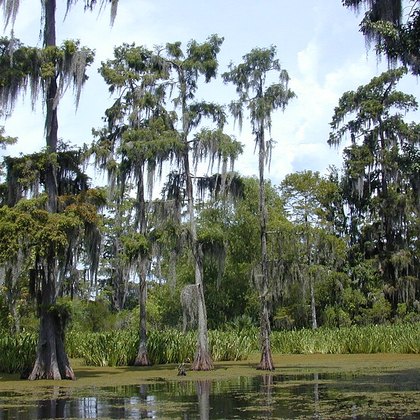
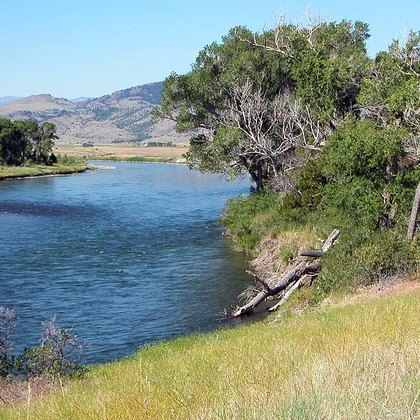
Wooded swamp, slow-moving streams, densely vegetated beaver ponds and tree-lined marshes — anywhere open water combines with trees to nest in. For food, a varied understorey of submerged aquatic plants, acorns and seeds is enough; the species rarely dives and forages mainly by dabbling or walking along the shore. A nest cavity requires a tree at least thirty centimetres across with an opening no more than ten centimetres wide, anywhere from just above the water to twenty metres up; artificial nest boxes are readily adopted in many areas.
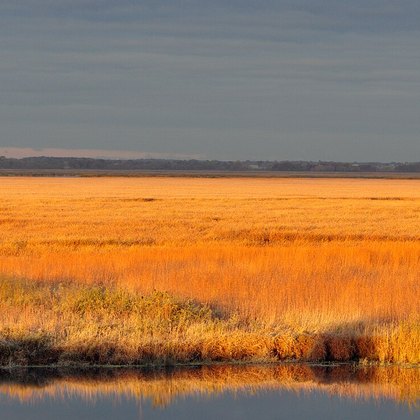
Where the bird is most often found, arranged by the USNVC — the vegetation classification of the United States and Canada — and CMECS for sea and coast.


Range and movements
Breeds across almost the entire eastern United States and southern Canada, centred on the forested wetlands of the Mississippi Valley, and separately along the west coast from British Columbia to California. In the interior west, from the Rocky Mountains to the Great Plains, it is all but absent as a breeder. Northern and Canadian birds move south for the winter as far as Mexico and the Bahamas; across most of the southeast and on the west coast the species is resident. Cuba holds its own breeding population, separate from the North American mainland.
- Resident
- Breeding (summer)
- Winter
- Passage
- dark = core range, pale = thinly spread
Where and when to look
Look for it along wooded streams and beaver ponds in early morning, when pairs swim among the shoreline trees before the water gets busy; a sudden, loud shriek from a flushing female is often the first clue. In late summer, hundreds of moulting and newly fledged birds gather in mixed groups on some marshes, best recognised by their patient searching among the bankside vegetation.
Conservation
One of the clearest conservation successes among North American ducks: around 1900 ornithologists feared extinction through unregulated hunting and the loss of nest cavities, until the Migratory Bird Treaty Act of 1918 curbed hunting and, from the 1930s onward, nest boxes were put up on a large scale. The population has now stabilised at well over four million birds across the east and west coast combined. Continuing loss of old forest with natural cavities remains the main concern, offset by the ongoing nest box programme.
Scientific name
Aix sponsa | (Linnaeus, 1758)
Linnaeus described the species in 1758 as Anas Sponsa, among the ducks; because it was later placed in another genus, author and year stand in parentheses. The genus Aix was introduced by Boie in 1828, after an Ancient Greek word Aristotle used for a diving bird that cannot be identified with certainty. sponsa is Latin for 'betrothed' or 'bride', after the male's festive plumage. The type locality is Carolina, based on the eighteenth-century description and illustration by Mark Catesby, whose work Linnaeus drew on for many of his North American bird species.