All species › Waterfowl › Ducks, swans and geese › Muscovy Duck
Muscovy Duck | Cairina moschata
Muskuseend | Pato real
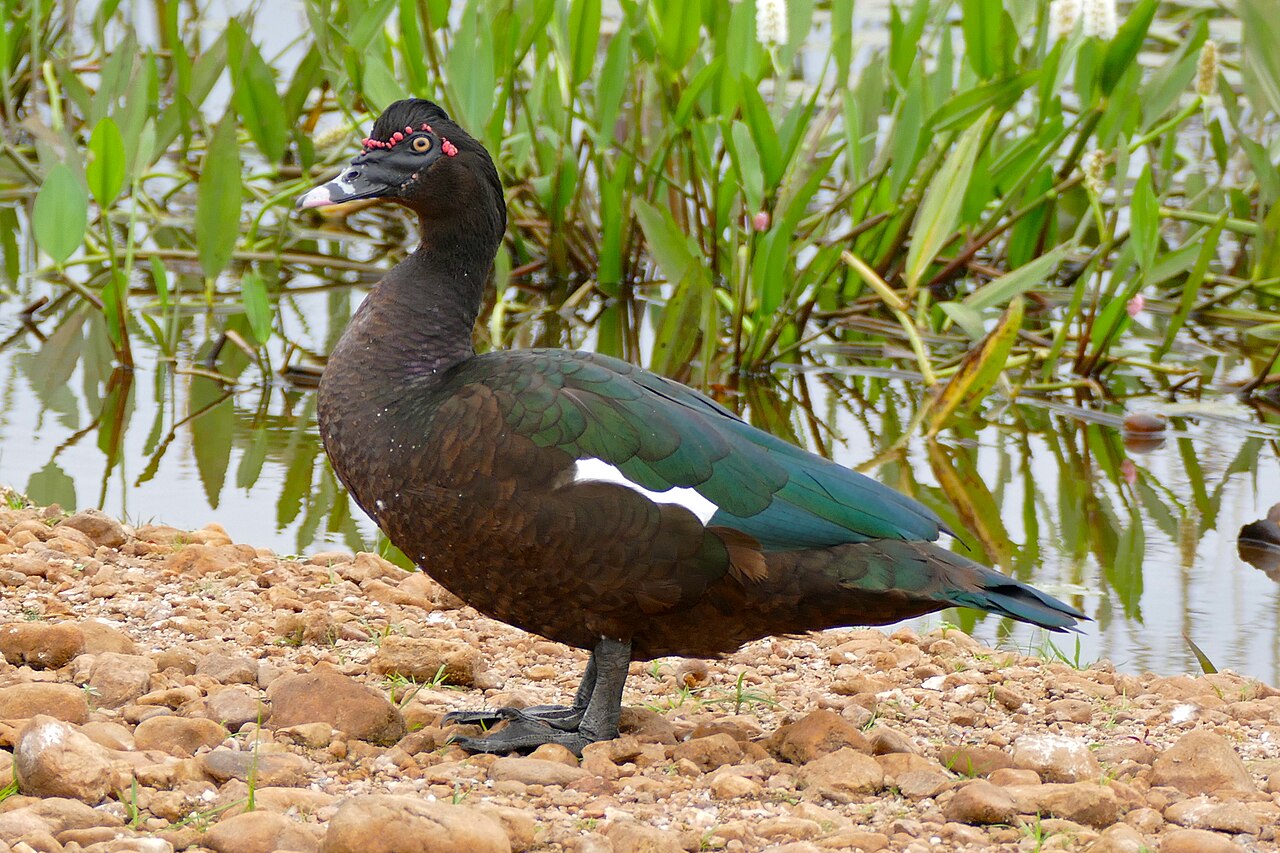
The Muscovy Duck is the heaviest duck in the Western Hemisphere: a large, dark waterbird with a bare red face covered in wart-like caruncles. In the extreme south of Texas a small, wary wild population has bred along the Rio Grande since the 1980s — the only place in the United States where the species counts as native. Almost everywhere else in North America the birds seen are feral descendants of the domesticated form, kept as farmyard poultry for centuries.
Voice
The species is markedly quiet. The female gives a soft, hoarse quack when startled, and a soft, high call to keep her ducklings together. The male makes almost no sound outside courtship, when he hisses and puffs while bobbing his head and raising his crest. At the roost, high in waterside trees, a group of Muscovy Ducks is often seen well before it is heard.
Recording: Manuel Grosselet — CC BY-NC-SA 4.0 · Mérida, Mérida Municipality, Yucatán, Mexico · xeno-canto
Identification
A stocky, heavy-bodied duck with a long neck, a bill that slopes gradually up to the forehead, and a fairly long tail, recognisable in flight by its slow, goose-like wingbeat. Wild birds are mostly black with a green sheen on the back and a large white patch on the wing; the bare face carries relatively few caruncles, mostly red and black. The male is considerably larger and heavier than the female, with a bigger head and more caruncle tissue. Feral birds show almost any combination of white, black and brown and typically carry much larger, uniformly bright red caruncles than wild birds.
Confusion species
The greatest source of confusion is not another species but the bird itself: telling a genuinely wild Muscovy Duck from a feral descendant of the domestic form. Wild birds are wary, flush silently from tall waterside trees, and show little white in the plumage and small, partly black caruncles; park birds outnumber them a hundredfold, are tame, often far whiter in pattern, and carry large, bright red caruncles. At greater range, the silhouette — long neck and heavy head — can suggest a goose.
Habitat
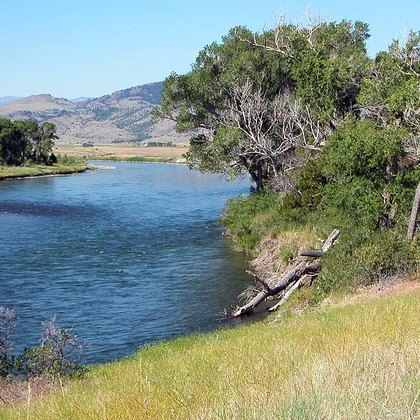
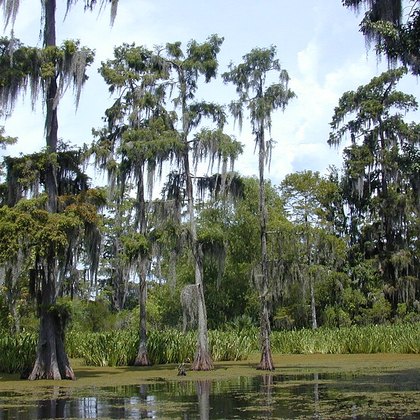
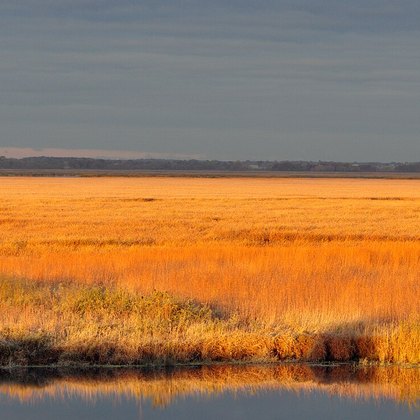
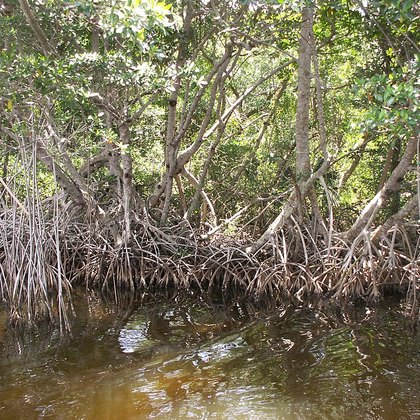
Wild birds keep to rivers and forested wetlands with tall waterside trees, resting in the cover of the canopy by day and feeding on shallow, vegetated water at night or early morning. A tree cavity well above the water is essential for nesting; artificial nest boxes are readily used. Feral birds use a far wider range of waters, from city ponds to drainage canals, and are much less tied to woodland edge than their wild relatives.
Where the bird is most often found, arranged by the USNVC — the vegetation classification of the United States and Canada — and CMECS for sea and coast.

Range and movements
The native range extends from northern Mexico, through Central America, to Argentina and Brazil, centred on lowland wetlands on both sides of the Andes. In the United States the species colonised the Rio Grande basin in the extreme south of Texas from Mexico only in the 1980s, with the first confirmed nesting recorded in 1994; the population remains confined to a handful of border counties. Separately, as a domesticated animal the species has spread across almost the entire world for centuries, with feral populations established in towns and on farms from Florida to California.
- Resident
- Breeding (summer)
- Winter
- Passage
- dark = core range, pale = thinly spread
Where and when to look
Look for the wild form along the Rio Grande between Falcon Dam and Roma, in Starr County, where tall gallery forest lines the river; watch early morning or late afternoon, as birds move from their roost to the water. Wariness is itself a field mark: a bird that lets you approach within a few metres is almost certainly feral, not wild.
Conservation
The wild Texas population is small — a few dozen to perhaps a few hundred birds — and dependent on the riparian forest along the Rio Grande, which is under pressure from water extraction and border infrastructure. Elsewhere in the United States the species is not protected: feral Muscovy Ducks in states such as Florida fall under a federal control order because of disease transmission and interbreeding with native waterfowl, and landowners may remove them. Worldwide, thanks to its wide range across Latin America, the species is listed as Least Concern (LC).
Scientific name
Cairina moschata | (Linnaeus, 1758)
Linnaeus described the species in 1758 as Anas moschata, among the ducks; because it was later placed in another genus, author and year stand in parentheses. The genus Cairina was introduced by Fleming in 1822, after the sixteenth-century naturalist Aldrovandi's belief that the bird came from Cairo — a mistake, since the species is entirely American. moschata is Latin for 'musky', after the musk odour given off chiefly by males. Linnaeus mistakenly gave the origin as 'India'; the type locality was corrected to Brazil by Berlepsch and Hartert in 1902.