All species › Waders, gulls and terns › Auks, puffins and murres › Least Auklet
Least Auklet | Aethia pusilla
Dwergalk | Mérgulo mínimo
The Least Auklet is the smallest auk in the world, no bigger than a sparrow, and at the same time the most numerous seabird in North America. On a few talus slopes in the Bering Sea hundreds of thousands to a million birds breed together, and in June the scree itself seems to move.
Voice
At the colony an unbroken chatter of thousands of birds at once, which carries across the water as a hiss. Close up three sounds separate out: a fast rattling cher-ch-ch, a short clear chip and a buzzing chirr delivered with the head rocking from side to side. Males walk in circles around a female while chattering without pause. At sea the bird is all but silent.
Recording: Steve Hampton — CC BY-NC-SA 4.0 · Gambell, Nome, Alaska, United States · xeno-canto
Identification
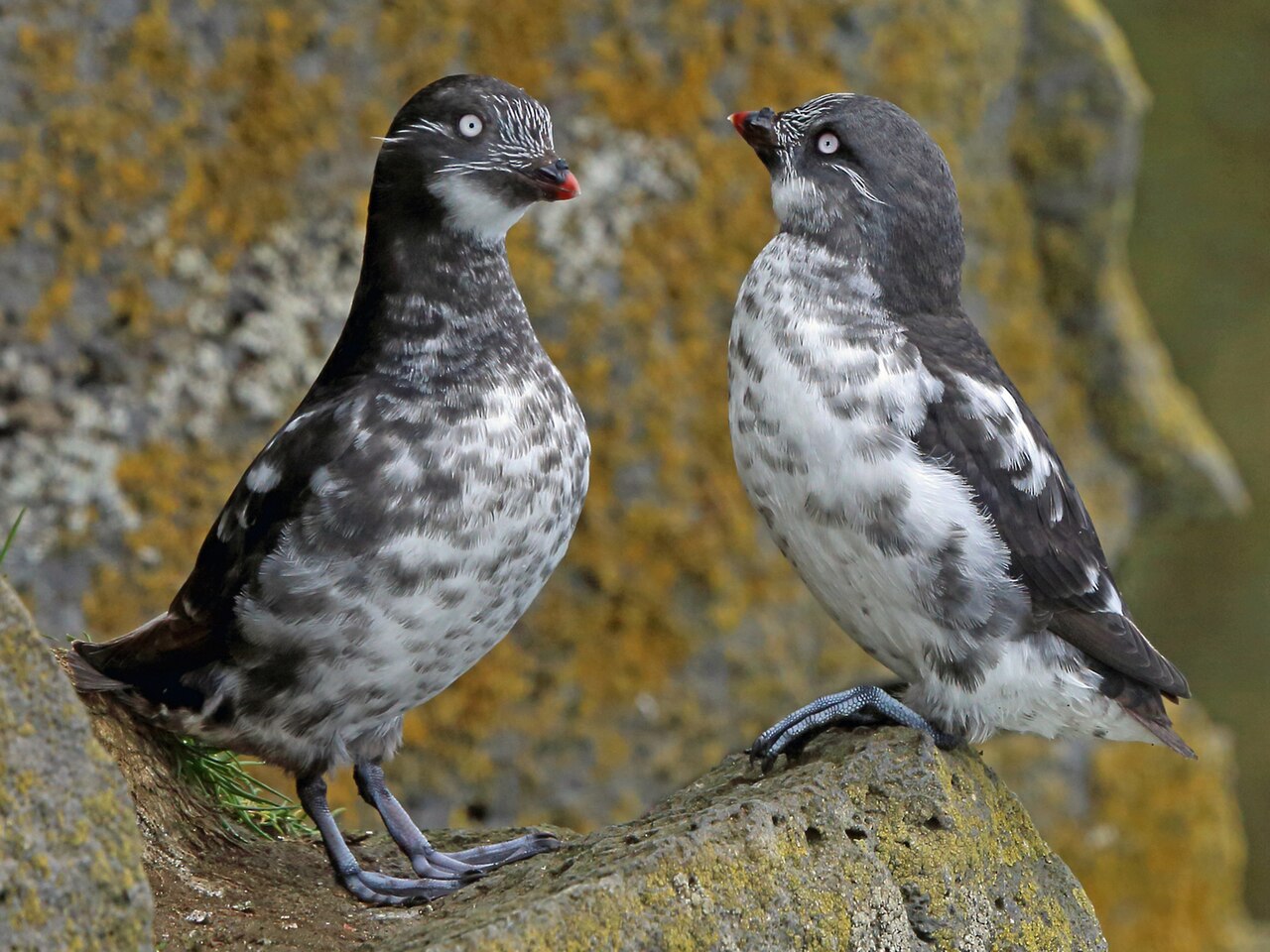
Sparrow-sized and short-tailed, dark above, with a white eye. In breeding plumage white bristly feathers cover the forehead and lores, a white plume runs back from the eye, and the bill is dark red with a small black horny knob at its base. The underparts are then variable: from almost pure white to densely mottled grey-brown, sometimes both within one colony. In winter the underparts are clean white, the bill is black, and knob and plumes are gone. Juveniles resemble winter adults but lack the ear plume as well. In flight: a whirring, rapid wingbeat and dense flocks skimming low over the swell.
Confusion species
Whiskered Auklet (Aethia pygmaea) is larger, dark-bellied, with three white facial plumes and a thin crest. Crested Auklet (Aethia cristatella) is more than three times as heavy and slate-coloured throughout. Cassin's Auklet (Ptychoramphus aleuticus) is larger and drab grey-brown, without white head markings and with a pale spot at the base of the bill. Dovekie (Alle alle) is similar in build but lives in the Atlantic; the two ranges do not meet.
Habitat
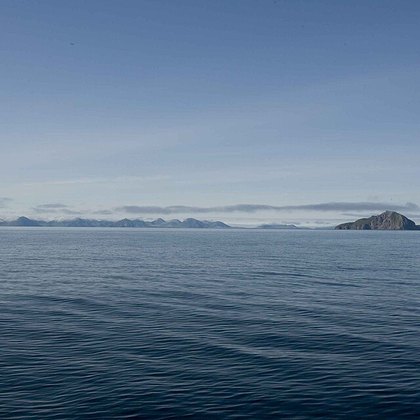
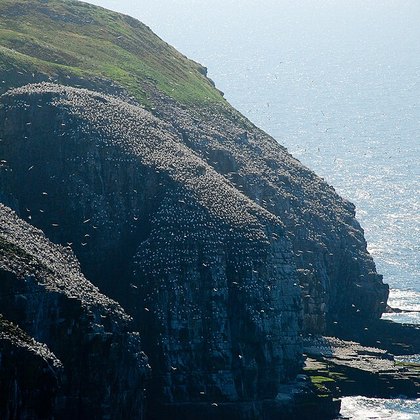
Breeds on talus slopes, boulder fields, lava flows and rocky beaches of remote islands, laying its single egg deep in a crevice on bare stone. Outside the breeding season it lives on the open sea, often close to the edge of the pack ice and over fronts where currents concentrate plankton. Vegetated or sandy shores, and any coast that land predators can reach, it avoids entirely.
Where the bird is most often found, arranged by the USNVC — the vegetation classification of the United States and Canada — and CMECS for sea and coast.


Range and movements
Breeds from eastern Chukotka and Kamchatka through the Commander and Kuril islands into the Bering Sea and the Aleutians; in North America the largest colonies are on St. Lawrence, Little Diomede, the Pribilofs and Aleutian islands such as Buldir and Kiska. In winter much of the population stays in ice-free water of the Bering Sea and the Gulf of Alaska, while the northernmost birds retreat ahead of the advancing ice. Further down the Pacific coast it is a vagrant: British Columbia and Washington have only a handful of accepted records.
- Resident
- Breeding (summer)
- Passage
- dark = core range, pale = thinly spread
Where and when to look
In June or July sit down beside a talus slope on St. Paul or St. George and wait half an hour: in the middle of the day thousands of birds are out among the stones and go up in clouds all at once. At sea you recognise the flock before you recognise the bird — small dark auklets, fast and tightly packed, in numbers no other species reaches.
Conservation
North America alone holds an estimated nine million birds, making this the most abundant seabird on the continent, and the species is listed as Least Concern (LC). It is nonetheless vulnerable, because nearly all of it sits on a few dozen islands: where arctic foxes or rats have been introduced, colonies disappear within a few years. Removing those animals from the Aleutians is the key measure; oil at sea and drowning in nets take their share as well.
Scientific name
Aethia pusilla | (Pallas, 1811)
Pallas described the species in 1811 as Uria pusilla, among the guillemots; because it was later moved to another genus, author and year stand in parentheses. The genus Aethia was introduced by Merrem in 1788, after aithuia, the name of a seabird in the classical Greek authors. pusilla is Latin for 'very small' and is meant literally here: no auk is smaller. The type locality is Kamchatka.