All species › Waders, gulls and terns › Auks, puffins and murres › Whiskered Auklet
Whiskered Auklet | Aethia pygmaea
Geoorde dwergalk | Mérgulo bigotudo
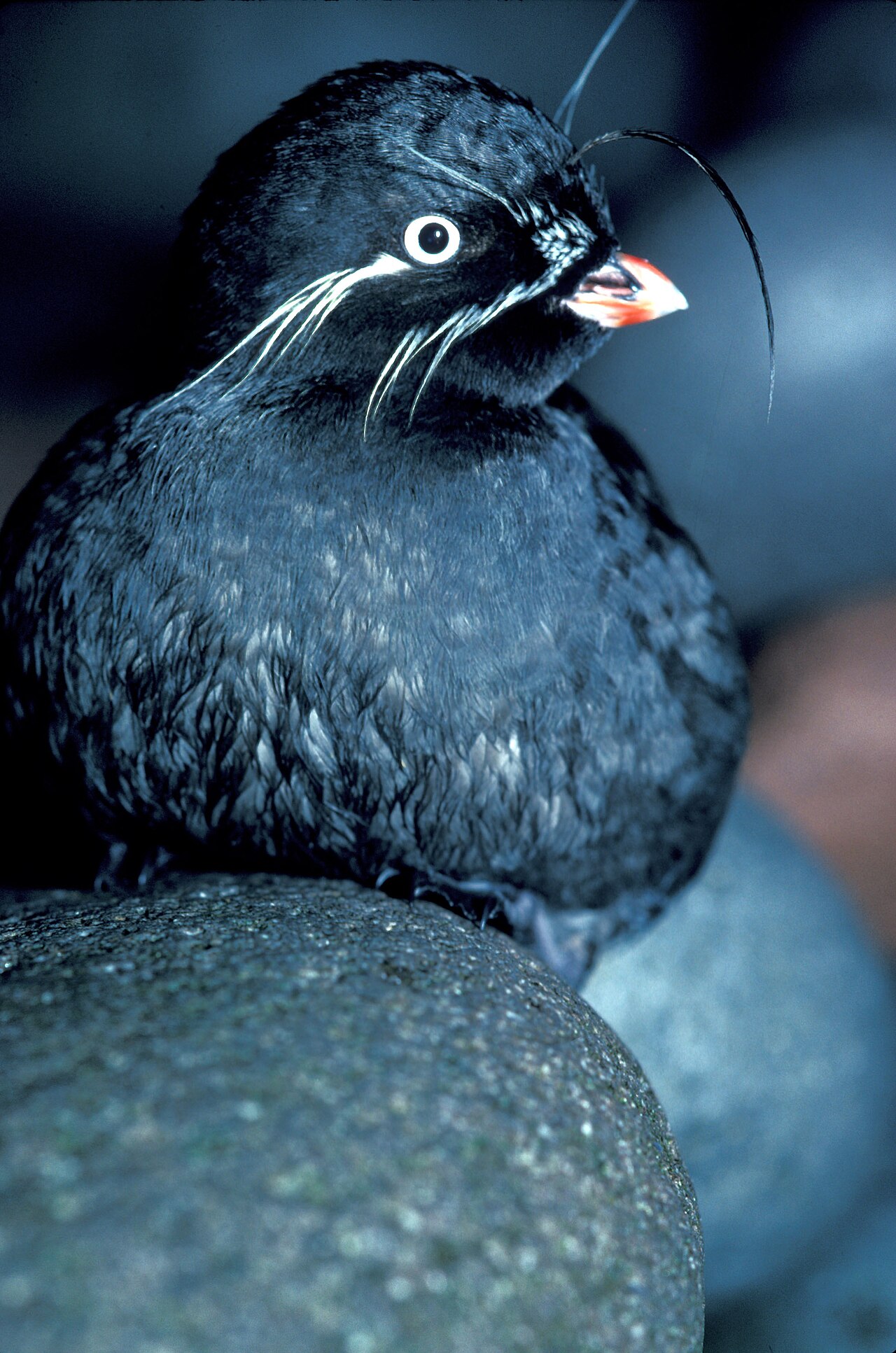
A small dark auklet with three thin white plumes on each cheek and a long crest that curls forward over the bill. It lives in the churning tide rips between the Aleutian islands, comes ashore only after dark, and is the only auk that sleeps at its colony all year round.
Voice
At night at the colony a series of short descending notes, followed by a nasal kirree and a musical ending; shortly before dawn this builds into a long rising trill that fills the whole boulder field. The contact call is a dry kik, and birds coming in give a plaintive, cat-like mee-ow — the sound that identifies the species fastest in the dark. At sea it is rarely heard at all.
Recording: McKenzie — CC BY-NC-SA 4.0 · Alaska, Aleutians West, Alaska, United States · xeno-canto
Identification
Upperparts and breast blackish brown, belly and undertail pale grey. The head is dark with three thin white plumes on each side — one above the eye, one below it and one behind it — and a long black crest curving forward over the bill. The bill itself is short, stout and red with a pale tip; the eye is white. In winter plumage crest and plumes are shorter and the bill duller. Juveniles lack the crest altogether and have a dull yellow bill with a dark tip. This species too smells of tangerine, though more faintly than Crested Auklet.
Confusion species
Crested Auklet (Aethia cristatella) is clearly larger and heavier, has only one white plume behind the eye, a fuller crest and a thick orange bill with loose horny plates. Least Auklet (Aethia pusilla) is less than half the weight, has no crest and is white-bellied in winter. Cassin's Auklet (Ptychoramphus aleuticus) lacks all head ornament and has a dark bill with a pale spot at the base. At distance behaviour helps: Whiskered Auklet stays low in the surf of the passes, Crested Auklet flies in straight lines out to open water.
Habitat
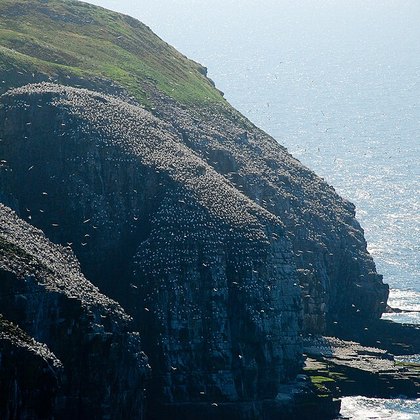
Breeds in crevices of talus slopes, boulder beaches and lava fields on small islands free of land predators. It feeds close to home: in the turbulent tide rips between the islands, usually within ten kilometres of the colony and over water no more than a hundred metres deep. It avoids the open ocean and does not leave the island group at any season.
Where the bird is most often found, arranged by the USNVC — the vegetation classification of the United States and Canada — and CMECS for sea and coast.



Range and movements
Confined to the Aleutians and to islands off eastern Siberia — the Commander and Kuril islands and the Sea of Okhotsk. In North America it therefore occurs only in the Aleutian chain of Alaska; away from that chain any record is exceptional, British Columbia included. It does not migrate: even in winter it stays in the water around its breeding islands. Within the chain its distribution changed sharply during the twentieth century — introduced arctic foxes made dozens of islands uninhabitable, and since their removal began the bird has been returning to them.
- Breeding (summer)
- Passage
- dark = core range, pale = thinly spread
Where and when to look
Watch the water rather than the land: from a boat in one of the passes between the Aleutian islands, where the current boils and the foam lines stand, they float in parties of a few dozen. Go in calm weather and around the turn of the tide, and watch the head — the three white streaks on dark are visible at a hundred metres.
Conservation
In 2003 the Aleutian population was estimated at at least 116,000 birds, against some 25,000 in the early 1970s. Almost all of that difference is down to the removal of arctic foxes, which from 1750 onwards were released on dozens of islands for fur farming and have been systematically eradicated since 1949. Rats, oil spills and the lights of fishing vessels — which the night-flying birds are drawn to and collide with — remain the main threats. The species is rated as of least concern (LC).
Scientific name
Aethia pygmaea | (Gmelin, 1789)
Gmelin described the species in 1789 as Alca pygmaea, among the auks; because it was later moved to another genus, author and year stand in parentheses. The genus Aethia was introduced by Merrem in 1788, after aithuia, the name of a seabird in the classical Greek authors. pygmaea comes from Latin pygmaeus, 'dwarf': after Least Auklet this is the smallest auk. Gmelin gave the type locality only as 'islands in the Bering Sea', without a more precise place.