All species › Waders, gulls and terns › Auks, puffins and murres › Crested Auklet
Crested Auklet | Aethia cristatella
Kuifalk | Alcita cristada
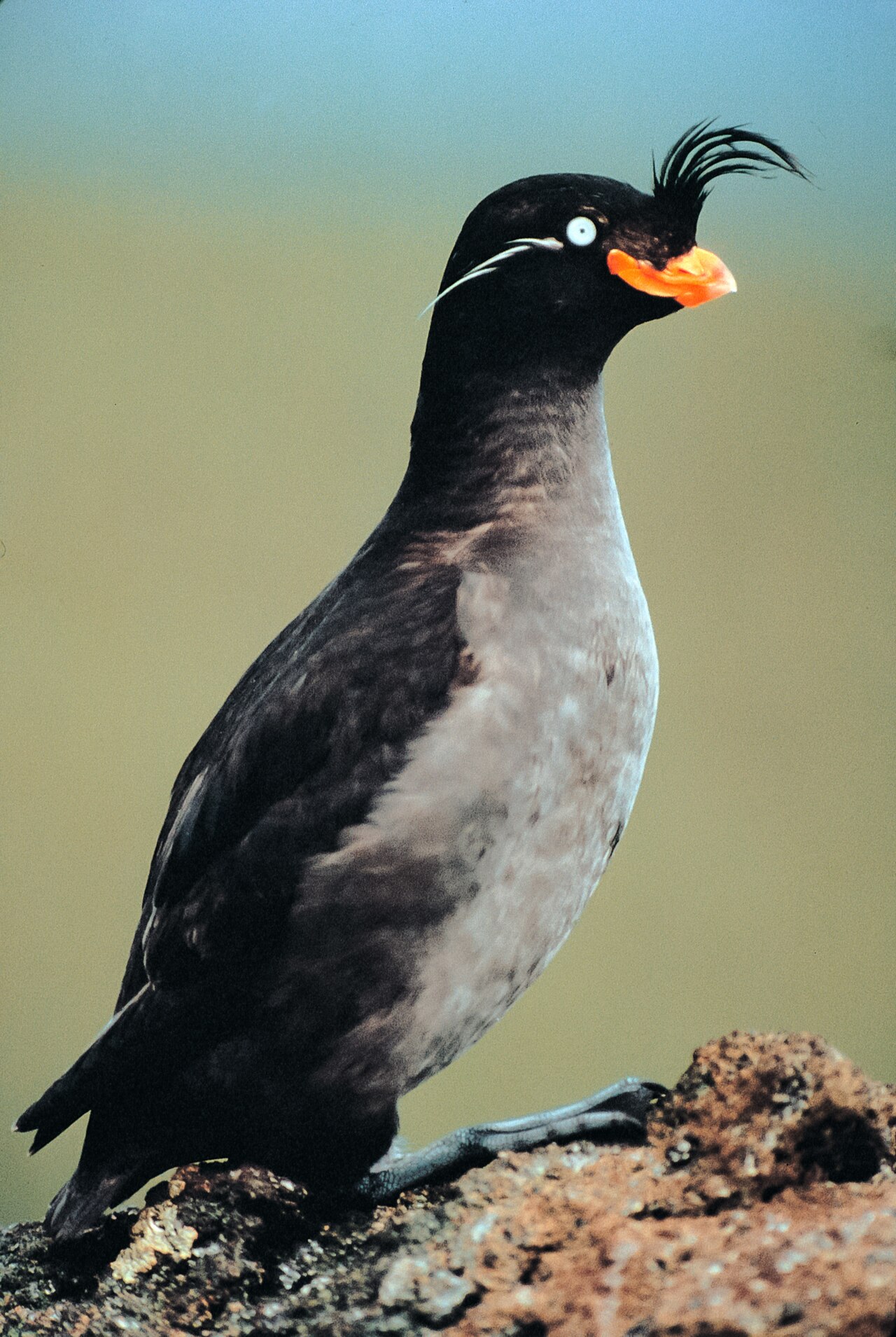
A squat, slate-coloured auklet with a thick orange bill and a crest of forward-curling feathers above the forehead. At the colony it smells of tangerine: the scent comes from feathers between the shoulder blades, and birds greeting each other push their bills into exactly that spot.
Voice
At the colony loud and incessant. The best-known sound is the trumpet call, a blaring series of honking and grunting notes — ah-ah-ah-aaah — which differs from bird to bird and stays the same from year to year, so that mates and neighbours recognise one another by it. There are also short barking and growling calls on landing and in disputes over a crevice. At sea the species is virtually silent.
No recording with a suitable Creative Commons licence has been found for this species yet; what to listen for is described below.
Identification
Uniformly slate grey to sooty black, belly and flanks included. In breeding plumage the bill is thick and orange-red with loose horny plates and a yellow tip, a single narrow white plume runs back from the eye, and a crest of between two and more than twenty forward-curving black feathers stands above the bill. In winter the bill is smaller and dull yellow, the crest shorter and the plume narrower. Juveniles have neither crest nor plume and a brownish-yellow bill. The silhouette is short and heavy with a large head; flight is fast, straight and low over the water.
Confusion species
Whiskered Auklet (Aethia pygmaea) is smaller, paler-bellied, and has three white facial plumes and a thinner, longer crest. Parakeet Auklet (Aethia psittacula) is the same size but white on belly and flanks, with an upturned bill and no crest. Least Auklet (Aethia pusilla) weighs less than a third as much and is white-bellied in winter. Rhinoceros Auklet (Cerorhinca monocerata) is much larger and browner, with a pale horn on the bill and two white plume-stripes across the head.
Habitat
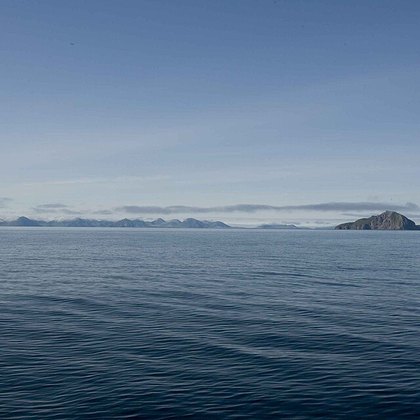
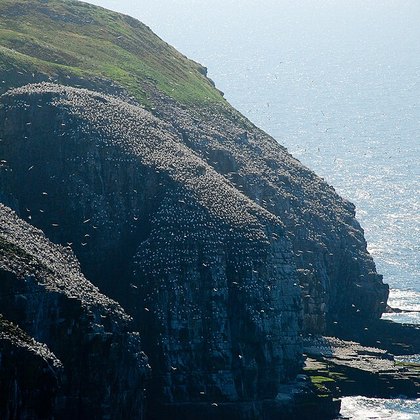
Breeds in crevices among boulders and in talus slopes on islands in the Bering Sea and the Sea of Okhotsk, in colonies that can run from hundreds of thousands to a million birds and often hold Least Auklets as well. It feeds by diving in deep water, especially over the shelf break and in passes where currents concentrate krill and copepods. Outside the breeding season it is wholly tied to the open sea and does not come ashore.
Where the bird is most often found, arranged by the USNVC — the vegetation classification of the United States and Canada — and CMECS for sea and coast.


Range and movements
Breeds patchily from eastern Chukotka, Sakhalin, the Kurils and the Commander Islands into the Bering Sea and the Aleutians. In winter birds from the northern colonies leave the ice and seek open water: regularly as far as Kodiak and elsewhere in the Gulf of Alaska, and on the Asian side to Hokkaido and northern Honshu. Further south along the North American coast it is a vagrant; British Columbia treats it as a rarity, and there are even a few records from the Atlantic.
- Resident
- Breeding (summer)
- Winter
- Passage
- dark = core range, pale = thinly spread
Where and when to look
The surest bet is a boat trip near a colony in the Aleutians or the Bering Sea in June or July: the birds lie in dense floating rafts off the shore and go up all at once at the slightest alarm. Against the light, watch for the crest standing up like a hook above the forehead, and for the orange bill — visible further off than any other feature.
Conservation
The world population runs into millions, with an estimated nearly three million birds in North America, and the species is listed as Least Concern (LC). At the colonies gulls, ravens and introduced arctic foxes and rats are the main enemies. Because the number of breeding sites is small, a single event can do great damage: the 2008 eruption of the volcano Kasatochi buried a colony of hundreds of thousands of auklets under ash. Oil spills and collisions with lit vessels take their toll as well.
Scientific name
Aethia cristatella | (Pallas, 1769)
Pallas described the species in 1769 as Alca cristatella, among the auks; because it was later moved to another genus, author and year stand in parentheses. The genus Aethia was introduced by Merrem in 1788, after aithuia, the name of a seabird in the classical Greek authors. cristatella is Neo-Latin for 'little crested', from cristatus, 'crested'. The type locality covers the region from Hokkaido to Kamchatka.