All species › Grebes › Grebes › Least Grebe
Least Grebe | Tachybaptus dominicus
Amerikaanse dodaars | Zambullidor Menor
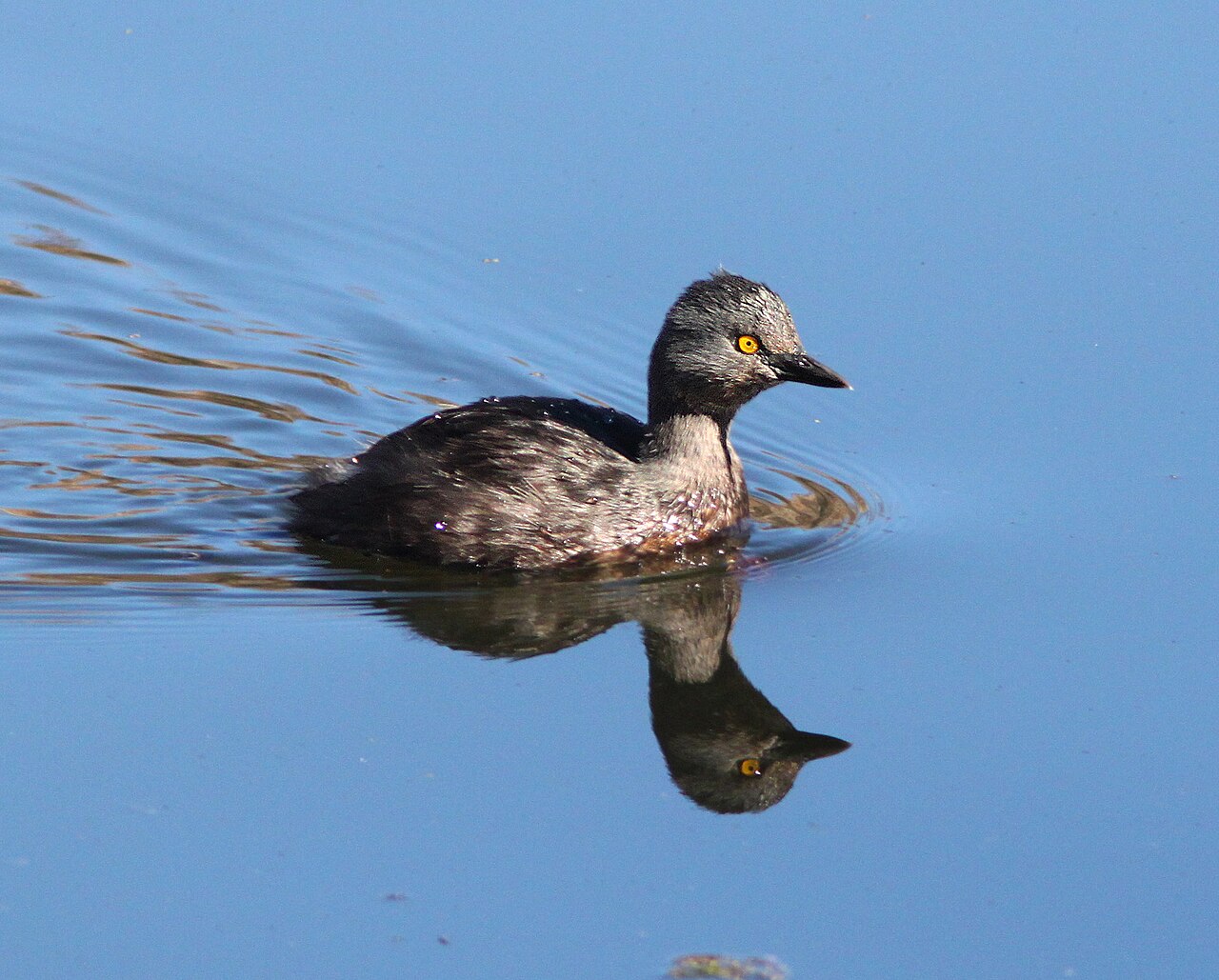
Least Grebe is the smallest grebe in North America, a tiny, dark diving bird with a bright golden eye that seldom ventures far from densely vegetated, shallow ponds. In the United States it reaches no further than the southern tip of Texas; south from there, across Mexico, Central America and much of South America, it is one of the commonest waterbirds.
Voice
The sound heard most is a fast, rattling trill that male and female often deliver as a duet, short and high-pitched. During courtship the male gives a loud, sharp gamp while displaying with raised head and puffed-out flank feathers. Otherwise it is a quiet bird, more often given away by a sudden dive under the duckweed than by any sound. The duet is used year-round to mark the pair's small territory against rivals.
Recording: Manuel Grosselet — CC BY-NC-SA 4.0 · Güendulain, Rojas de Cuauhtémoc, Oaxaca, Mexico · xeno-canto
Identification
A small, compact waterbird with a slender neck, a thin pointed bill and a golden eye. In breeding plumage it is almost uniformly dark, steely grey with a purplish sheen on head and neck and a blacker throat, with a small white tuft at the stern that shows now and then. Outside the breeding season it is duller and browner, with a paler, yellowish bill and a white throat. Young birds resemble the non-breeding adult but show faint pale streaks on the head. It sits low in the water with no visible tail, and at the least danger sinks silently rather than flying off.
Confusion species
Pied-billed Grebe (Podilymbus podiceps), which can share the same ponds at the southern tip of Texas, is considerably larger and heavier-built, with a thick, ivory-coloured bill instead of Least Grebe's thin, pointed one, and lacks the golden eye. Where the two occur together, Least Grebe is always the smaller, darker bird that dives rather than swims away. From Eared Grebe and Horned Grebe, which turn up in the same region as winter visitors, it differs in its much smaller size and the absence of any pale eyebrow or crest pattern.
Habitat
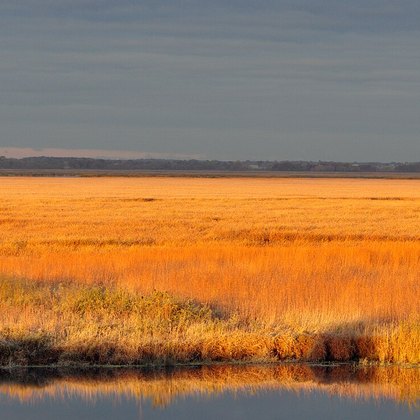
It seeks small, shallow ponds choked with aquatic plants, oxbow lakes — called resacas in Texas —, sewage-treatment ponds and slow ditches, with enough open water to dive in and enough cover to retreat into. It avoids large, open lakes without shoreline vegetation and fast-flowing water. Even a temporary pool left by rain can attract it. Further south in the tropics it also uses brackish coastal lagoons and mangrove creeks.
Where the bird is most often found, arranged by the USNVC — the vegetation classification of the United States and Canada — and CMECS for sea and coast.



Range and movements
In the United States Least Grebe breeds almost entirely in the lower Rio Grande Valley at the southern tip of Texas, where it is present year-round; further north and west, into south-eastern Arizona, Louisiana and California, it turns up only sporadically without breeding. From Mexico south it is resident across nearly all of Central America, the Caribbean and South America to Argentina. It does not migrate, but does wander short distances outside the breeding season to newly formed waters.
- Resident
- Breeding (summer)
- Winter
- Passage
- dark = core range, pale = thinly spread
Where and when to look
Look for it in the resacas and treatment ponds around Brownsville and the Rio Grande Valley at the southern tip of Texas, where it is present all year; scan the edge of the duckweed and watch for the golden eye before the bird dives. Almost anywhere else in the United States a sighting is mostly luck — a wandering bird on a small pond after a wet spell.
Conservation
Not threatened worldwide (LC) and one of the commonest grebes across much of its range; the world population is estimated at well over half a million birds. In the United States it remains confined to a small part of Texas and is vulnerable there to the drying and pollution of small wetlands. Elsewhere in its range it even benefits locally from ponds and treatment wetlands built by people.
Scientific name
Tachybaptus dominicus | (Linnaeus, 1766)
Linnaeus described the species in 1766 as Colymbus dominicus, in the genus then used for loons; because it was later moved to another genus, author and year stand in parentheses. The genus Tachybaptus is Greek for 'fast diver', after the ease with which these grebes vanish underwater. The specific name dominicus refers to Santo Domingo, the type locality on the island of Hispaniola where the first specimen came from.