All species › Passerines › Finches, euphonias and allies › Lesser Goldfinch
Lesser Goldfinch | Spinus psaltria
Witbandsijs | Jilguero menor
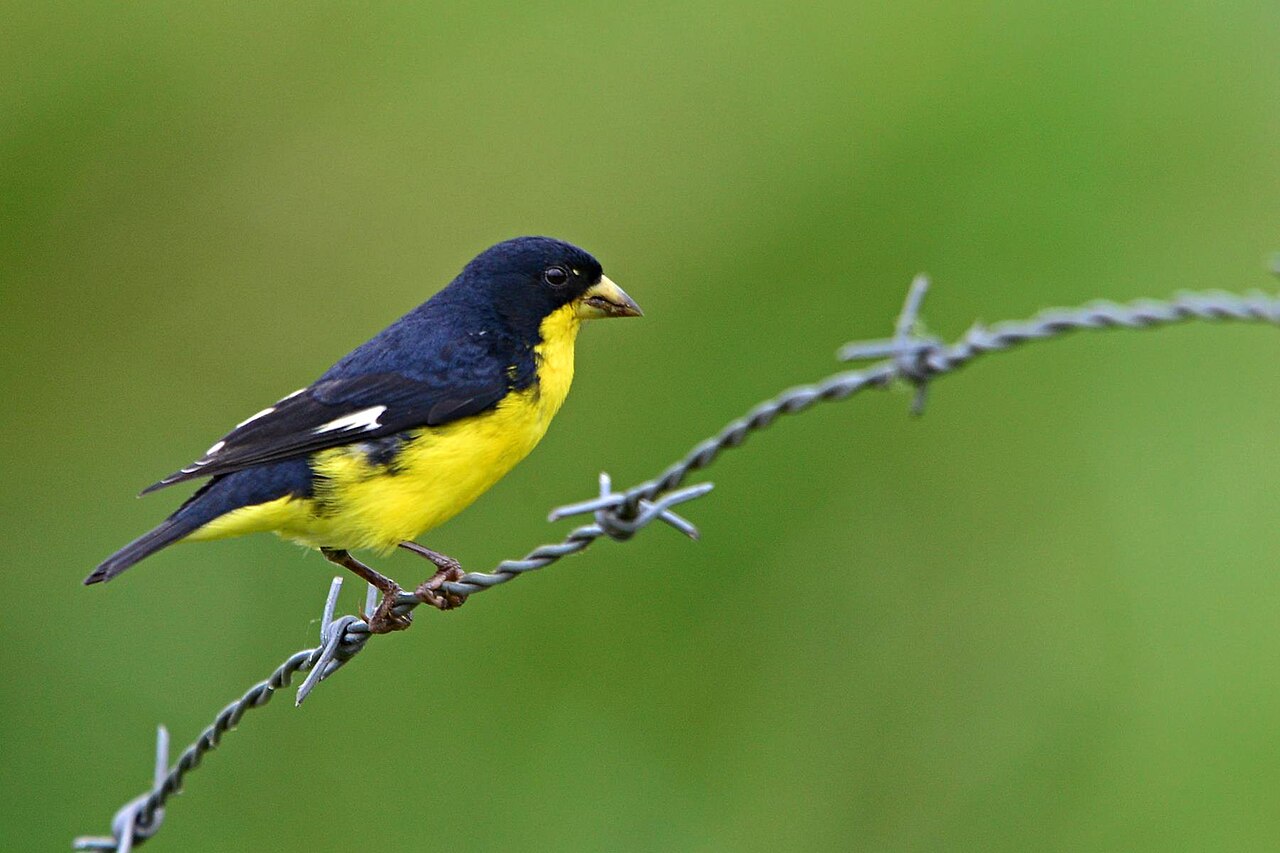
The Lesser Goldfinch is the smallest North American siskin: barely eleven centimetres, with yellow underparts and a white patch in the black wing. It occupies open country with shrubs and trees from the southwestern United States into South America, and has become a fixture of gardens in many western cities.
Voice
The flight call is a hard, repeated chig-chig-chig, alongside a high, drawn-out whistle that slides from one pitch up to another — that two-note whistle is the handiest mark at a distance. The song is a long, continuous twitter, more clearly divided into phrases than that of the American Goldfinch, and often includes imitated notes of other species. A singing male keeps it up for minutes from an exposed perch.
Recording: José María Loaiza B. — CC BY-NC-SA 4.0 · Distrito Metropolitano de Quito, Pichincha, Parroquia Nanegalito, Nueva Granada, Hacienda Los Yumbos, Ecuador · xeno-canto
Identification
Small, with a short conical bill and a short notched tail. The male is bright lemon yellow below; the upperparts are olive green in western birds and glossy black in birds east of the Rockies and southward. The black wing shows a sharply defined white rectangle at the base of the primaries, and the black tail has white corners. The female is olive green above, dull yellow below, with two whitish wingbars and the same white wing patch in reduced form.
Confusion species
American Goldfinch is larger, has a black forehead and an orange bill in breeding plumage, and lacks the white primary rectangle; in winter plumage it is plain greyish brown with a pale rump, while Lesser Goldfinch stays olive green. Lawrence's Goldfinch is grey on head and body with yellow only on the breast, and the male has a black face. Pine Siskin is streaked across the whole underside. The white wing patch of Lesser Goldfinch shows in every plumage and is the quickest distinction.
Habitat
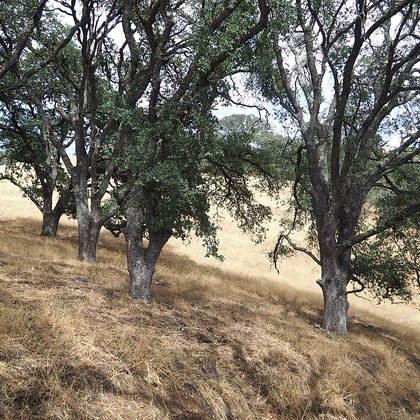
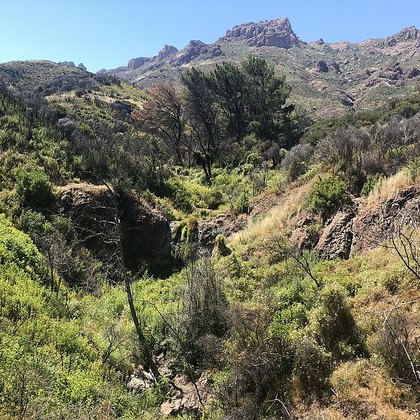
Open oak woodland, scrub, chaparral, riparian woodland along streams and the edges of farmland, from sea level to well over two thousand metres. Dense closed forest it avoids. It eats seeds of composites and other herbs, buds and seed of alder and birch, and comes to nyjer seed and sunflower hearts in gardens and parks. Water is a constant factor: flocks visit a drinking place daily.
Where the bird is most often found, arranged by the USNVC — the vegetation classification of the United States and Canada — and CMECS for sea and coast.




Range and movements
The range runs from southwestern Washington and Oregon through California, the Great Basin and the southwestern United States, across all of Mexico and Central America to Venezuela and Peru. Over most of that it is resident; only at the northern and eastern edge — Washington, Idaho, Colorado, Nebraska, Kansas and Oklahoma — is it a breeder that disappears in winter. In the Pacific Northwest it has expanded northward rapidly in recent decades, probably helped by feeders and urban planting.
- Resident
- Breeding (summer)
- Winter
- Passage
- dark = core range, pale = thinly spread
Where and when to look
Listen for the two-note whistle: one pitch held, then a step up. Look for it at the edge of a parking lot or on a dry slope where thistles and sunflowers stand in seed, and watch for the white wing patch — it shows even when the bird has its back to you, where back colour is no help.
Conservation
The species is numerous and listed as Least Concern (LC), and numbers are stable or increasing over most of the range; in the northwestern United States it is expanding. Locally it is declining, among other places in the Andean foothills of Ecuador. Large-scale conversion of scrub to built-up land reduces breeding habitat, while gardens with feeders and water supply new habitat. Trapping for the cage-bird trade still plays a part in parts of Central America.
Scientific name
Spinus psaltria | (Say, 1822)
Thomas Say described the species in 1822 as Fringilla psaltria, from a specimen taken on the Arkansas River near the mountains, close to present-day Colorado Springs; because it was later moved to another genus, author and year stand in parentheses. The genus Spinus goes back to Greek spinos, an ancient name for a small finch. The species name psaltria is Greek for 'female harpist', after the sustained twittering. The Dutch name refers to the white wing patch, the English name to its size relative to the American Goldfinch.