All species › Passerines › New World sparrows › Lincoln's Sparrow
Lincoln's Sparrow | Melospiza lincolnii
Lincolngors | Chingolo de Lincoln
Lincoln's Sparrow is a finely marked sparrow of wet willow thickets and bogs across boreal Canada and the western mountains, with a buff breast band crossed by hair-fine black streaks. It keeps low in cover and migrates as far as Central America.

Voice
The song is full and bubbling, with trills, gurgling passages and a buzzy note among them, and recalls a wren or a finch rather than a sparrow; it starts high and thin and then swells. Only the male sings, with a limited number of variants. The call is a dry, hard chep, and in flight a thin, high tseee.
Recording: Doug Hynes — CC BY-SA 4.0 · Terra Nova (Village), Newfoundland and Labrador, Canada · xeno-canto
Identification
A fairly small sparrow with a rounded head that shows a short crest when the bird is alert, and a slender bill. Across the breast and flanks lies a buff wash bearing very fine, sharply drawn black streaks; below it the belly is white. The moustachial stripe is buff and bordered black on both sides. A buff eyering surrounds the eye, with a grey supercilium above it and a dark eyeline. The crown is brown with black stripes and a grey median stripe; the upperparts are olive-brown with black streaking.
Confusion species
Song Sparrow is larger and heavier, with coarser dark brown streaking on a white breast, a central breast spot and a longer tail, and no buff breast band. Swamp Sparrow has a plain grey unstreaked breast and unstreaked flanks. Savannah Sparrow shows yellow above the eye, pink legs and a notched tail, and sits in open grass rather than in cover. The decisive mark is the buff breast band with hair-fine streaks, together with the buff eyering and moustachial stripe.
Habitat
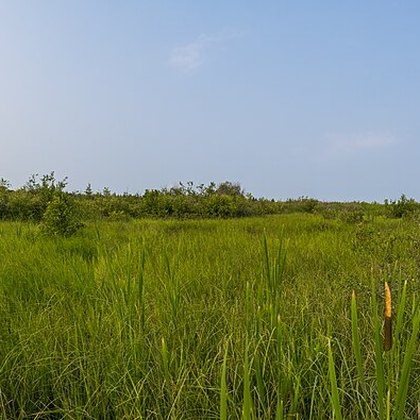
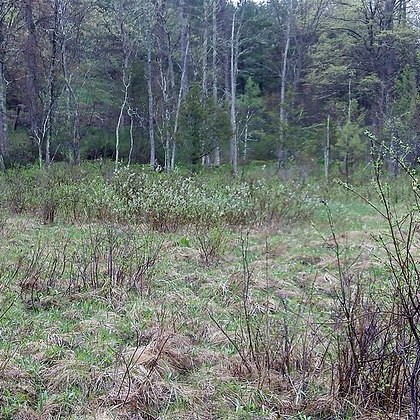
In the breeding season wet thickets of willow, alder and dwarf birch along streams, peat bog with sphagnum and sedge tussocks, and openings in boreal conifer forest; in the western mountains the same wet thickets up into the subalpine zone. On migration and in winter it uses drier ground instead: weedy fields, streamside thickets, woodland edges, hedges and scrub around fields, always with cover close to the ground.
Where the bird is most often found, arranged by the USNVC — the vegetation classification of the United States and Canada — and CMECS for sea and coast.




Range and movements
The breeding range covers Alaska and nearly all of boreal Canada to Newfoundland, and in the United States the Cascades, the Sierra Nevada and the Rocky Mountains as far as Arizona and New Mexico, plus the Great Lakes region and northern New England. Migration crosses almost the whole continent; in the east it is rather scarce, in the west common. It winters in the southern United States, throughout Mexico and on south into Guatemala, Belize, Honduras, El Salvador and Nicaragua.
- Resident
- Breeding (summer)
- Winter
- Passage
- dark = core range, pale = thinly spread
Where and when to look
Look for it in September and October in scrub along a ditch or field edge among the Song Sparrows: watch for the finer streaking and the buff breast band. It usually stays low and comes up briefly to pishing. In the breeding season the song is the quickest route — walk past a willow thicket in a mountain valley in June and listen for the bubbling, un-sparrow-like sound.
Conservation
The species is listed as Least Concern; the population is put at about 88 million birds and is stable across the range. The breeding range lies largely in thinly settled boreal and montane country, which keeps pressure low. Locally, grazing of wet meadows and streamside thicket in the western mountains matters, because it removes the low cover the bird needs.
Scientific name
Melospiza lincolnii | (Audubon, 1834)
Audubon described the species in 1834 as Fringilla Lincolnii; because it was later moved to another genus, author and year stand in parentheses. The specimen was collected in 1833 near the mouth of the Natashquan River in present-day Quebec, during Audubon's voyage to Labrador. The species name honours Thomas Lincoln of Dennysville, Maine, the young companion who shot the bird. The genus Melospiza was introduced in 1858 by Spencer Fullerton Baird, from Greek melos 'song' and spiza 'finch'.